The Dreamcatchers: A Journey in Cover Design

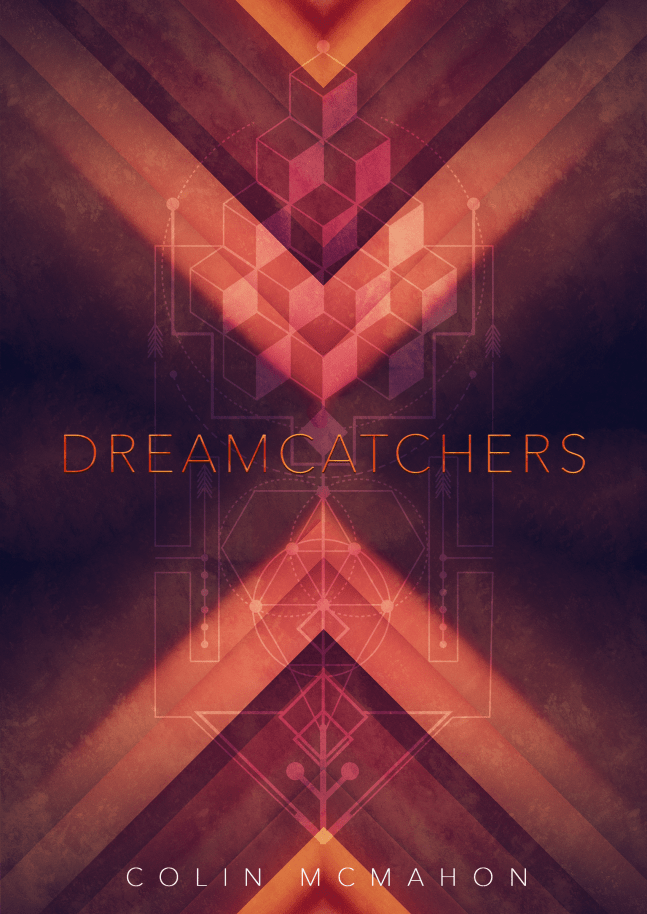
The Dreamcatchers is out and available now, so it is easy to miss all the work that went into bringing the final product into your hands. Since I’ve already written about my writing style and inspiration sources for The Dreamcatchers, I thought today that we might focus on the exterior. You know what they say: “You can’t judge a book by its cover!”

While they may be right – You can’t – it doesn’t mean that many people don’t. Creating a compelling book cover is important. It is nothing less than the reader’s first impression of your work. Some writers may be good illustrators (or at the very least graphic designers) but, for most of us, creating a good cover means stepping outside our comfort zone.

It is one of the first times we bring our work to someone else – Ask them to judge it – and then, even more disarmingly – Ask them to create something new from it. Lightning doesn’t always strike the first time either.

Let me take you through the book cover creation process for The Dreamcatchers:

Capturing the Right Tone

I’ve always loved reading fantasy. It is hands down my favorite genre to dive into. When I think of what intrigues me about this writing, it is the promise of impossible adventure. I am about to enter a world that isn’t my own, no matter how real it feels. But how do I pick which fantasy to read?

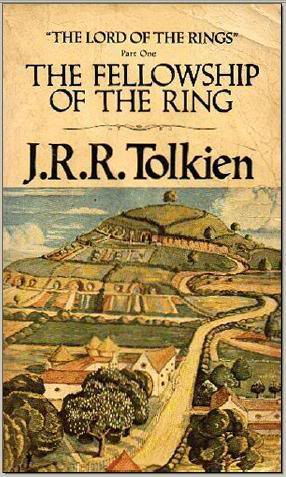
…I usually go by the cover. To me, the most intriguing books have cover designs that look like windows into the imagination. I always loved The Lord of the Rings‘ cover art. It provided an immediate visualization of Middle Earth:
cda77dfca51feb179d6847d14e14cfc4

So, when it came time for The Dreamcathers, naturally I wanted to do the same thing. This proved a challenge. Setting a story in dreams lends itself to some surreal imagery. Just choosing one dream felt too limited. I also didn’t want to use the world of the dreamcatchers, since I felt that, out of context, they would look too alien and sci-fi.

My publisher was also concerned about the audience. The Dreamcatchers contains frightening chapters and its core audience is in their teens. Perhaps something as family-friendly as Tolkien or J.K. Rowling wasn’t the best idea.

I was convinced to go more abstract – and I think it was the right decision. But, for any out there curious, I had a friend do a rough mock-up of my original Dreamcatchers cover design, and here it is:
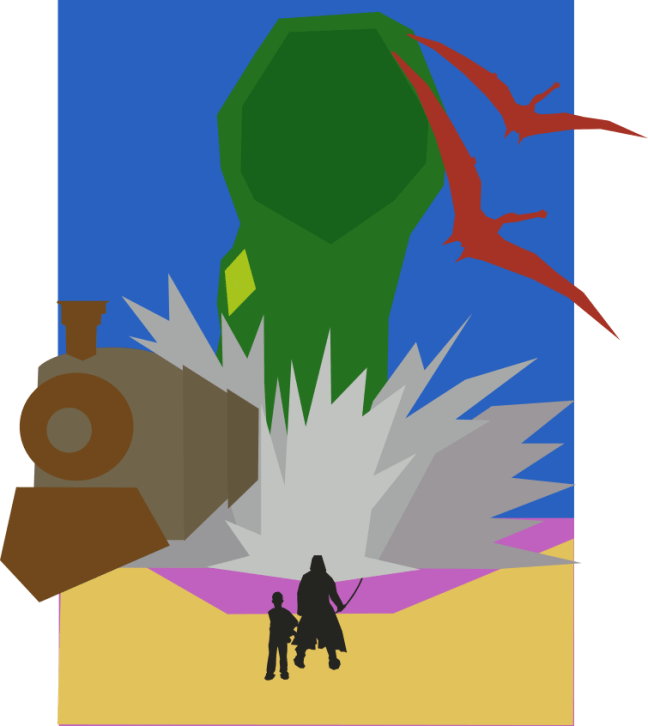
The Dreamcatchers original cover
Those who have read the book can hopefully recognize certain elements of the story. The base outline for Vakarian was actually lifted from a The Hobbit: The Battle of the Five Armies poster.

The Essence of Story

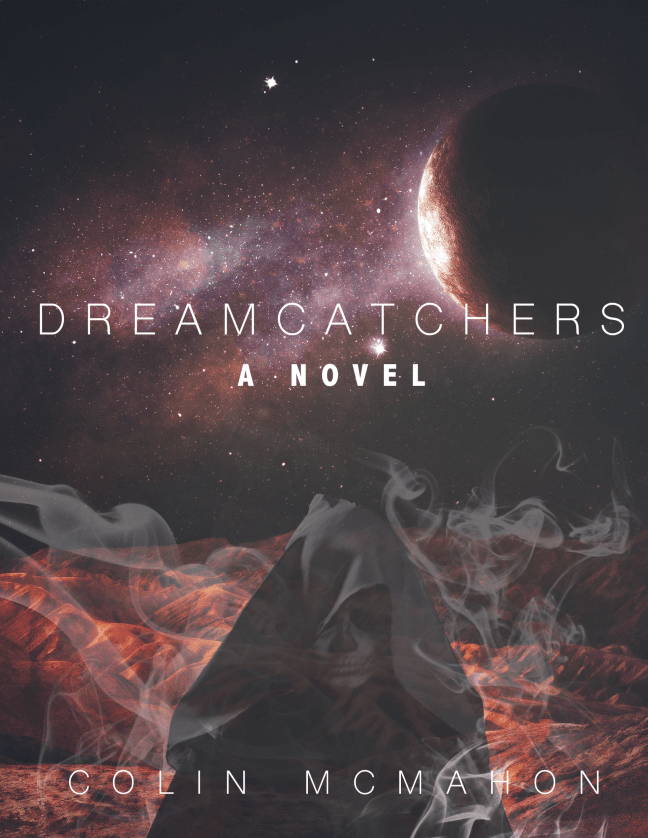
Being abstract posed its own challenges. While The Dreamcatchers is a fantasy, it is not the traditional one. There is no magic, no castles – instead, it is set primarily in a space-like realm filled with humanoid characters. Seeing the issue? Doesn’t that sound a little science-fiction-y? The early cover art definitely tended toward an outer space feel:
dreamcatcher7

While this rough outline has some potential, I felt it was just too jarring. The colors evoked Mars more than anything ethereal and the hooded figure was too sinister (had we decided to work from this mock-up, the face would have been a difficult change). The planet and stars in the background are also out-of-place.

Overall, I was worried that someone looking at this cover would get the impression that The Dreamcatchers was a sci-fi horror story. Going a little more abstract didn’t help:

dreamcatcher4o2

It became clear that my messaging was getting garbled. I wanted to show readers a new world – this was true. But it wasn’t a place they could reach in a space ship.

When you’re working with your illustrator, you must be clear. They’re busy people and likely yours isn’t the only project on their plate. This disconnect was being caused by a breakdown in communication. My illustrator, the Happy Writing Co., only understood half of what I wanted, so the illustrations fit this mold.

As author, I had to articulate the essence of The Dreamcatchers in a way that made sense. The right cover had to entice in a way that conveyed mystery, otherworldly experience and, above all, the surreal. At the same time, the reader needed an entry point. Vakarian, being a nefiri dreamcatcher, wasn’t the best person for the job.

So, it turned to Tony.

The Writer’s Gift of Communication

Writers may not always believe it, but we have a gift of communication. I’m not saying we’re all amazing speakers, but we possess the ability to put words to paper – and that’s pretty great. We also know our stories, inside and out. Remember that when dealing with your own publisher: No one knows your story better than you.

I didn’t want to focus on any one dream of Tony’s, but I wanted the idea of him dreaming to be conveyed on the cover. I also wanted the reader to know that where he was going wasn’t safe. At first, I think I went too heavy handed with my image suggestion. Together with Happy Writing Co., we settled on an initial idea:

dreamcatchers4

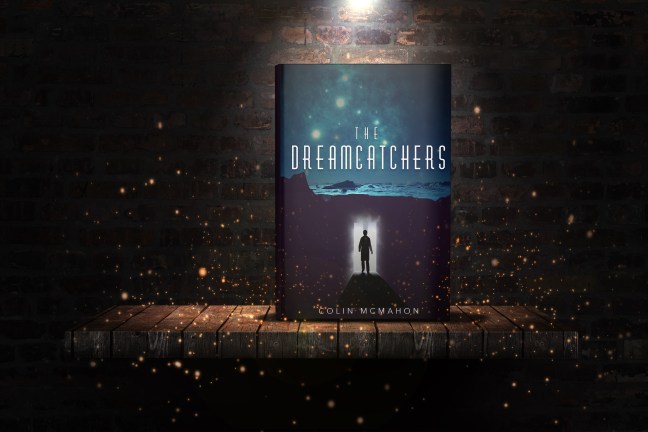
As you can see, we hadn’t even bought the full image yet. We were still in testing with the mock-ups. Despite looking a bit alien-y, I knew we had a winner. It just needed some dressing. There needed to be something more:
dreamcatchersmagical

And you know the rest. There are other designs that I didn’t show but hey, never reveal all the secrets, right?

The final result was incredible – a cover that entices and feels like something new, without going too far on the science fiction. I could not be more happy with how The Dreamcatchers‘ cover turned out. The Happy Writing Co. – who was unbelievably patient – did an amazing job and deserves the credit. They hit it out of the ballpark.

I hope this look inside The Dreamcatchers‘ cover selection process has been enlightening and given you some advice for when you pursue your own publication. Remember, illustrators are people and should be treated as such – you’re a team so try not to butt heads. Great things can be accomplished when you’re aligned and working toward a common goal.

Now, before you go, enjoy one more mock-up:
dreamcatchers5.png

Oh, and if you’re intrigued, you can pick up your own copy of The Dreamcatchers right here!

Top 10 ports I want on Switch

The Nintendo Switch seems to be a hit. With just over a year under its belt, it has sold just under 20 million units – already over 6 million more than the poor Wii U ever sold in its entire lifespan. While the Switch has some impressive original software, the main drive behind its success appears to be its play potential. Gamers finally have a modern portable that feels amazing (and can double as a home console).

I own a Switch and I love it. I take it with me on the T and hook it up to my TV when I’m home. I have no doubt that Nintendo will continue to bring original quality content to their platform for the foreseeable future. So today, let’s not talk original content – let’s talk ports. If you’re unfamiliar with the term, a video game port is simply a game that was originally made for another system before being “ported” over to a new one. For example – Bethesda’s DOOM originally came out for PS4, Xbox One, and PC before being released – or ported over – to the Switch.

All right, now that we have the terminology out of the way – let’s talk ports!

Child of Light

Ubisoft appears to have a weird relationship with Nintendo at the moment. Over the past two console generations, the companies have presented together as friends, but the Ubisoft library on Nintendo consoles has been…lacking. One of the first third parties to endorse the Wii U – the company quickly backtracked, cancelling a project and moving exclusives Rayman Legends and Zombiu to wider markets.

One game that the Wii U did receive was Child of Light. An indie-style 2D adventure RPG that was quaint and charming, Child of Light isn’t a classic by any stretch – but I remember enjoying my playthrough. It is a light-hearted, simple game that would feel right at home alongside many of the indie darlings already on Switch.

I feel like Ubisoft has some really low hanging fruit here when it comes to increasing their revenue on Switch. I could see this game selling really well if priced between $15 and $20.

Assassin’s Creed IV

And speaking of Ubisoft, let’s give another of their recent classics some new life. Assassin’s Creed IV: Black Flag has already sold over 5 million units – on PS4 and Xbox One. That’s right, just the remastered editions. Clearly this is a game that fans love and are willing to double-dip for.

If we’re all honest, Assassin’s Creed seems like a series suffering from fatigue. Few intellectual properties successfully transition from generation to generation (remember Prince of Persia?) and, until they add significant gameplay adjustments or just set a game in Japan, I personally feel like the future of the franchise is less than exciting.

So why not relive the glory days? Having a pirate adventure on-the-go sounds pretty great! If Ubisoft is feeling bold, they can even throw in an Assassin’s Creed Classic Trilogy collection as well.

The Mass Effect Trilogy

Hey remember that time EA released Mass Effect 3 (and only Mass Effect 3 – minus DLC) on Wii U? Me neither. Let’s all join in not remembering that event by enjoying the full trilogy on Switch. Mass Effect is in a bad spot right now. The once A-list series suffered a less than stellar ending in Mass Effect 3 before releasing the equivalent of a Disney direct-to-DVD sequel in Mass Effect: Andromeda.

The brand needs to rebound and EA has already released a trilogy package for 360 and PS3. The Switch can handle it, and the move would remind gamers of all the fun they had with the first three games…while not talking about the 4th.

I know I would buy it, but I’m also a huge fan. I mean – I did write a fan screenplay.

Soul Calibur II HD Edition

So, some time ago Namco re-released Soul Calibur II  for both Microsoft and Sony. This version was dubbed Soul Calibur II HD Online and featured both previous console exclusives Spawn and Heihachi. That’s great and all, but they missed the best exclusive.

Despite having a much small install base, Soul Calibur II for the Gamecube nearly outsold its PS2 rival. Why? One word: Link. Link fit into Soul Calibur II like Kratos fit into Mortal Kombat. Given that Nintendo is trying to bolster its presence in online gaming, getting a remastered port (with all three exclusive characters) would be a boom. Not to mention Nintendo seems to have a good relationship with Namco – working with the company on Super Smash Bros. for Wii U/3DS.

Red Dead Redemption: Definitive Edition

Let’s be real for a second. We all know that Red Dead Redemption II will never come to the Switch. I love that little system but it is nowhere near powerful enough. So, while Nintendo owners nurse the pain of not being able to take the latest Rockstar adventure portable, why not toss them a bone from memory lane?

The first Red Dead Redemption is an amazing game. In my opinion, it is the best experience that Rockstar Studios has created so far. And, since it never got a PC port, people don’t have an easy way to play it right now.

Taking Red Dead Redemption – along with all of its amazing DLC – on-to-go sounds fantastic and a profitable fit for both Nintendo and Rockstar. With Bethesda reporting solid sales numbers from its early Switch endeavors, there appears to be a market for mature gaming on Switch. Adding the original Red Dead Redemption would go a long way to bolster said offerings.

The Monkey Island Classic Trilogy

Once upon a time, LucasArts existed. Not only that – they made games! Even more unbelievably, most of those games were gems; classics of timeless quality and appeal. With the news that one such product, Grim Fandango, is coming to the Switch, we can only hope that LucasArts’ other classic adventure game series isn’t far behind.

Playing as a pirate is fun, Guybrush Threepwood taught me that. The Monkey Island series had three stellar entries before falling off into obscurity. These share would fit in well alongside other quirky games like Night in the Woods and Golf Story. I don’t know who owns the rights to these three games – but given that two have already been remastered (and the third is available on Steam), I can’t imagine it would be too difficult to get them working on Nintendo’s newest hardware.

Fallout: New Vegas

While rumors of Fallout 3 on the Switch have existed for some time, I haven’t heard as much talk about the other, arguably better Fallout game of the 7th generation. This is likely due to Fallout: New Vegas having a more complex ownership. Developer Obsidian Entertainment partnered with Bethesda to create the post-apocalyptic romp through the wasteland, and getting both publishers to sign off on a remastered version may take some doing.

Regardless, New Vegas is a gem among modern RPG games. Bethesda has already enjoyed success with Skyrim on Switch, so bringing in its old Fallout library makes sense. If we do see Fallout 3, I can only hope that a New Vegas announcement is soon to follow.

Alpha Protocol: Remastered Edition

So far, I don’t think my list has been unique. Most of these potential ports have been discussed on other sites at some point in time. But now, here is one that I am almost certain no one else will have talked about – because most people don’t remember it…because it wasn’t super great when it first came out.

Alpha Protocol was an attempt by Obsidian Entertainment to launch its own IP – back before the days of Pillars of Eternity. It was a spy RPG in the vein of Mass Effect, where the player took on the persona of a secret agent, and every choice impacted story progression. And, in terms of story – it was fantastic! I remember playing it and being really absorbed, loving how I was always a jerk…but I could decide exactly what kind of jerk I wanted to be. To offer a modern comparison: It is like how CD Project Red handled Geralt in The Witcher 3.

The problem was the combat. Released close to Mass Effect 2, Alpha Protocol felt slightly worse than Mass Effect 1. The skill tree felt unbalanced, with certain abilities like hand-to-hand combat feeling under-powered and useless in boss fights. The resulting gameplay issues turned critics off, and the game sold less than 1 million units.

BUT – I maintain that it is still mostly a good game. One that could be fixed with less than a year of work. It might not become a classic, but Alpha Protocol could enjoy a second life on Switch. Several other games have already seen similar revivals on Nintendo’s new system, so – if I worked at Obsidian – I would at least consider it. Great stories are timeless – and Alpha Protocol had an immersive plot.

Star Wars: Rogue Leaders HD

Once upon a time, a company called Factor 5 made some great Star Wars games on Nintendo systems. If you’ve ever played Rogue Squadron or Rogue Leader, you’ve sampled their work. Then, as with many game companies, they hit bad luck and, ultimately, went bankrupt.

What makes this story worse is they had a completed game set for launch on the Wii that just didn’t happen. LucasArts was notorious for cancelling promising projects in development at the time (never forget Battlefront III) and Rogue Leaders became just another casualty.

Which is a darn shame because those old games are great and, since Disney took over the franchise, there has been a shortage of quality Star Wars video game content. How amazing would it be to throw the fans a bone by releasing an HD version of a game that was already intended to be a remaster of a classic Gamecube title? Talk about minimal work for maximum gain.

There is money to be made here – Disney just needs to move on it:

The Legend of Zelda: The Wind Waker HD

I’ve tried to leave Nintendo games off this list. For one thing, I firmly believe that every Wii U classic will be on the Switch at some point because, you know, money. For another, I wanted to be more creative. That said, The Legend of Zelda: The Wind Waker remains my personal favorite Zelda game.

The treatment that Nintendo gave it for the Wii U was superb so, I simply ask – bring to the Switch man…come on. I can only put so many hundreds of hours into Breath of the the Wild. The work is done – the game looks amazing – let’s just get a move on.

And that’s it for my list. If you’ve made it this far – thanks for reading. If you were expecting something more literary from me – sorry for this offshoot but I’m a gamer as well as an author. Don’t worry, I’ll have something book-related for you soon!

A couple of honorable mentions real quick: Can we get the original two (or three) DOOM games on Switch…and where is Resident Evil 4? I thought Capcom had a quest to put that game on every system.

The Witches: Finding Narrative in History

I recently had the task of reading Stacy Schiff’s The Witches (full title is The Witches: Salem, 1692). I write “task” instead of “pleasure” for two reasons. First, I can’t honestly say I enjoyed reading 400 pages about a mass hysteria that turned into tragedy and gross injustice, in which 20 innocent people lost their lives. Second, I wasn’t really sure if I liked it while I was reading it.

I think Stacy Schiff had an incredible challenge: Bring the reader into Salem, 1692 – introduce them to all relevant characters – outline what happened in the order that events occurred – and give appropriate backstory/information whenever needed. Considering the cast begins with 20 victims (to say nothing of accusers and judges), that’s a lot of people to wrangle.

Now that I’ve finished, I’m on the positive side – I liked Schiff’s The Witches. However, I do feel that it has an interesting battle, and that is narrative vs. history. Throughout the book, I felt the two were constantly at war with one another in Schiff’s writing. She would attempt to give each chapter a narrative, but in the end most felt bogged down by superfluous information.

It was great for historical relevance but not so much for storytelling. So I want to write about that: How does a nonfiction writer balance the battle between history and narrative?

The challenge of finding a narrative

To begin, it depends on what you’re researching. Schiff begins her book by stating that the puritan settlers of Massachusetts were studious record keepers…except when it came to 1692. This means that she had to fill in a lot of gaps. To give contrast, I’m reading another piece of nonfiction right now called Console Wars: Sega, Nintendo, and the Battle that Defined a Generation (quite a topic change, I know) and, not only is this book discussing much more recent history, the author had the ability to actually interview most who were directly involved.

So, right away Schiff’s writing must rely heavily on inference and intuition, which can blur the line between fiction and nonfiction. This may sound like an advantage when it comes to establishing narrative but think again. Most historical nonfiction authors have two priorities: Get it right and make it interesting.

Schiff was immediately challenged with the first priority. When the information isn’t readily available, more research is needed. She had to expand her scope – bring in tangentially related information. When developing a narrative, widening your scope is the last thing you want to do.

A plot is often a very simple thing that is then dressed up by character, setting, and other elements. For example, Star Wars can be boiled down to “hero saves galaxy” without losing its essence. The plot of the Salem Witch Trials is that innocent people were wrongly accused and convicted of an impossible crime – but how do you get there when many details (in some cases whole defenses) have been omitted or destroyed.

A weak plot begs for outside help – but that outside help can overwhelm and distract from the initial goal of writing the story. You see this in fiction – certain authors can fall more in love with “world building” than with telling a story. If too much attention is paid to details – or supplemental information – without enough devoted to core knowledge, the story can fall flat. In short – it won’t be interesting.

But with a topic like the Salem Witch Trials, is that even possible?

Does history need a narrative?

It is difficult for me to write about Stacy Schiff’s The Witches without getting lost in the history. This is, to me, essential knowledge for every American (or at least my fellow Massachusetts residents). Today, my state likes to hold itself up as a land of reason, science, and logical debate (…and sports teams), so it is an important reminder that we have come a long way, and that there were serious consequences when we abandoned our better senses.

Schiff The Witches
This monument sits in Danvers, Massachusetts – which used to be known as Salem Village.

So, which such a packed slice of history – does narrative really matter? Isn’t simply recounting the trials enough? I would say no. Schiff’s biggest triumph is that she brings her reader into the mindset of the 1962 puritan. Through this lens, we are better to understand truly what happened – beyond the simple order of events.

Saying that innocent people died in the Salem Witch Trials is like saying the Holocaust happened. It loses a lot of its resonance and meaning without discussing the “how” and the “why.” These events cannot be made simple by vague summation. Even growing up, I thought that disasters like these happened because of “evil people” or something like that.

Evil people don’t exist and believing they do only opens the door for more bigoted leaders to come to power. In what narrative she can salvage, Schiff presents Salem as a dark place in more ways than one. The people they are constantly afraid. Real world dangers such as disease and Native Americans mix with supernatural ones like the devil and demons. Add to it a poor understanding of science and a constant persecution complex and this community was ripe for disaster.

But even that isn’t the whole picture. There were grudges to be settled, opportunists doing whatever they could to get ahead, teenage women suddenly thrust into a position of power, wrongs to be avenged, and simply matters of colonial politics.

Again – it’s a lot. What happened over a couple months needs the preceding years to explain it in proper context.

I’ll leave these thoughts with this question. What is more interesting, saying Giles Corey was executed for witchcraft, or this:

The final impact of Stacy Schiff’s The Witches 

In the end, I feel that Schiff’s The Witches is a weak narrative saved by its historical significance. Given her obstacles, I think she did the best she could. Much of the real procedure has been lost, letting us only speculate as to the true nature of this delirious period of history. We have an incomplete picture but, through her supplemental research, Schiff goes a long way to fill in the gaps.

I just wish it didn’t derail the main action so much. It also doesn’t help that each chapter is roughly 40 pages – or that one of her asides was to mention Albus Dumbledore from the Harry Potter series (in the same chapter that discusses alleged sex abuse in 1692 Salem – I’m not kidding).