Writing Character Workshop: Jar Jar Binks

When Star Wars Episode I: The Phantom Menace released in 1999, reception was mixed to put it lightly. While many children (including myself) enjoyed the movie, it sent ripples of anger through the more adult Star Wars fanbase and drew ire from movie critics overall. While many, many, many…many dissections of Phantom Menace have been completed since that 1999 launch – what’s one more?

For my own examination into the film, I want to focus primarily on Jar Jar Binks – a side character who drew particular ire for what many fans saw as his annoying nature or tendency to devolve the film into dirty humor (fart and poop jokes). Let me say this now – this is not intended to be a “hate” essay. I have nothing but respect for Ahmed Best, who has suffered more than enough at the hands of harassing jerks and jackasses claiming to be Star Wars fans.

This article is intended to view only how Jar Jar Binks was written. Let’s examine what kind of character Jar Jar was supposed to be and what function he may have been intended to serve in the story. For those who have seen the film and want a refresher, here is a rundown of every scene with Jar Jar Binks present:

What type of character was Jar Jar supposed to be?

When George Lucas first conceived of Star Wars, he drew a great deal from the past. One of his primary inspirations was Joseph Campbell, a renowned mythologist who had spent years analyzing ancient myths from across the world. Campbell believed in the idea of the “monomyth” or that every heroic tale from the past has a common core and can be broken down into similar elements.

For instance, many heroes begin their journey as outsiders, drawn into a larger conflict rather than being present with it from the very beginning. Going on said hero journey challenges the protagonist, who ultimately returns victorious but a changed person. Lucas used this idea and many others from Campbell in his original Star Wars trilogy, and the themes have been present in the series ever since.
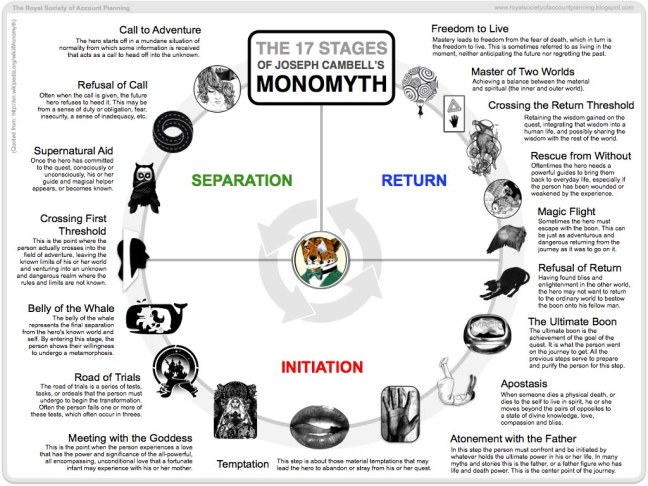
monomyth

Using Campbell and this idea of monomyth means relying on established archetypes. An archetype is a typical example of certain person or thing, or an idea that has been replicated many times over. For instance, a bully is a character archetype. Every bully shares certain traits – namely intimidation and an abusive nature. The idea of a bully has become so ingrained in society that simply saying the word evokes a near complete image.

When Lucas created his characters for Star Wars, he used archetypes to form the foundation. Luke Skywalker – the heroic outsider, Obi Wan Kenobi – the wise old mentor, Han Solo – the scoundrel with a heart of gold, Princess Leia – the princess in distress: All of these characters came from an already established foundation of traits and personality. When Lucas wrote the prequels, he attempted the same thing. It is easy to read Shakespeare’s Othello in the tragedy of Anakin Skywalker or Oedipus in his desire to alter a prophecy.

Regardless of how well it worked, Lucas clearly had visions of grandeur on his mind. So, what about Jar Jar? Where does he fit in?

Jar Jar as the fool

A popular character archetype that owes a lot to Shakespeare is the fool or clown. This character is, by nature, ridiculous and outwardly very stupid. They are usually of low stature and aren’t doing well in their life. However, they are apart from the situation – no one directly trusts the fool, but the fool is typically present. This can give them wisdom, as they tend not to have subtly. When a fool speaks, they state the obvious, which can include information that the protagonist has overlooked.

A famous fool includes Dory from Finding Nemo. What she may lack in brains, she makes up for in wisdom, directly stating the flaws in Marlin’s parenting techniques.

character fool
Many fools tend to be sidekicks, giving them ample opportunity to travel and communicate with the main character.

Is Jar Jar a fool? He is certainly ridiculous enough to qualify on that level. Jar Jar is clumsy, clownish and prone to self-deprecation. However, what wisdom does he bring?

There two scenes that may qualify. The first comes at his introduction, right after he has met Obi Wan Kenobi and Qui Gon Jinn. Jar Jar suggests that they seek the gungan city for shelter and to hide from the droid army.

In the second scene, an anxious Padme is reflecting on the plight of her people. Jar Jar happens to mention that his race, the gungans, have a huge army that can challenge the invading droid forces. While Jar Jar never directly states that the gungans can help, Padme uses this information later to make her plan to fight back.

Jar Jar also states that relations between the naboo and gungans are strained but really doesn’t elaborate further. As far as this writer’s recollection, these are the only moments where Jar Jar may fit the mold of a fool.

Jar Jar as the heart

A more recent character archetype is the heart. Born out of many television ensembles, the heart is a member of the team that has no real special talent or skill. However, they serve as a moral compass, helping every other character around them maintain equilibrium and a healthy psyche. Hearts can be smart or stupid, strong or weak – but their primary strength must always lie in their emotional capacity.

The character Bolin from The Legend of Korra is a heart. While never stated, it is implied that he is not as strong a fighter as Korra or Mako, nor is he particularly smart. Instead, Bolin is trusting and giving, always there for friends that need a hand. His primary motivation comes from a desire to help others, a trait common in many heart characters.

The Heart can be similar to a fool, but with more positive intentions.

At first glance, Jar Jar Binks may look like a likely heart. However, there are problems with this fit. Jar Jar is often reluctant to help, oftentimes being volunteered for assignments he didn’t ask for. Also, apart from the Padme scene, Jar Jar is rarely shown comforting another character.

Jar Jar as the unlikely hero

At the heart of Star Wars is a love for the unlikely hero. Anakin, Luke and Rey have all come from humble origins to take center stage in galactic affairs. The same can be said of Han Solo, Finn, and Rose. None of these people began with the traditional, noble heritage of a hero – they instead earned their place through courageous acts or unnatural talent.

Unlikely Hero Tan smaller
David, in his fight with Goliath, became one of the first and most famous unlikely heroes.

Jar Jar Binks definitely fits this bill, at least on the surface. He comes from nothing – an outcast of his own people. By the end of the film, however, he is a victorious general and well on his way to becoming a senator that will represent Naboo on the galactic stage. From a storyboard perspective, Jar Jar fits this archetype to the letter.

But let’s look closer: Is Jar Jar a hero? Does he in fact do anything to really save the day? Jar Jar’s role in the finale is to lead the gungan army against the droids. It is intended as a diversion to allow the other protagonists to act. Jar Jar loses this battle and is captured. Faced with this development, he promptly surrenders.

When Anakin destroys the droid control ship, the droids are deactivated and the gungans saved. Given how he acted, I say it is reasonable to compare Jar Jar more to a character in distress rather than an active hero. He is never looking beyond his personal safety.

Writing exercises: How would you improve Jar Jar Binks?

I personally believe that Jar Jar Binks has elements of all three character archetypes above. I believe his character suffers from poor implementation of these ideas into the script. He certainly has the negative elements of a fool but is not given enough opportunity for the positive. He appears well meaning but is never anyone’s emotional center. And he is given countless opportunities to perform a heroic action but never rises to the challenge.

He, like many elements of George Lucas’ prequel trilogy, feels like a rough draft of a competent character.

So, rather than dwell on the failure – how can we fix him? Well, I for one believe that all strong character writing begins at the three scales: competency, sympathy, and productivity. A well written character has a mix of these traits on a scale system. For instance, a character can be very competent but unsympathetic or vice versa. Most writers tend to use middle degrees on these scales rather than turning one all the way up or down.

Fixing Jar Jar begins with looking at his three scales, all of which are too far down (in my opinion). Altering these scales alters Jar Jar. Writers should be careful to keep the original idea in tact. It’s easy to fix Jar Jar by transforming him into someone else entirely, but more challenging to simply make alterations.

If Jar Jar is supposed to be the fool, turn his sympathy and productivity up to have him make more emotional impact. To be an unlikely hero, turn up the competency. However you approach it, keep your archetype goal in mind.

This exercise can be a simple scene rewrite or a full plot makeover. If you’re curious to see how you did, I recommend posting on FanFiction.net. You can use a pen name and the feedback can be helpful.

Jar Jar Binks may have earned the fan’s hatred (not that it takes much) but I believe he is a character built on solid bones. Looking at his failure requires studying character construction and plot development, two things that can only make you a stronger writer. Best of luck!

Thinking Deeper: Analyzing Star Wars: The Last Jedi

Star Wars: The Last Jedi came out in theaters six months ago and the impact of its release is still being felt. To say the film is controversial appears to be an understatement. Some claim it is the death of Star Wars, a film worse than all the prequels (really?) that shreds the source material. To others, including myself, it is a breath of fresh air and maybe the first true Star Wars “sequel” in quite some time.

One of the main reasons that I love Last Jedi is that the movie generates conversation. I saw Solo last week and am already forgetting it. It wasn’t a terrible film by any stretch, nor was it really good. Solo just exists, checking off all the boxes it has to without feeling particularly inspired or warranted. I feel like there was no deeper subtext or character development. Spoilers: Han Solo is a scoundrel but a good guy. Did I really need to spend $16 just to confirm that?

With Last Jedi, I felt like I was watching a movie that wasn’t content to simply check boxes. It didn’t care that it was a “Star Wars film” and spent more time trying to be a genuine movie. The result is an experience that gives me something new every time I watch it. Here are some of the thoughts and readings I’ve had while watching Rian Johnson’s Star Wars: The Last Jedi:

Luke Skywalker is George Lucas

I know, shocker right – that Luke S. could mean Lucas? Watching Mark Hamill in Last Jedi is fantastic. True to the series’ Kurosawa roots, Luke is no longer the bright-eyed boy on Tatooine but a grizzled, jaded Jedi master. Unlike Harrison Ford’s Han Solo from The Force Awakens, Hamill’s Luke feels different from when we last saw him. His character has been appropriately aged along with himself.

When I was last watching the movie, I paid attention to Luke’s dialogue – in particular his self-loathing. Luke Skywalker did the impossible, he redeemed Darth Vader. Bear in mind, Luke is still fairly young in Return of the Jedi – at most 30. It’s not everyone who saves the galaxy before they can even qualify for a midlife crisis.

Therefore, it’s easy to see how Luke made mistakes. In his hubris, he felt he could do anything after that. It’s a very human reaction. Some would say it’s exactly what happened to Star Wars creator George Lucas after he made the original trilogy.

The struggles of George Lucas in making Star Wars have been widely documented. He had to fight on every decision and ultimately had to shoulder more than his share of the work. Lucas saw someone few people did, perhaps that nobody else did: that Star Wars could be a hit. And he did it. When everyone doubted, George Lucas did it. The man created a property that has impacted the lives of millions and created a devote following (to say the least).

To quote Hamill’s Luke from Last Jedi: he “became a legend.”

Then the time came for George to duplicate his massive success. The year was 1999 and the world was hungry for Star Wars Episode I: The Phantom Menace. Then the movie, and its two sequels came out and…well…lighting did not strike twice. With the introduction of characters like Jar Jar Binks and concepts like midichlorians, many fans thought that Lucas was destroying his creation and tarnishing his legacy.

And not to mention the Special Editions that are widely held as inferior to the original theatrical cuts. On all fronts, it seemed like George Lucas could do no right. Yet still he forged ahead. Why? Because he was George Lucas…a legend.

Until, one day, older and definitely with some bitterness, George Lucas sold Star Wars and retired to his home, essentially becoming a grizzled old hermit himself and completing the character arch that he envisioned for so many of his Jedi heroes.

Did Rian Johnson write Luke S. as a metaphor for Lucas? Who knows. But the similarities are uncanny.

Are sacred texts the expanded universe?
Part of me wonders if the sacred texts are a stand-in for the expanded universe. If so, then Yoda’s dig is even more of a burn…although not entirely undeserved in my opinion.

Kylo Ren really is a Star Wars fanboy

When I first wrote my article declaring Kylo Ren a Star Wars fanboy, I had no idea how right I’d be. In a movie script obsessed with subverting history, Kylo Ren is the character most consumed by it (even more than lonely Luke). Despite his vocal claims to the contrary, Ren cannot let go of the past.

He sees himself as the central figure in the story, a view he asserts on Rey in the following line:

“You have no place in this story; you come from nothing. You’re nothing.”

Charming. Such a wonder why Rey promptly runs away after that exchange. Kylo Ren’s delusions of grandeur aside, his character typifies the negative perception that Star Wars fans feel they “own the trilogy” more than anyone else. This belief (to varying extents) was represented in the documentary, The People vs George Lucas where the filmmakers made the argument that fans owned Star Wars more than its creator.

The story of Star Wars has become so ingrained in pop culture that most everyone knows at least the basics. The heroic Skywalker stands at the center of the galaxy, reshaping it in his image. For both Luke and Vader, this perspective holds weight and no doubt Kylo Ren sees himself as simply a continuation.

He knows how the story will go, how could he not? He believes himself to be the main character. This fits with a large viewpoint in the Star Wars fandom that family lineage matters. Even in the Expanded Universe, the focus was largely on Luke, Han and Leia – not to mention all of their children and spouses.

This idea runs so counter-intuitive to the message of the original film, which showed that heroes could come from anywhere – even a nowhere like Tatooine. Kylo Ren has done very little to declare himself a hero, yet he still clearly sees himself as one.

His expectations and actions based around how he believes the “story” will go reflects the controlling nature of fandom. The cry for newness while wallowing in the familiar. Kylo Ren must be the hero because…well, that’s how he wrote it in his head.

Who owns Star Wars?
Part of me is starting to wonder why we feel the need to “own” things – especially universes that aren’t real. Star Wars has impacted so many people, I’m honesty not sure if anybody can really say they own it more…except Disney.

The toxic masculinity of Poe Dameron

When I first saw The Last Jedi, I had problems with Poe Dameron’s subplot. Specifically, I didn’t understand why Admiral Holdo didn’t just tell him the plan. Was she worried about a spy? Was it subversion just for subversion’s sake?

Since then, I’ve noticed quite a few things in Poe Dameron’s dialogue. Holy hell, is he an asshole. Never mind that he gets nearly the whole bomber fleet killed at the beginning of the movie (an action which gets him justifiably demoted), he refuses to treat Holdo with respect.

His first “not what I expected” conveys a personal disappointment. The feared military hero, Vice Admiral Holdo, is nothing more than a skinny, older, soft-spoken woman who doesn’t convey bravado or really anything. She just sets about doing her job.

Watch Poe’s first conversation with Holdo, look at what he’s saying:

Poe: “Vice admiral? Commander Dameron. With our fuel consumption there’s a very limited amount of time that we can stay out of range of those star destroyers.”

Holdo: “Very kind of you to make me aware.”

Yes, because there is no way that the Vice Admiral of the Resistance fleet already understood the very basic situation. If you’ve ever wondered what “mansplaining” is – this is an example. Poe, who was recently demoted for screwing up royally, still feels entitled to assert himself.

His lack of faith in his superior officers translates into a loss of hope and a dangerous turn that gets more people killed. The First Order learns of the rebel plan partly through Poe’s actions.

Remove the fact that Holdo is a woman and treat it like a standard military operation: A demoted officer immediately undermines his superior’s orders because he feels left out. Granted, we never see if Holdo tells anyone the plan because we’re confined to Poe’s view point.

We see him rebel again and again, not to further any real cause but his own desire for control. It is a subplot that I did not fully pick up on the first time through – mainly because I was so surprised to find it in a film like this.

tumblr_p7nz16lwDy1ub0sqqo1_1280

Visual storytelling: Snoke and Hux

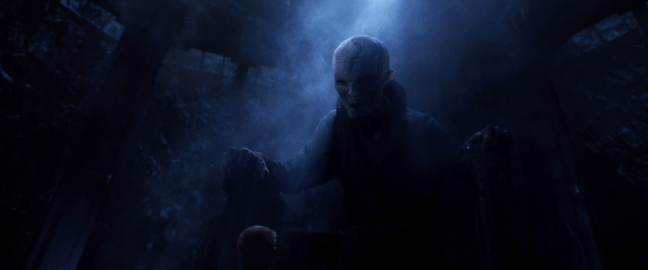
One last point I want to make before I wrap this article up. When I saw Force Awakens, I didn’t have to think about my least favorite characters: Supreme Leader Snoke and General Hux. Snoke, despite the performance of Andy Serkis, came off as Emperor Palpatine 2 – a character who served the story because, well, it’s a Star Wars movie and those need a creepy old dude in a chair.

Hux, by contrast, had the personality of an evil brick. I had no sense of these people as characters, merely as roles. Snoke was the leader and Hux was a general. Got it. Last Jedi greatly improves this without taking serious script time and Johnson does it through visual storytelling.

First, Snoke: Look at that robe! Who wears a fabulous glitter gold robe complete with slippers while overseeing a military operation? Someone who is very arrogant and very much in control – a.k.a. the dear Supreme Leader. By the simplest wardrobe change, Snoke takes on some of his own character and becomes less of a Palpatine clone.

Snoke more interesting in Last Jedi
Best part of Snoke in Force Awakens? When I thought he was 20 feet tall.

Hux, by contrast, has more of his characters conveyed through his unspoken actions. Whether it is the smug sneer he gives Kylo Ren at the start of the film or when he almost pulls a gun on Ren’s unconscious body, the audience understands the relationship between these two characters. No one ever blurts “power struggle” because they don’t have to.

This dynamic gives Hux depth and informs us better of his character.

There’s more to say on Last Jedi but I’ll save it for another day. Suffice it to say, I feel strongly about this movie and I hope Episode IX can live up to its fine example. I’m genuinely sorry for the other Star Wars fans who saw this film and thought it was the worse thing since Jar Jar – but I implore them to give it another go. No, it’s not what you were expecting – but that’s okay. This film still has a heart and, more importantly (at least to me) it has a mind clearly present in its script.

Rebels’ Thrawn: Turning Genius into Competency

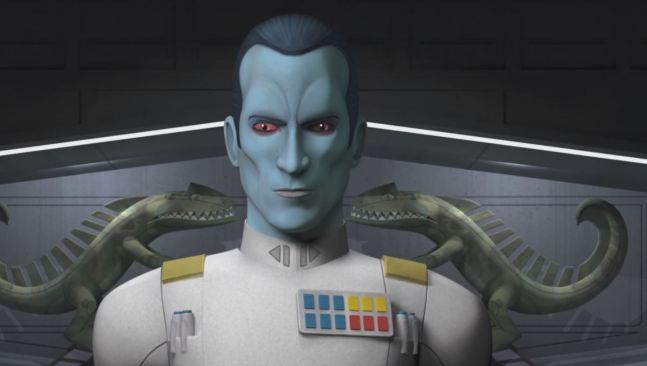
At this point, I feel my appreciation of Timothy Zahn’s Grand Admiral Thrawn is well documented. The villain first appeared in the Star Wars universe as the direct follow-up to Darth Vader and Emperor Palpatine. The success of Thrawn came from the fact that he met two conditions: 1) He had very different character traits from Vader or Palpatine. 2) He came off as no less dangerous.

Thrawn is a villain without the Force. Indeed, physically, he is not intimidating. He can fight – sure, but against a jedi it would not be a contest. Thrawn’s weapon is his intellect. He can stand in a room with Luke Skywalker and Luke will be unable to touch him, because Thrawn has calculated every scenario and anticipated every plan. The Grand Admiral’s own designs have layers upon layers upon layers of intricacy. Simply put: Thrawn has no intellectual equivalent.

Thrawn outsmarting jedi
From a graphic novel adaptation of Heir to the Empire. Thrawn’s research leads him to a way to disrupt the Force.

At least, that is how he was in the Heir to the Empire trilogy – the novels that sparked the Star Wars expanded universe (long before Disney or the prequels). Author Timothy Zahn crafted compelling new characters (Grand Admiral Thrawn and Mara Jade) that breathed life back into the Star Wars fandom. About 24 years later, Disney is rebooting the Star Wars expanded universe – hoping to capture the brilliance while whittling out the…well the not-great ideas.

I was overjoyed to hear that Grand Admiral Thrawn was to be made officially canon in Star Wars Rebels. After seeing season three (Thrawn’s introduction) however, I have doubts that the show writers are up to the task of capturing what made Thrawn compelling.

Thrawn in Rebels

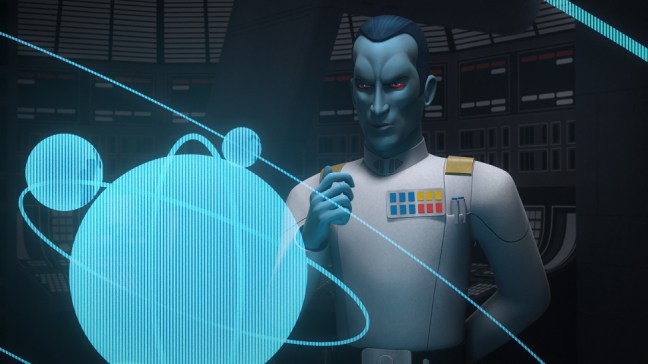
Grand Admiral Thrawn is assigned into Rebels after the unexplained departure of Darth Vader (he is hunting the rebels until he isn’t). For much of season three, Thrawn is present but passive. He observes but rarely acts. When he interacts with the rebels, one of two things happens. Thrawn “lets them go” or he turns over their handling to a subordinate…who promptly fails, allowing the rebels to escape. Neither of these courses of action paint Thrawn as a genius.

Plans without Payoff

The former could have done so with appropriate payoff. Early on in the season, Thrawn captures a family heirloom of Hera’s and seems very intent on learning about her family and culture. Later on, Thrawn lets Commander Sato escape after learning the extent to which the man values family.

The problem here is that neither of these developments are revisited in season three. Thrawn never utilizes his knowledge of Hera’s family to out-think her and never manipulates Sato’s dedication to family. Nope, instead he just finally figures out where the rebel base is and attacks it. That’s it. For a master of planning, Thrawn is incredibly simple.

Dork-Side-Rebels-Review-Zero-Hour-7
Given Commander Sato’s death at the end of season three, it is very unlikely that Thrawn’s information gathering will ever be worth it.

So…why does Thrawn let them escape? It comes off as masked incompetence rather than cleverness. Thrawn is merely spinning his failures to sound more positive. “I didn’t let them get away… I wanted this! Yeah, yeah that’s it!”

In addition, a subplot of season three centers around Agent Kallus, an imperial agent turned rebel spy. While Thrawn learns of Kallus’ true loyalties fairly quickly, he does nothing to use this information to his advantage. This despite a scene where Thrawn says he will do exactly that. I believe the line is “Agent Kallus will have far more use as a rebel spy” or something like that. But nothing comes of it in terms of payoff – Thrawn never feeds Kallus false information and Kallus eventually leaves to join the rebels. In literary terms, this is loading a gun without ever firing it. What was the point?

Star-Wars-Rebels-Thrawn-Featured-03202017
I also find it hard to believe that Thrawn, who meticulously studies art, would not immediately notice a removed planet in a map he had been researching.

The “Stupid Watson” Syndrome

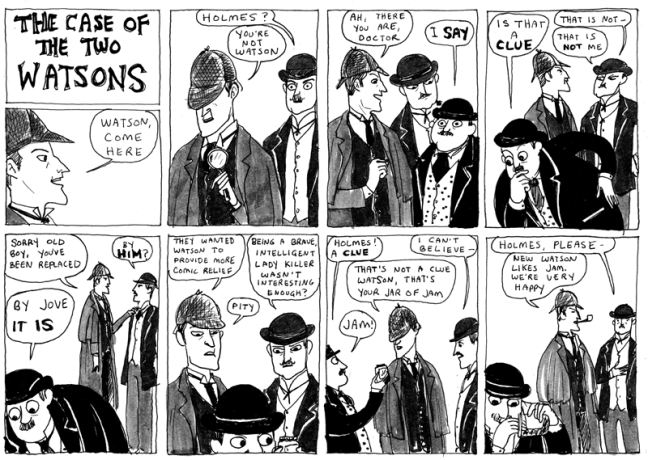
I credit pointing out the “Stupid Watson” syndrome to author and cartoonist, Kate Beaton. In the early Sherlock Holmes movies of the 20th century, Watson is re-imagined from a clever doctor to a bumbling sidekick with juvenile-or-senile levels of intellect. While it’s good for a chuckle, it raises a question: “Why does Holmes hang out with this guy? Isn’t this creating more work for him?”

Stupid Watson syndrome

The answer is that it was lazy writing. Rather than make Holmes look like the genuine genius he is, they paired him with a moron to amplify his competence and make even mundane actions look intelligent. In Rebels, the show writers did a similar thing with Thrawn.

Thrawn continually hands off command to people who promptly screw up – much as Sherlock Holmes in the old movies continually gave Watson tasks, which he promptly screwed up. The problem here is that the genius stops looking smart when he repeatedly places idiots in charge.

It also is uncharacteristic of a mastermind. In the season three finale, Thrawn begins by overseeing command of the bombardment of the rebel base. He then hands off that command to go down to the surface so that he can accept the rebel surrender. For a macro-manager, this is an odd choice. Why abandon the position of control? It also gives the writers an easy way out. Thrawn didn’t lose the battle – Governor Price did. This isn’t Price’s first failure so why – with the situation so crucial – does Thrawn again give her command?

Star-Wars-Rebels-Thrawn-1-09202016
Only fools keep around other fools whom they can pass the blame onto.

It would be one thing if this new Thrawn was supposed to be different from the original, but Disney has taken pains – including bringing back Timothy Zahn to write a new origin story – to recapture Thrawn’s evil genius. They want the compelling character who gave birth to the expanded universe. Unfortunately, at least in season three, Rebels writers have not been up to the task of writing genius. The Thrawn in Rebels is so far only a pale shadow of his literary predecessor – he is nowhere near as interesting and less than half as threatening. Let us hope they can turn it around in season four.