
When you’re a writer, every and any piece of writing can serve as a lesson for how to write (or in this case not write) a story. We often think of books as natural learning tools – after all, a common message for writers is that every writer must do two things: write a lot and read a lot. That said, lessons come from every form of storytelling, including comics and screenplays.
The Godzilla franchise is the longest running major motion picture series in existence. With a current 34 movies released (one more due out in May), Godzilla has firmly resonated with international audiences for decades. That’s a success story that any storyteller should note. Recently, the king of the monsters went animated for the first time in his film history.
The results…pretty mixed. Reviews and fans are divided on what to think of Polygon Pictures’ anime trilogy. It’s widely available on Netflix so if you haven’t seen it, you can give it a watch. I personally can’t really recommend it for entertainment purposes.
For writing instruction, however, well – this new Godzilla series provides some cautionary tales of what can go wrong during scripting.
The Importance of Building a Protagonist
Every story revolves around some kind of a protagonist. They don’t need to be a hero – they don’t even need to be good – they are simply our point of view character. The entirety of the story is laid out through their perspective (bias). The best protagonists resonate with the audience.
We feel their struggles, experience their doubt, and want them to succeed. Think of Charlie Brown – we want him to do well and be happy, even when we know he won’t. He’s endearing to us as readers.
In the Netflix Godzilla anime trilogy, we get Haruo:
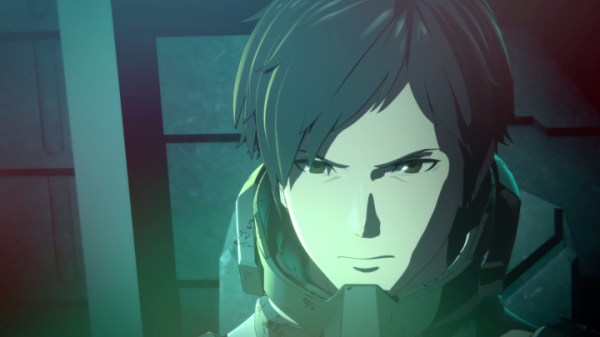
In case you’re wondering, he’s as charming as his disposition suggests. I put it forth that Haruo is not a strong protagonist. He struggles sure – he is up against Godzilla, one would hope there is a challenge. Haruo, however, is not sympathetic – but I get the impression they want him to be.
Right away, we’re introduced to a young Haruo as he loses his parents to Godzilla. Shortly thereafter, Haruo also loses his grandfather. That’s a lot of loss. No wonder he scowls all the time.
The problem with Haruo, in my opinion, is that he feels artificial. In each film, he can be characterized via one emotion. In the first film, it’s determination. Haruo is driven to kill Godzilla, so much so that we never see him reflect on anything else. Yeah there’s brief flashes to his life before (and we’re told how much Haruo hates living in defeat), but we don’t really see his struggle. This is in part because the whole crew seemingly loves him – everyone supports Haruo, even the people who don’t.
Despite opening the film by being incarcerated, Haruo is always at the center of the action and often in a position of power. Without seeing his struggle – besides cliche “my parents are dead!” moments – Haruo does not seem to have reason for his mad passion.
Let this be a lesson: It is okay to have zealot protagonists, but the danger here is they may be unreliable/unsympathetic and feel one dimensional. To get the audience firmly behind them, we have to see exactly where they came from/what lead them to this path. If we don’t, then they may be better off as a side character.
Ahab is fascinating in Moby Dick, but part of that is because he is seen through Ishmael’s eyes.
Bad Character Writing can be Sexist
I make no assumptions about the writers/directors of these movies. I am not calling them (as people) sexist. Their writing, however…geezy creezy.
Female characters are few and far between in this trilogy. There is an obligatory female soldier, the two Mothra priestesses, and…that’s it. Three movies, three female characters – and two of them are interchangeable twins.
It’s more than this, though, that raises the “sexism” flag. When writing a character, you must always keep in mind agency. What is agency? How the character pushes or changes the plot.
For instance, in the second movie – the female soldier (Yuko), falls into a trap and must be rescued. She has no agency in this scene, merely serving to establish a scenario for Haruo to be the hero. Despite being a trained soldier, she squeals and does very little in the way of self-preservation.
Oh, she is also romantically interested in Haruo…as are the priestesses. Yep, evidently he’s just a lady killer. Must be all that talk about how Godzilla must die – really compelling stuff.

To be fair, all the characterization in these films is pretty weak (remember when I said Haruo gets one emotion per movie?) but the danger comes when doing female characters. Sexism is real and has a long sad history and, if you’re not careful as a writer, you can add to it.
I don’t know if the writers of these movies were aware of just how token their female representation was, or just how many stereotypes it played into, but nevertheless – here we are.
How to Manage Audience/Reader Expectations
One of the biggest reasons that many Godzilla fans dislike these anime movies is the lack of, well, Godzilla. The Big G is more of a presence in the films than an actual character. While he has a fair amount of screen time, most of it is spent with him just standing around or walking very slowly.
Since the films take place on a forest-covered future Earth, there’s no real destruction either. It removes the stakes as Godzilla trudges on. Yeah, he’s probably stepping on trees but…who cares?
In addition, Godzilla films are known for their monster fights and the anime film teased all of Godzilla’s biggest rivals (Ghidorah, Mothra, and Mechagodzilla) returning in prominent roles. And Godzilla fights…exactly one of them, if this can be called a fight:
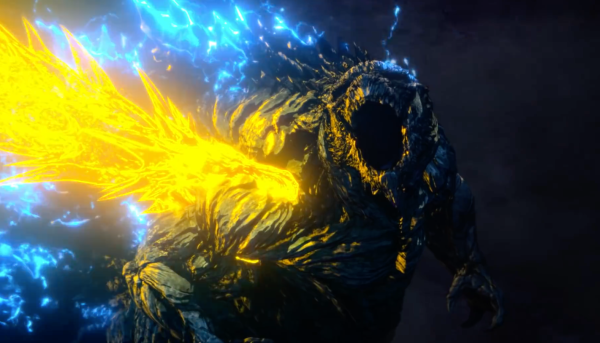
I for one am okay when Godzilla films subvert expectations (there are 34 movies, after all). That said, I understand the audience frustration when – after teasing Mechagodzilla for a film – we only get a generic futuristic battle city that we’re told was once Mechagodzilla (really).
It also reduces the threat of Godzilla to portray him as a colossally slow, rarely active threat. I know he’s giant but the Earth is a big place – couldn’t they just avoid him?
The trilogy was sold as a story about a world ruled by Godzilla, a “planet of monsters.” It felt like a truly barren (read as boring) world.
The Dangers of Exploring High Concepts
So what does the Godzilla trilogy do with its three films since it isn’t developing characters or showcasing monster brawls? IDEAS!
Get ready for three long philosophical outpourings, some of it lecture, some of it debate. And, to be fair, some of it works. I especially enjoyed the climax of the second film, where the question becomes “Is it worth it to give up your humanity to destroy a monster?” The plot implies that, by crossing this line, Haruo will become the very thing he has sworn to destroy. It’s interesting and it feels specific enough in the context to be an intelligent espousal on common Godzilla themes.
However, this film trilogy shoots for the stars more than once, and – more ofen than not – ends up missing entirely. Unfortunately, the biggest disaster comes at the end when the film tries to imply that all forms of human ingenuity and technological curiosity are evil and will only end with the creation of a monster.
Yep – all inventions lead to war. That seems to be the closing lesson. If it sounds like general, broad-based garbage, it is because it is. What’s sad is this lesson has been done in films – and done correctly. The original Planet of the Apes is famous for how well it handles man’s self-made destruction.
The film directly creates ties between nuclear war and the apes ascension. The Godzilla trilogy tries to do this as well, only Godzilla does not appear until well after the first usage of nuclear weapons. He comes in the 21st century for…reasons? It is very unclear and therefore creates a number of causes. Is it war? Climate change? Pollution?
Something awakens Godzilla and the final film tries to tell us it was the atom bomb…but he woke up sixty years too late. Of course, if he had risen directly post WWII, well then they never could have done all the space stuff. I mean they could have but it would all have had to look retro and stylized – you know – visually interesting.
When tackling high thought concepts, everything needs to be air-tight. Get specific, get down into the details. Don’t just have characters talk about war and peace like they want to be Tolstoy.
Overall, the Godzilla anime trilogy on Netflix is an interesting failure. There are some things I enjoy very much but the films trade too much for too little. I personally would have preferred more developed characters and a more living world to all the lecturing and science-babble that takes place in the films. The dueling alien philosophies were interesting but ultimately felt overbearing and plot controlling – mostly because they were the main focus rather than being a charming side addition to world lore.
Of course, the wonderful thing about art is its all subjective! If you don’t agree with me, that’s cool. I just hope you take the lessons I suggested with you on your writing – they will most definitely help.

 Colin McMahon