Loki vs. Killmonger: Sympathy vs. Empathy in Villains

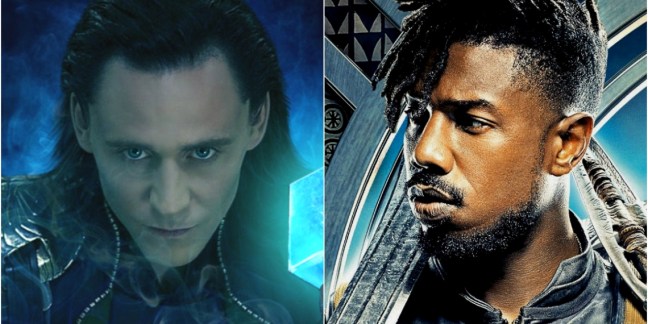
Loki Killmonger

I’ve written a lot about villains. Why we like them – why some work better than others – why it can be difficult to follow up one great villain with another. I’ve also written a little about Marvel’s villains and how they…they are. Marvel doesn’t have the best reputation when it comes to creating compelling antagonists. Their idea of a villain is often simply a bad dude with a similar power set to the protagonist. The bar is in fact so low that Josh Brolin’s Thanos is – in my mind – easily in the top three, despite having an overall goal that doesn’t make a lick of sense.

But let’s not talk about number three today. Let’s instead discuss my one and two, AKA Loki and Killmonger. Both defy the Marvel mediocrity and create lasting impressions. I know I’m not the only one who thinks this way – one trip to Google showcases just how many people appreciate and identify with these villains. My question, and the purpose of this article, is: Why? Why do people love Loki and Killmonger? Let’s take a look.

Loki as a sympathetic villain

Before Loki became known as just a snarky, smirking Tom Hiddleston, his character actually had a meaningful arc. One of the reasons that I believe Kenneth Branagh’s Thor stands above the average Marvel movie (of which there are now at least a dozen) is because of how the director approached the subject matter. Branagh has a background in theater – primarily Shakespeare – and I feel he applied this very well to the creation of his Loki.

I never liked Loki in the comics. He’s mischievous and…that’s it. To be blunt, he’s a dick. There’s not much more to him. Sure, he mentions he’s Thor’s brother at least once an issue, but I never believed there was actually anything there. It was a classic storytelling blunder: Telling the reader instead of showing them the relationship.

Thor corrected this problem. Loki is presented first and foremost as Thor’s brother…his overlooked, demeaned brother. The movie makes it very clear early on who Odin loves more, and these problems are only deepened as Loki learns of his secret, problematic origins. In short, he’s spurned and it’s easy to see how he falls.

But he doesn’t seem happy about it – this is the other important factor. Remember how I mentioned Loki’s trademark smirk? He actually doesn’t wear it often in 2011’s Thor. Instead, his face is more this:

Loki sympathetic

A mix of surprise, anguish, and pain. Loki’s world is upended in the first Thor. He is desperate to prove himself to Odin and show that he is every bit as worthy as his brother.

Unlike how he would appear in later movies, we don’t see Loki taking a lot of pleasure in being evil. Instead, it seems like he feels this is his best and only option. Loki is driven, single-minded, and self-destructive.

Upon learning that Thor has had a change of heart and wants no part of genocide, Loki laughs maniacally…and cries. Tom Hiddleston plays a character who is literally coming apart emotionally.

I believe this is what makes Loki compelling. His “mischievous” nature is given reason: He can’t stand a status quo where he is routinely cast to the side in favor of his older, incredibly arrogant brother.

As Thor changes, Loki’s behavior becomes more erratic and he ultimately pushes himself to an extreme downward spiral. I don’t think it is any accident that Thor climaxes with Loki falling into a void, as that symbolizes the completion of the descent that has been happening within the character all movie.

It’s compelling, and it’s sad. We see Loki as horrible to his brother yes, but also caring to his father and mother. He is a monster, but he is a human one. This allows him to be a strong sympathetic villain.

Killmonger as an empathetic villain

And then there’s Killmonger. Erik Killmonger AKA N’Jadaka is not sympathetic, at least not to me – and I’ll explain why. Sympathetic can be defined as eliciting compassion, feeling, or understanding. While I think Killmonger does a great job for the second two, I personally find that he fails at the first – because he is too far gone. In Thor, we see Loki at the start of his fall. In Black Panther, Killmonger is a full blown psychopath.

The character kills indiscriminately, friend and foe alike. He is quick to betray, murdering several unarmed people in cold blood. Unlike Loki, we don’t see Killmonger behaving like a human to any other character in the film – even his own father. When asked if he feels sorrow for the loss of his dad, all Killmonger can say is “everybody dies.”

151f36718ae4570e982584042230
“Erik Stevens. Graduated Annapolis aged nineteen, MIT for grad school. Joined the SEALs and went straight to Afghanistan, where he wrapped up confirmed kills like it was a video game. Started calling him Killmonger.”  – Everett Ross

And while there is some sorrow for how far Killmonger has fallen – since we know he was once innocent – it is too indirect, at least for me. It’s the same problem as showing Darth Vader as a child. Yeah, they’re nice as kids but…they’re kids. Even Hitler was probably fine as a boy.

This is not to say that Killmonger isn’t an effective villain. I think he’s terrific, but he’s serving a different purpose than Loki. Killmonger is an empathetic villain because the audience understands the root of his extremism.

Systematic and overt racism are enormous problems in today’s society, as well as the police state that many people of color feel they are subjected to. Given that Wakanda is a paradise – a technological utopia – Killmonger exists to show just how much of a fantasy that really is.

Given his plight, Wakanda could very easily be Norway or Sweden. Sitting comfortably, claiming to be a bastion of enlightenment, while other human beings suffer. Of course, the fact that Wakanda is an African nation adds incredible emphasis to this point, given the continent’s history of being abused and exploited by the “civilized” European world.

So while Killmonger may be a monster, he is “a monster of our own making” as T’Challa puts it. If Loki is Shakespeare, Killmonger is Shelley. He was created by a person (T’Challa’s father) who wished no responsibility for his actions.

But, like the Frankenstein monster, the audience is left drawing the conclusion that, no matter how right the creature may be about how wronged it was, it is still a danger to the world and the innocent people within.

All Killmonger knows is hatred, so that is all he can bring.

So there you have it, my thoughts and feelings about Loki and Killmonger. I think there’s a lot writers can learn from both characters, especially when it comes to creating compelling villains. Whether it is empathy or sympathy, these antagonists have to create feelings within us to be memorable. If not, well…they’re just this:


Thinking Deeper: Analyzing Star Wars: The Last Jedi

Star Wars: The Last Jedi came out in theaters six months ago and the impact of its release is still being felt. To say the film is controversial appears to be an understatement. Some claim it is the death of Star Wars, a film worse than all the prequels (really?) that shreds the source material. To others, including myself, it is a breath of fresh air and maybe the first true Star Wars “sequel” in quite some time.

One of the main reasons that I love Last Jedi is that the movie generates conversation. I saw Solo last week and am already forgetting it. It wasn’t a terrible film by any stretch, nor was it really good. Solo just exists, checking off all the boxes it has to without feeling particularly inspired or warranted. I feel like there was no deeper subtext or character development. Spoilers: Han Solo is a scoundrel but a good guy. Did I really need to spend $16 just to confirm that?

With Last Jedi, I felt like I was watching a movie that wasn’t content to simply check boxes. It didn’t care that it was a “Star Wars film” and spent more time trying to be a genuine movie. The result is an experience that gives me something new every time I watch it. Here are some of the thoughts and readings I’ve had while watching Rian Johnson’s Star Wars: The Last Jedi:

Luke Skywalker is George Lucas

I know, shocker right – that Luke S. could mean Lucas? Watching Mark Hamill in Last Jedi is fantastic. True to the series’ Kurosawa roots, Luke is no longer the bright-eyed boy on Tatooine but a grizzled, jaded Jedi master. Unlike Harrison Ford’s Han Solo from The Force Awakens, Hamill’s Luke feels different from when we last saw him. His character has been appropriately aged along with himself.

When I was last watching the movie, I paid attention to Luke’s dialogue – in particular his self-loathing. Luke Skywalker did the impossible, he redeemed Darth Vader. Bear in mind, Luke is still fairly young in Return of the Jedi – at most 30. It’s not everyone who saves the galaxy before they can even qualify for a midlife crisis.

Therefore, it’s easy to see how Luke made mistakes. In his hubris, he felt he could do anything after that. It’s a very human reaction. Some would say it’s exactly what happened to Star Wars creator George Lucas after he made the original trilogy.

The struggles of George Lucas in making Star Wars have been widely documented. He had to fight on every decision and ultimately had to shoulder more than his share of the work. Lucas saw someone few people did, perhaps that nobody else did: that Star Wars could be a hit. And he did it. When everyone doubted, George Lucas did it. The man created a property that has impacted the lives of millions and created a devote following (to say the least).

To quote Hamill’s Luke from Last Jedi: he “became a legend.”

Then the time came for George to duplicate his massive success. The year was 1999 and the world was hungry for Star Wars Episode I: The Phantom Menace. Then the movie, and its two sequels came out and…well…lighting did not strike twice. With the introduction of characters like Jar Jar Binks and concepts like midichlorians, many fans thought that Lucas was destroying his creation and tarnishing his legacy.

And not to mention the Special Editions that are widely held as inferior to the original theatrical cuts. On all fronts, it seemed like George Lucas could do no right. Yet still he forged ahead. Why? Because he was George Lucas…a legend.

Until, one day, older and definitely with some bitterness, George Lucas sold Star Wars and retired to his home, essentially becoming a grizzled old hermit himself and completing the character arch that he envisioned for so many of his Jedi heroes.

Did Rian Johnson write Luke S. as a metaphor for Lucas? Who knows. But the similarities are uncanny.

Are sacred texts the expanded universe?
Part of me wonders if the sacred texts are a stand-in for the expanded universe. If so, then Yoda’s dig is even more of a burn…although not entirely undeserved in my opinion.

Kylo Ren really is a Star Wars fanboy

When I first wrote my article declaring Kylo Ren a Star Wars fanboy, I had no idea how right I’d be. In a movie script obsessed with subverting history, Kylo Ren is the character most consumed by it (even more than lonely Luke). Despite his vocal claims to the contrary, Ren cannot let go of the past.

He sees himself as the central figure in the story, a view he asserts on Rey in the following line:

“You have no place in this story; you come from nothing. You’re nothing.”

Charming. Such a wonder why Rey promptly runs away after that exchange. Kylo Ren’s delusions of grandeur aside, his character typifies the negative perception that Star Wars fans feel they “own the trilogy” more than anyone else. This belief (to varying extents) was represented in the documentary, The People vs George Lucas where the filmmakers made the argument that fans owned Star Wars more than its creator.

The story of Star Wars has become so ingrained in pop culture that most everyone knows at least the basics. The heroic Skywalker stands at the center of the galaxy, reshaping it in his image. For both Luke and Vader, this perspective holds weight and no doubt Kylo Ren sees himself as simply a continuation.

He knows how the story will go, how could he not? He believes himself to be the main character. This fits with a large viewpoint in the Star Wars fandom that family lineage matters. Even in the Expanded Universe, the focus was largely on Luke, Han and Leia – not to mention all of their children and spouses.

This idea runs so counter-intuitive to the message of the original film, which showed that heroes could come from anywhere – even a nowhere like Tatooine. Kylo Ren has done very little to declare himself a hero, yet he still clearly sees himself as one.

His expectations and actions based around how he believes the “story” will go reflects the controlling nature of fandom. The cry for newness while wallowing in the familiar. Kylo Ren must be the hero because…well, that’s how he wrote it in his head.

Who owns Star Wars?
Part of me is starting to wonder why we feel the need to “own” things – especially universes that aren’t real. Star Wars has impacted so many people, I’m honesty not sure if anybody can really say they own it more…except Disney.

The toxic masculinity of Poe Dameron

When I first saw The Last Jedi, I had problems with Poe Dameron’s subplot. Specifically, I didn’t understand why Admiral Holdo didn’t just tell him the plan. Was she worried about a spy? Was it subversion just for subversion’s sake?

Since then, I’ve noticed quite a few things in Poe Dameron’s dialogue. Holy hell, is he an asshole. Never mind that he gets nearly the whole bomber fleet killed at the beginning of the movie (an action which gets him justifiably demoted), he refuses to treat Holdo with respect.

His first “not what I expected” conveys a personal disappointment. The feared military hero, Vice Admiral Holdo, is nothing more than a skinny, older, soft-spoken woman who doesn’t convey bravado or really anything. She just sets about doing her job.

Watch Poe’s first conversation with Holdo, look at what he’s saying:

Poe: “Vice admiral? Commander Dameron. With our fuel consumption there’s a very limited amount of time that we can stay out of range of those star destroyers.”

Holdo: “Very kind of you to make me aware.”

Yes, because there is no way that the Vice Admiral of the Resistance fleet already understood the very basic situation. If you’ve ever wondered what “mansplaining” is – this is an example. Poe, who was recently demoted for screwing up royally, still feels entitled to assert himself.

His lack of faith in his superior officers translates into a loss of hope and a dangerous turn that gets more people killed. The First Order learns of the rebel plan partly through Poe’s actions.

Remove the fact that Holdo is a woman and treat it like a standard military operation: A demoted officer immediately undermines his superior’s orders because he feels left out. Granted, we never see if Holdo tells anyone the plan because we’re confined to Poe’s view point.

We see him rebel again and again, not to further any real cause but his own desire for control. It is a subplot that I did not fully pick up on the first time through – mainly because I was so surprised to find it in a film like this.

tumblr_p7nz16lwDy1ub0sqqo1_1280

Visual storytelling: Snoke and Hux

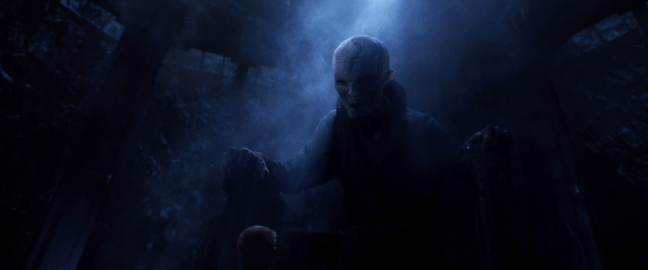
One last point I want to make before I wrap this article up. When I saw Force Awakens, I didn’t have to think about my least favorite characters: Supreme Leader Snoke and General Hux. Snoke, despite the performance of Andy Serkis, came off as Emperor Palpatine 2 – a character who served the story because, well, it’s a Star Wars movie and those need a creepy old dude in a chair.

Hux, by contrast, had the personality of an evil brick. I had no sense of these people as characters, merely as roles. Snoke was the leader and Hux was a general. Got it. Last Jedi greatly improves this without taking serious script time and Johnson does it through visual storytelling.

First, Snoke: Look at that robe! Who wears a fabulous glitter gold robe complete with slippers while overseeing a military operation? Someone who is very arrogant and very much in control – a.k.a. the dear Supreme Leader. By the simplest wardrobe change, Snoke takes on some of his own character and becomes less of a Palpatine clone.

Snoke more interesting in Last Jedi
Best part of Snoke in Force Awakens? When I thought he was 20 feet tall.

Hux, by contrast, has more of his characters conveyed through his unspoken actions. Whether it is the smug sneer he gives Kylo Ren at the start of the film or when he almost pulls a gun on Ren’s unconscious body, the audience understands the relationship between these two characters. No one ever blurts “power struggle” because they don’t have to.

This dynamic gives Hux depth and informs us better of his character.

There’s more to say on Last Jedi but I’ll save it for another day. Suffice it to say, I feel strongly about this movie and I hope Episode IX can live up to its fine example. I’m genuinely sorry for the other Star Wars fans who saw this film and thought it was the worse thing since Jar Jar – but I implore them to give it another go. No, it’s not what you were expecting – but that’s okay. This film still has a heart and, more importantly (at least to me) it has a mind clearly present in its script.

How to Train Your Child to Love Dragons

Dragons have fascinated humanity for millennia. No matter which part of the world you travel to, odds are the indigenous culture had at least one myth devoted to these beasts. While some may run to conspiracy, the logical explanation for widespread dragon mythology is dinosaur bones… or are dinosaurs a cover-up for dragons?!

They’re not. Dinosaurs have always existed but it’s easy to forget that we’ve only started formulating scientific study on these fossils during the last couple centuries. Before then, they were just giant bones – proof that our planet once held strange and amazing animals.

The natural mystery of the dinosaurs gave birth to arguably the greatest fantastical creation of all time. One that symbolizes our creative spirit as a species and adds an element of wonder to our collective consciousness. So, in my mind, passing on this love of dragons is essential in healthy human development.

After all, I love dragons and I consider myself a well-balanced individual (twitch).

Early Childhood

If you’re trying to get your child to love anything then start early. I don’t mean ramming dragons in the face of your baby and screaming “like it!” – rather, maybe just choose books and films that are age appropriate. Luckily, popular culture has you covered.

In terms of movies, recent hits like Pete’s Dragon and The Chronicles of Narnia: Voyage of the Dawn Treader both feature friendly, nonthreatening creatures. Another obvious choice is the How to Train Your Dragon series from Dreamworks Animation.

If I may state a personal preference and a loved childhood memory, I would recommend Flight of Dragons. This light, whimsical fantasy gives dragon flight and fire a pseudo-science explanation and features a lot more elements of the genre. Talking animals? Got it. Ogres – yeah there’s one. James Earl Jones voicing the villain who turns into a giant monster – okay, we’re onto something here.

Also, it’s got this song:

Yeah, that will be in your head awhile. It’s a wonderfully meta film, choosing the author of the source book as a main character. And speaking of books, you don’t get much more famous than The Hobbit. Read that to your child and I guarantee, apart from the giant spiders, Smaug will be a highlight.

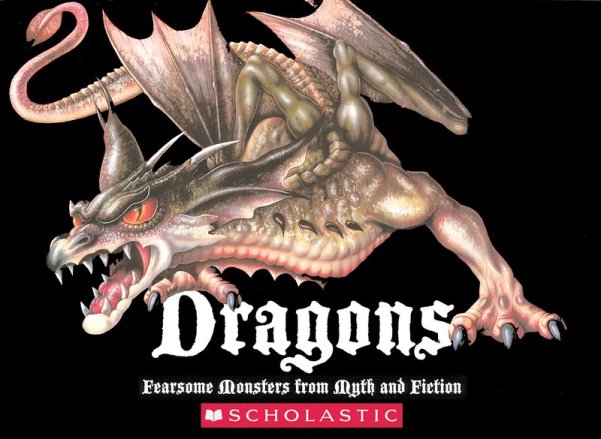
In terms of other books, really you can’t go wrong. There are so many dragon stories out there. I would also advise purchasing those giant picture books – like World of Dragons or something. They’re image focused so literacy isn’t a barrier, and the better ones feature drawings that will compel the development of a healthy imagination.

children dragons
One of the coolest aspects of dragon lore is how many different shapes and designs the creature can take. Try to look for literature that highlights each vision.

The tweens

As kids age, “cool” starts to matter more. Everyone wants to be cool – gotta do the cool things to be cool. However, they’re not quite teenagers yet so, you know, parents have yet to become the exact opposite of cool. So you can still make recommendations but the best bet is just making things available for consumption.

A film like Dragonheart, while rated PG-13, is perfect for this age range. After all, you can’t get much more awesome than Sean Connery voicing a dragon. It’s a little more violent without being Game of Thrones and the sexual innuendos will likely fly over your childrens’ heads… like a dragon, get it? I’m very clever.

Notable books include easy reads like Harry Potter, stuff your child can devour and process easily, helping to fuel not just a love of dragons but a greater affection for reading in general.

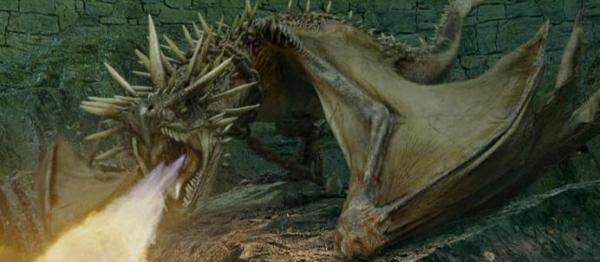
Harry Potter children dragon
Harry Potter ages along with the series, but its never particularly terrifying or overtly mature.

Teenage Years

Okay, now you’re not cool anymore. Being a teenager is all about being rebellious. Are they old enough to watch Game of Thrones? Doesn’t matter, they’ll likely watch it anyway.  However, this desire to revolt can be capitalized on with some appropriate dragon literature.

Gork the Teenage Dragon is every story of young adult high school trauma and liberation only… you know, with dragons. We follow Gork, a young, smaller dragon who is too nice for his own good. This hurts his chances of winning a female for the mating dance (a more straight forward name for “prom”) and impressing his family.

Gork has no idea what he wants to be but he feels the enormous pressure to be great. Typical teenager stuff, just substitute the people for dragons.

teenage dragon books
I feel the cover gives an excellent indication of the overall tone of this story.

The Magicians trilogy also provides dragons in more mature setting, although parents have to be comfortable exposing their child to teenage sex and drug use – if anything, it can be seen as prep for actual high school.

At this point, more scholarly works like Beowulf may also be attempted. Video games like Dragon Age also, as the name suggests, feature dragons very promptly. And I think it’s safe to assume that Skyrim will still be being released on new systems, even ten years from now.

And there you have it. Obviously there’s more to cover. I haven’t even scratched the surface of dragon pop culture.

I don’t claim to be an expert on the subject but I like to think that I still remember what it was like to be a child. Dragons are amazing creatures of power and mystery. These are qualities that I believe are attractive to children. Keep in mind, you don’t always have to go traditional.

As I mentioned in the beginning, dinosaurs are part of dragon lore and can easily expand the overall love of fire-breathing winged beasts. There’s also Godzilla, who is pretty amazing and fights other dragon-like creatures on a regular basis. I’m just saying.