The Minecraft Expectation

Well, it is over. With the 2.5 BILLION (yes, BILLION) sale of Mojang to Microsoft, Markus “Notch” Persson’s five-year relationship with his independent game phenomenon, Minecraft, has come to an end.  This essentially means that, without Notch, Microsoft paid a couple billion dollars to own Minecraft. Oh, and Scrolls too. That is insane. It showcases just how essential Microsoft believes Minecraft is to the future of gaming. Many gamers have had mixed-to-negative reactions to the purchase. Indeed, Minecraft is the most successful ‘indie’ (independently-made) video game in history. To have it swallowed up by a mammoth corporation like Microsoft is… well, we’ll see what happens. There is one person, however, who is very happy that Minecraft is now in Microsoft hands, and that is Notch:

"I’ve become a symbol. I don’t want to be a symbol, responsible for something huge that I don’t understand, that I don’t want to work on, that keeps coming back to me. I’m not an entrepreneur. I’m not a CEO. I’m a nerdy computer programmer who likes to have opinions on Twitter."
“I’ve become a symbol. I don’t want to be a symbol, responsible for something huge that I don’t understand, that I don’t want to work on, that keeps coming back to me. I’m not an entrepreneur. I’m not a CEO. I’m a nerdy computer programmer who likes to have opinions on Twitter.”

That is from a letter written by the Swedish programmer on his departure (the rest can be found here). It highlights the unrealistic expectation of Minecraft, and why we, as gamers, should try not to have ‘the Minecraft Expectation’ when it comes to games – especially indie ones. When I say the Minecraft Expectation, I refer to the supported belief that Notch was expected to keep working on Minecraft, without ever charging gamers for this additional content. This game has changed dramatically since its unveiling as a PC alpha test (earliest playable version – not technically a finished product) back in 2009. Minecraft was not even available for profit until 2011. And then it costs roughly twenty bucks to purchase. In the three years since there has been patch after patch of new and rebalanced content added to the game. And it has all been free.

New creatures, areas, and even worlds have been added since the initial release.

On the face of it, this is awesome for gamers. Nearly everyone hates paid dlc (downloadable content), especially when it feels like the retail game would be incomplete without it. What happened with Minecraft, I believe, is the opposite end of that dlc spectrum. Yes, there are games that withhold content and appear to delight in charging for every last dollar they can get from the consumer. But Notch was too nice. He had become bound to game he didn’t want to keep adding content to, and people treated him as a traitor if he even thought about doing something else.
Paying for content that feels like it should have been part of the original game is never a way to build a good relationship with the gaming community.

Independent developers do not have much money to finance their projects. Some use Kickstarters and paid early access to supplement funding. The only way that Minecraft has been able to continue this level of content and support is because, well… it’s worth around 2.5 billion dollars. Is it reasonable to expect a quality, finished product for the investment – absolutely. Is it reasonable to expect continued support and patching without ever needing to pay more for said content – not really. Not unless the game is a cultural event like Minecraft. How many of those come along?

There is a good balance and I believe companies like Blizzard Entertainment do it well. They provide continued free support for their games, while at the same time releasing the occasional paid expansion pack. Their retail games never feel incomplete, like the expansion is needed. It is just a way for devoted fans to explore new content, while paying the developer’s salary.
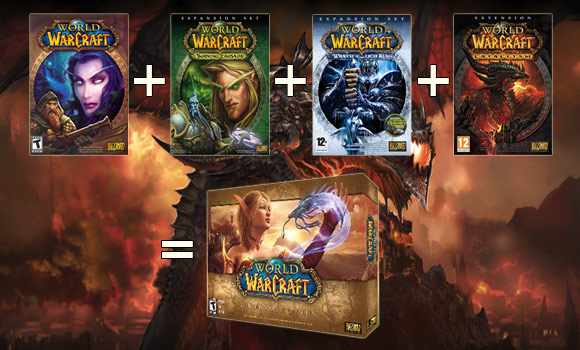
World of Warcraft is supported and expanded regularly, yet the game has also seen a wealth of retail expansions.

Yeah, games are fun. They are art, they are expression, they are a sublime form of escapism. That said, they are also part of someone’s job. As gamers, there is a responsibility to fiscally support the products we want and to reject those we don’t. At this point, no one “owes” anyone any continued support of Minecraft. If Microsoft never releases additional content and goes straight for Minecraft II, who can blame them? So long as that game is a quality experience like the first – Microsoft has held up their end of the deal as a developer.

South Park: the Stick of Truth vs Saints Row IV

Warning: Video links are NSFW (South Park ridiculousness)

Last year saw the end of one of the larger video game publishers, THQ. The company was responsible for such hits as the Saints Row series, the Darksiders series, and the Red Faction series. Further proof that producing successful games does not guarantee longevity in what can only be described as a cutthroat industry. When THQ went under, two enormous titles, South Park: the Stick of Truth and Saints Row IV, were still in development. The public was excited for both of these titles and, luckily, each found a home with a new publisher. South Park: the Stick of Truth was released courtesy of Ubisoft, while Saints Row IV found new life with Deep Silver. THQ’s last great games would be live to be played be the public. What makes these two titles very interesting, however, is the fact that they deal with similar subject matter. Both are games designed to parody other games. Well, as it happens with any two like products, the question becomes: which one is better?

Spoiler alert: I pick this one.

To begin, let’s examine the core games that each title is parodying. South Park: the Stick of Truth was molded to make fun of the traditional RPG (roleplaying game), where a silent protagonist teams up with a team of other, computer-controlled adventurers to complete an epic quest. Think old school Final Fantasy for this one. Heck, just look at how Canada looks in the game:

I love how Quebec is transformed into "the Caverns of Quebec."
I love how Quebec is transformed into “the Caverns of Quebec.”

The game also draws attention to the illusion of choice. There is one sequence in particular where the player character is ambushed by elves (kids dressed as elves). The elves offer a choice: fight or come quietly. Immediately after, one of the elves mentions that the fight is pointless and that the player will be forced to come along no matter what. There are several other instances throughout the game where the player is offered “choice,” and each one unfolds in a similar manner.

There is a point in the game where the player is asked to choose between Kyle and Cartman. This choice is also meaningless as both characters remain in your party.

I have already written and article talking about the Saints Row series but, just to reiterate: this is, at its heart, a spoof of the Grand Theft Auto series. Saints Row IV marks a large departure as series such as Prototype and Infamous become the primary draw for gameplay. While the core game focuses on spoofing those two series, Saints Row IV draws from several other key sources. The Mass Effect trilogy is evoked in two ways. First, Keith David is in the game as… Keith David. The character serves as a comedic stand in for his Mass Effect character, David Anderson.

2494030-keith+david+model

In addition, Saints Row IV pokes fun at Bioware’s relationship system. The idea that your player character is irresistible to everyone else and can have sex just by talking to another person. Where Mass Effect restricted it to one or two partners per playthrough, Saints Row IV allows the player to have sex with everyone in their party (minus Keith David), including one machine. This pokes fun at the idea that the only reason any player ever completed a relationship in a Mass Effect game was for the sex scene “reward” (there will be another, more serious article on this) at the end.

While both games are intelligent parodies, it is Saints Row IV that pulls ahead with simply better gameplay. It is the more fun game to play. While South Park: the Stick of Truth is hilarious, it is only meant to be played a certain way. The player is encouraged to directly complete quest after quest. Wandering (an element central to most RPGs) is discouraged. This is a short game with only a set amount in it. The repetition of things to do becomes apparent to any player who chooses to explore and (uselessly) grind against enemies. While this isn’t a huge knock against South Park, it is a limitation that Saints Row IV does not have (at least not as glaringly).

I feel that this difference is best showcased by comparing game maps, have a look:

The South Park map is exactly what you would expect. There are never more than half a dozen quest markers on screen at a time.
Most of the map for Saints Row IV. There is a much greater variety in mission type. There is also a mode just to see collectables.

Another area where Saints Row IV excels is the intelligence of some of its make-fun segments. For example, there is the moment where Saints Row IV switches to a 2D beat ’em up making fun of Streets of Rage (the segment is called Saints of Rage I believe). It is short and fun and, most importantly, easy. The joke does not overstay its welcome.

South Park: the Stick of Truth is not so smart. Any gamer out there can tell you about the frustrations of button mashing sequences. They are as the name suggestions: hit a button as fast as you can and hope it is fast enough to work. Not big on the skill but high on the tedium. On one level, the South Park game makes excellent fun of this. There is a completely voluntary sequence where the player character can use the bathroom and the player must button mash to complete the task. Fun, easy, and short – all three things. There are also several sequences where the player must button mash to complete boss battles or advance the story. These are not always fun or easy and come dangerously close to exactly copying the games that they are trying to make fun of.

One last point that I will harp on: glitches can ruin games and there are far more game ending glitches in South Park: the Stick of Truth. I encountered one such glitch and the game was nearly ruined for me. I will not dive into this further as I am planning to do a full article on the game production patterns over at Obsidian (the developers of South Park: the Stick of Truth). Suffice it to say, this is not the first Obsidian game to be held back by technical slip-ups.

For players seeking a humorous game experience, neither title will leave you disappointed. However, there are simply more funny jokes in Saints Row IV that are done better. Trey Parker and Matt Stone are geniuses in the world of cartoons, but the good folks over Volition, Inc. have the edge when it comes to properly enabling comedy through video games. There are advantages to being more familiar with your craft.

Unveiling the Pilot (Part One): The Red Rings of Redemption Play Lost: Via Domus

Today marks the beginning of something new for the Red Rings of Redemption. I am proud to announce that the first part of the pilot for the Youtube series, The Red Rings of Redemption Play, is now online for public viewing pleasure. Obviously this represents a work in progress. While the eventual series will follow a similar format, changes will be made. Feedback at this stage is more than welcome as we are aiming to create the best program we can.

I will just say for starters that editing and a few issues on the technical side (sound syncing) will be improved in the later videos. There were a few issues that arose this particular filming that prevented it from being tighter.

So with that being said I invite you to watch us as we embark on this next stage of the journey. Here’s hoping it will be fun!