A Rose by any Other Name… Can be Confusing: The Thing (2011)

In 1982, one of the greatest horror movies was released. I say this as a fan of John Carpenter, and as someone who really loves Halloween: John Carpenter’s best film by far is The Thing. The film can be seen as a masterwork, both in terms of paranoia/suspense and in terms of practical effects at work. That said, upon initial release – The Thing did not fare well.  Many critics (Roger Ebert included) were grossed out by the film’s excessive gore, and found the effects to be a little too real. Carpenter’s The Thing went on to be a box-office flop… with fame and deserved acclaim not being bestowed for many years.

Really? People found this too gross? Go figure.

Sounds like perfect material for Hollywood in 2011, right? So audiences were treated to The Thing again in 2011. Ready for the kicker though? Despite the name, The Thing is not, nor was it ever intended to be (by its director anyway) a remake. This film is a prequel.

A prequel with the same name. Makes… absolutely no sense. So why did it happen? The short answer is: I don’t know. After spending a few hours digging, I have not found an answer beyond this: they did not want the film to have a “:” in the title. Makes sense right? These days there is little that implies Hollywood marketing the way that a colon can. For example, take a look at this unofficial poster art for (one of) the upcoming Jungle Book movie:

jungle_book__origins_logo_by_paulrom-d8k6g3s

That’s right. They’re making two Jungle Book movies at the same time. One is not made by Disney, however, and so it is titled Jungle Book: Origins to differentiate… and to let audiences now that the studio is hopeful for a franchise. Well, I do agree with director Matthijs van Heijningen Jr. The Thing: Origins or anything like that would have sounded pretty dumb.

But what about The Thing From Another World?

While 2011’s film was no remake, Carpenter’s sure as heck was. Really, all three films have shared the same basis, and that is the Who Goes There? novella written by John W. Campbell. Say, Who Goes There? would be a great title for a horror movie… oh but it doesn’t have The Thing in it. And everyone knows that, if a movie is to be financially successful, it must name the money-making property behind it.

Or perhaps not.
Or perhaps not.

So, while the director says one thing – I believe another factor strongly went into influencing the title for The Thing: Studio interference. This happens a lot in movies and happened a ton on this one. For example, one of the greatest criticisms leveled against the 2011 film was the effects. Gone were the brilliant practical effects of the 1982 classic, replaced by cheap, fake-looking CGI. What was the director thinking?

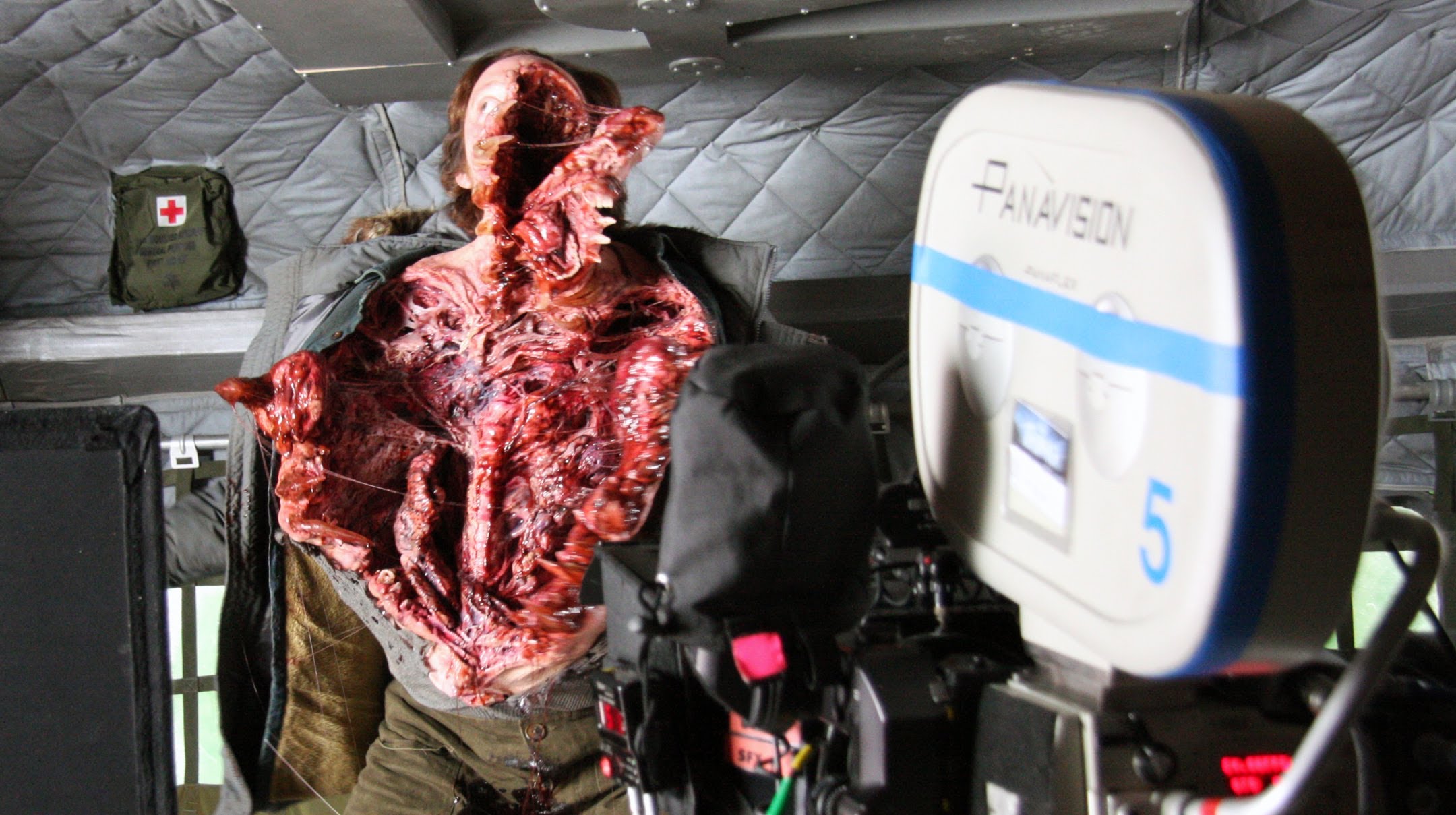
The director was all for practical effects. In fact, here is a look at the original effects for the new movie, before they were all replaced in post-production:

Pretty cool looking (although still nowhere near as bloody as 1982). Yet apparently, for whatever reason, the studio did not feel confident in this look. CGI is all the rage after all. ‘Cause this:
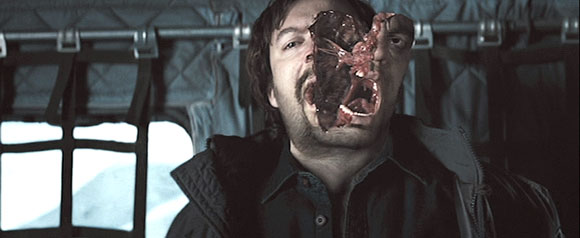
the-thing-2011-two-faced

Looks so much better than this:

maxresdefault

Apparently.

Also, The Thing (2011) lost its original ending, as the studio felt it was too confusing. The original ending featured many more alien designs, and has been dubbed “the pilot ending” by the director. In case you were wondering, we got “the Tetris ending” in the theatrical cut.

The point is: this movie had more than one master, and sadly that usually never works out in the film’s favor. I also know for a fact the script went through at least one complete rewrite from a scriptwriter whose other work has been.. less than stellar.

From the research I have done it appears that two goals were in mind. The first (from the director and crew) was to create a prequel that paid tribute to everything that makes the Carpenter film fantastic. The second was a bid to update The Thing for modern audiences in the 21st century, without risking grossing audiences out this time.

Nothing risky about this. Audiences love computers!

How did it turn out? The Thing bombed at the box office… again. History repeated itself, at least in that respect. Sadly, I don’t believe the 2011 prequel is destined for the same late recognition as the 1982 original, in part for the abysmal effects. The film is simply nowhere near the level of its predecessor, and I don’t believe it would be even if the effects were left alone. The paranoia isn’t there, the performances aren’t there. It is simply… lesser.

This was a film that started out pure but was then corrupted and taken over by an outside force, and in that respect – the title actually makes sense.
Marketing Method: Jurassic World

Fourteen years ago, Jurassic Park III hit theaters (yes, you are that old). The film received mixed reviews with many people calling it more fun than The Lost World… but also more stupid. The “they’re not monsters, they’re animals” approach championed by Steven Spielberg was gone, replaced instead with “here’s a new dinosaur… bigger and more terrible than T-Rex.” Granted, Jurassic Park III never pretended to be anything more than a simple thrill ride, just watch the trailer:

Three big things to take away from that trailer: 1. Dr. Grant is back!!!!!!! 2. Raptor intelligence. 3. New dinosaur – bigger and meaner than Tyrannosaurus.

While some enjoyed this approach, it is worth noting that Jurassic Park III was both the worst reviewed critically of the series (49% on Rotten Tomatoes and 42 on Metacritic) and the least profitable. The film grossed only 368 million with a 93 million budget, Lost World by comparison grossed 618 million with a 73 million dollar budget.

So while the film was an experiment, it does not seem like one the producers would like to repeat. Let’s look at the trailer for the brand new entry, Jurassic World:

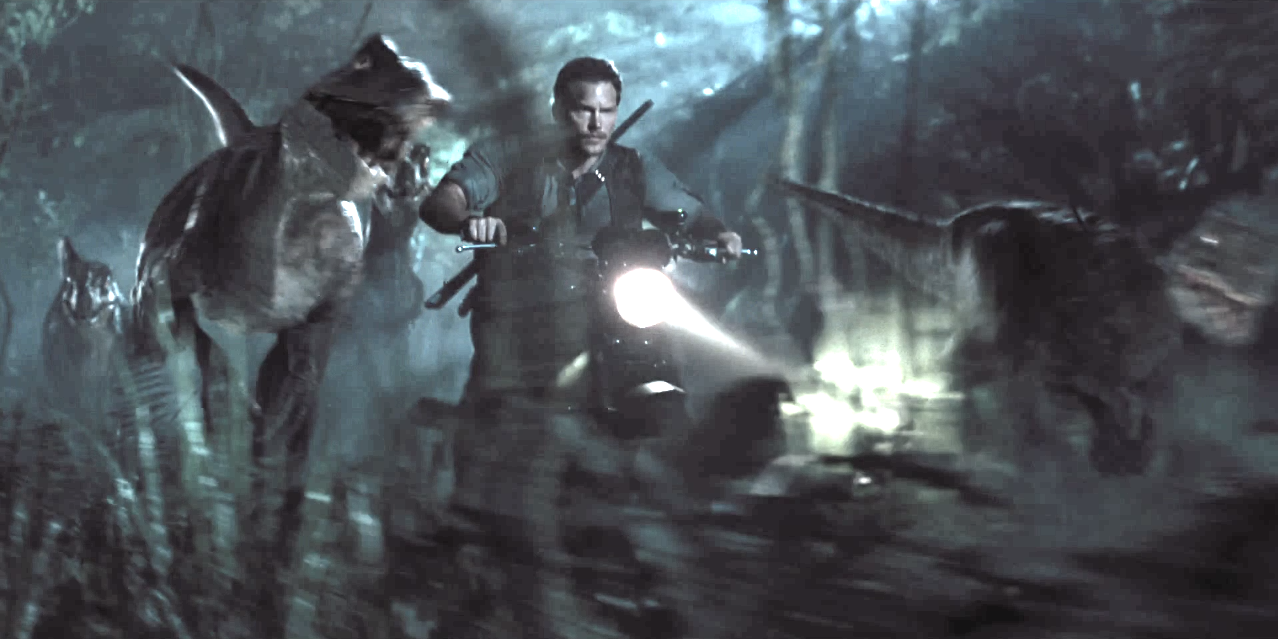
Three big things to take away from that trailer: 1. Star-Lord is in Jurassic Park!!!! 2. Raptor Intelligence. 3. New dinosaur – bigger and meaner than Tyrannosaurus.

Wait…

Yeah, it seems like at least one part of the Hollywood machine, Jurassic World‘s marketing, is very content to recycle the old hooks of Jurassic Park III. Both films also share a similar “over the top” approach. Jurassic Park III includes shots in a river, in a giant bird-cage, in a lot of environments to add spectacle. Jurassic World shows much the same… adjusted from 2001 to 2015 (over the top means so much more today).

It is hard to claim you are making any kind of serious movie when this is a shot in the trailer.

This marketing move is perplexing, given how the last film was received. While some fans enjoyed Jurassic Park III‘s ride, many wanted a return to the more intelligent Spielberg approach. Instead, audiences will be treated to Indominus Rex, the new dinosaur created by genetic modification… of all the largest and most dangerous dinosaurs into one… cause that sounds intelligent.

They should have just gone all out and added the DNA of Adolf Hitler... cause it might look cool with a mustache.
They should have just gone all out and added the DNA of Adolf Hitler… cause it might look cool with a mustache?

Indeed Indominus Rex has found itself at the center of Jurassic World’s marketing, and the controversial reaction to it. While some have expressed excitement, others have voiced the same critical words that Chris Pratt’s character states in the trailer: “doesn’t seem like a good idea.”

Escalation is a typical strategy in Hollywood sequels: bigger means better. Jurassic Park has been a film franchise that has followed this philosophy with every sequel. One T-Rex became two, became a Spinosaurus, became an Indominus Rex. What’s next? Two cloned dinosaurs… are they planning to give it wings? The problem with this approach is that it all says one thing: what is there isn’t exciting without something new added. In this case dinosaurs… dinosaurs are not exciting without new and better dinosaurs. What?

Dino Riders: the logical conclusion. Also, why has no one made a Dino Riders movie yet?

Granted, the story arch of the first Jurassic Park does not lend itself well to sequel material. There is a park that makes dinosaurs, dinosaurs get out, dinosaurs eat people – cut and we’re done. It isn’t an idea that demands “what comes next?”. The Lost World tried to change the formula, adding messages of conservation and naturalism vs. profiteering… to mixed results. Jurassic World looks squarely back in the first movie’s camp, however the trailer does contain some self-awareness that may be a sign that audiences are in for a treat. After all, Jurassic Park III had no character calling out how inane its central plot mechanic was.

Director Colin Trevorrow is untested, and that can be a good thing when it comes to injecting freshness into a series. However, two recent developments have further damaged excitement towards Jurassic World. Trevorrow has already said he has no plans to return for a sequel, which can be taken as either creative vision to do something else… or the studio was less than pleased with the final product. By itself, it is easy to assume the former, until we look at the early reviews… or lack thereof. As of right now: no critical review has been received on either Rotten Tomatoes or Metacritic. This is odd for a movie with such an imminent release. Pixar’s new film, by contrast, does not release until later than Jurassic World – and that already has reviews pouring in.

Time will tell what type of movie Jurassic World is. One thing seems already certain though, the Jurassic Park franchise marketing department needs to go extinct.

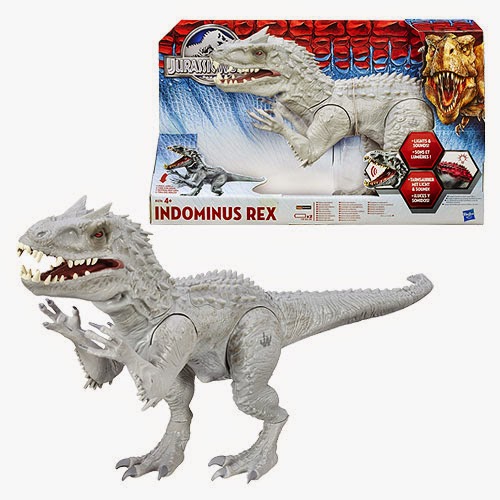
Unrelated note but am I the only one who also thinks these new toys are terrible? Seriously, it just looks like a mess of hard, jagged, plastic. Yeah, I want my child to play with that.
Unrelated note but am I the only one who also thinks these new toys are terrible? Seriously, it just looks like a mess of hard, jagged, plastic. Yeah, I want my child to play with that. I miss the old style figures.

Tomorrowland: Brad Bird's Bioshock

When the second trailer for Disney’s Tomorrowland was released, various websites on the Internet began to spot an interesting similarity between the new live-action picture and one of the most popular video game series in the past decade. Director Brad Bird‘s optimistic opus about the potential of the future bore an eerie resemblance to Bioshock, a game series about dystopia and the different ways ideology can be taken too far. Some found the similarities so uncanny as to create a mash-up trailer combining elements from both properties:

https://www.youtube.com/watch?v=Y3RIuEO1Zx4

Marketing does not always reflect the reality of the movie. That said, having seen Tomorrowland and played through all three Bioshock games, all I can say is: yep.

Warning: mild spoilers to follow.

The most obvious similarity exists in the concept. A futuristic society is created with the desire of being “better” than the rest of the world. Something goes wrong and it is up to an outsider to fix it. Right there I have just described the basic premise to both Tomorrowland and every Bioshock game. Yet the comparison does not stop there.

The movie opens with a young Frank Walker (the boy who will grow to be George Clooney), an inventor who arrives at the 1964 World’s Fair to show off his invention: the jetpack. Frank meets a mysterious girl, Athena (played very well by Raffey Cassidy) and is able to ascertain passage to Tomorrowland. What does the passage look like? Frank gets on a boat on the “It’s a Small World” ride. Halfway through, the waterway drops out and brings Frank to a seemingly endless body of water with a single walkway leading to a bathysphere. Sound familiar?

Depending on who you ask, "It's a Small World" is more or less ominous than a solitary lighthouse in the middle of the ocean.
Depending on who you ask, “It’s a Small World” is more or less ominous than a solitary lighthouse in the middle of the ocean.

Frank is next transported to Tomorrowland, a society founded and driven by one man: Governor Nix (Hugh Laurie). Nix is a leader who appears to have forsaken the rest of the world in favor of building his own vision of a better tomorrow. While his philosophy is slightly different, Nix is very comparable to the likes of Andrew Ryan and Zachary Comstock.

"You've got simultaneous epidemics of obesity and starvation, explain that one. Bees butterflies start to disappear, the glaciers melt, the algae blooms. All around you the coal mine canaries are dropping dead and you won't take the hint! In every moment there's a possibility of a better future, but you people won't believe it. And because you won't believe it you won't do what is necessary to make it a reality. " - Governor Nix
“You’ve got simultaneous epidemics of obesity and starvation, explain that one. Bees and butterflies start to disappear, the glaciers melt, the algae blooms. All around you the coal mine canaries are dropping dead and you won’t take the hint! In every moment there’s a possibility of a better future, but you people won’t believe it. And because you won’t believe it you won’t do what is necessary to make it a reality. “
– Governor Nix

Yes a disconnected world with lofty ideals and an extremist leader – what could go wrong? The nature of the exact problem with Tomorrowland is partly what separates it from other dystopias like Rapture and Columbia. The stubbornness and unfeeling nature of Nix aside, Tomorrowland has created a technology that is interfering with the rest of the world. I won’t spoil what it is exactly, other than to say it ties in strongly with the overall theme of the movie (similar to how the problems with Rapture and Columbia tied in to the themes of those games).

The last comparison really worth mentioning is Athena, the single agent acting against the wishes of her master and bringing in outside help to Tomorrowland. She accompanies the heroes throughout the entire plot, chipping in where she can and providing evidence that not everything in Tomorrowland has gone wrong. She also plays an essential role in how the story is resolved. Sound familiar:

Athena does not throw coins to either George Clooney or , proving that she is not as financially useful as Elizabeth.
Athena does not throw coins to either George Clooney or Britt Robertson, proving that she is not as financially useful as Elizabeth.

Almost forgot: there are also nonhuman guardians protecting Tomorrowland, and its secrets, from intruders of the outside world. Do they look as cool as this:

bioshock_big_daddy_and_little_sisterNope, they look more like this:

a-scene-from-tomorrowland

It is difficult to say whether or not the wealth of similarities between Tomorrowland and the Bioshock series is anything more than coincidence. I have searched for information on whether or not Brad Bird is a gamer, and I have found none. Given his age (57), and where he is in life – I do not believe he has ever played Bioshock. Yet Damon Lindelof, who co-wrote Tomorrowland, may very well have – again I cannot be sure. The idea of the Bioshock series is not so revolutionary that it is impossible to believe other creative minds did not come up with it on their own. Humanity has been discussing utopia and dystopia for centuries.

And alike as they are, Tomorrowland and Bioshock do enjoy their differences. The main story arch is different between them, and Tomorrowland enjoys an optimism (that some reviewers have labeled preachy while this reviewer found refreshing) that Bioshock does not possess.

It could be argued that Disney should have embraced the Bioshock comparison more openly, as their movie is currently struggling for financial success.