Tomorrowland: Brad Bird's Bioshock

When the second trailer for Disney’s Tomorrowland was released, various websites on the Internet began to spot an interesting similarity between the new live-action picture and one of the most popular video game series in the past decade. Director Brad Bird‘s optimistic opus about the potential of the future bore an eerie resemblance to Bioshock, a game series about dystopia and the different ways ideology can be taken too far. Some found the similarities so uncanny as to create a mash-up trailer combining elements from both properties:

Marketing does not always reflect the reality of the movie. That said, having seen Tomorrowland and played through all three Bioshock games, all I can say is: yep.

Warning: mild spoilers to follow.

The most obvious similarity exists in the concept. A futuristic society is created with the desire of being “better” than the rest of the world. Something goes wrong and it is up to an outsider to fix it. Right there I have just described the basic premise to both Tomorrowland and every Bioshock game. Yet the comparison does not stop there.

The movie opens with a young Frank Walker (the boy who will grow to be George Clooney), an inventor who arrives at the 1964 World’s Fair to show off his invention: the jetpack. Frank meets a mysterious girl, Athena (played very well by Raffey Cassidy) and is able to ascertain passage to Tomorrowland. What does the passage look like? Frank gets on a boat on the “It’s a Small World” ride. Halfway through, the waterway drops out and brings Frank to a seemingly endless body of water with a single walkway leading to a bathysphere. Sound familiar?

Depending on who you ask, "It's a Small World" is more or less ominous than a solitary lighthouse in the middle of the ocean.
Depending on who you ask, “It’s a Small World” is more or less ominous than a solitary lighthouse in the middle of the ocean.

Frank is next transported to Tomorrowland, a society founded and driven by one man: Governor Nix (Hugh Laurie). Nix is a leader who appears to have forsaken the rest of the world in favor of building his own vision of a better tomorrow. While his philosophy is slightly different, Nix is very comparable to the likes of Andrew Ryan and Zachary Comstock.

"You've got simultaneous epidemics of obesity and starvation, explain that one. Bees butterflies start to disappear, the glaciers melt, the algae blooms. All around you the coal mine canaries are dropping dead and you won't take the hint! In every moment there's a possibility of a better future, but you people won't believe it. And because you won't believe it you won't do what is necessary to make it a reality. " - Governor Nix
“You’ve got simultaneous epidemics of obesity and starvation, explain that one. Bees and butterflies start to disappear, the glaciers melt, the algae blooms. All around you the coal mine canaries are dropping dead and you won’t take the hint! In every moment there’s a possibility of a better future, but you people won’t believe it. And because you won’t believe it you won’t do what is necessary to make it a reality. “
– Governor Nix

Yes a disconnected world with lofty ideals and an extremist leader – what could go wrong? The nature of the exact problem with Tomorrowland is partly what separates it from other dystopias like Rapture and Columbia. The stubbornness and unfeeling nature of Nix aside, Tomorrowland has created a technology that is interfering with the rest of the world. I won’t spoil what it is exactly, other than to say it ties in strongly with the overall theme of the movie (similar to how the problems with Rapture and Columbia tied in to the themes of those games).

The last comparison really worth mentioning is Athena, the single agent acting against the wishes of her master and bringing in outside help to Tomorrowland. She accompanies the heroes throughout the entire plot, chipping in where she can and providing evidence that not everything in Tomorrowland has gone wrong. She also plays an essential role in how the story is resolved. Sound familiar:

Athena does not throw coins to either George Clooney or , proving that she is not as financially useful as Elizabeth.
Athena does not throw coins to either George Clooney or Britt Robertson, proving that she is not as financially useful as Elizabeth.

Almost forgot: there are also nonhuman guardians protecting Tomorrowland, and its secrets, from intruders of the outside world. Do they look as cool as this:

bioshock_big_daddy_and_little_sisterNope, they look more like this:

a-scene-from-tomorrowland

It is difficult to say whether or not the wealth of similarities between Tomorrowland and the Bioshock series is anything more than coincidence. I have searched for information on whether or not Brad Bird is a gamer, and I have found none. Given his age (57), and where he is in life – I do not believe he has ever played Bioshock. Yet Damon Lindelof, who co-wrote Tomorrowland, may very well have – again I cannot be sure. The idea of the Bioshock series is not so revolutionary that it is impossible to believe other creative minds did not come up with it on their own. Humanity has been discussing utopia and dystopia for centuries.

And alike as they are, Tomorrowland and Bioshock do enjoy their differences. The main story arch is different between them, and Tomorrowland enjoys an optimism (that some reviewers have labeled preachy while this reviewer found refreshing) that Bioshock does not possess.

It could be argued that Disney should have embraced the Bioshock comparison more openly, as their movie is currently struggling for financial success.

Joss Whedon: Age of Ultron's Directing Marvel

When February 22nd rolls around next year, I can guarantee that Avengers: Age of Ultron will not be nominated for Best Picture. Nor should it be for, in my opinion, the movie always has too much going on to ever come together in a complete and fully rewarding way. That said, I can also guarantee that Joss Whedon will miss a nomination as Best Director, and this will be a far greater oversight. That is because while Avengers: Age of Ultron may not be an incredibly “good” movie, it is still a really fun and well-made one. Considering the weight of characters, plot threads, action sequences, and emotional threads that all had to be balanced: this is an achievement, one that is not likely to be repeated this year (and perhaps ever).

Alas, Whedon will have to contend with simply being adored by fans as a great director and a leader in the feminist human rights movement... what a shame.
Alas, Whedon will have to contend with simply being adored by fans as a great director and a leader in the feminist human rights movement… how will he sleep at night?

To give a rundown: Age of Ultron is the continuing adventures of Captain America, Iron Man, the Incredible Hulk, Thor, Black Widow, Hawkeye, and Nick Fury – meaning all these characters are in the movie. Oh, and let’s not forget the three new Avengers: Quicksilver, Scarlet Witch, and the Vision (of these characters begin the movie as villains). Okay, got them too. Oh and let’s not forget the cameos and supporting characters: War Machine, Falcon, Maria Hill, Stan Lee (cause apparently he needs at least one scene), Peggy Carter, Heimdall, Erik Selvig, Baron Strucker, Ulysses Klaue, and many others… seriously – there are others. I’m just done listing them. Oh, and OH YEAH – Ultron… and Thanos too…

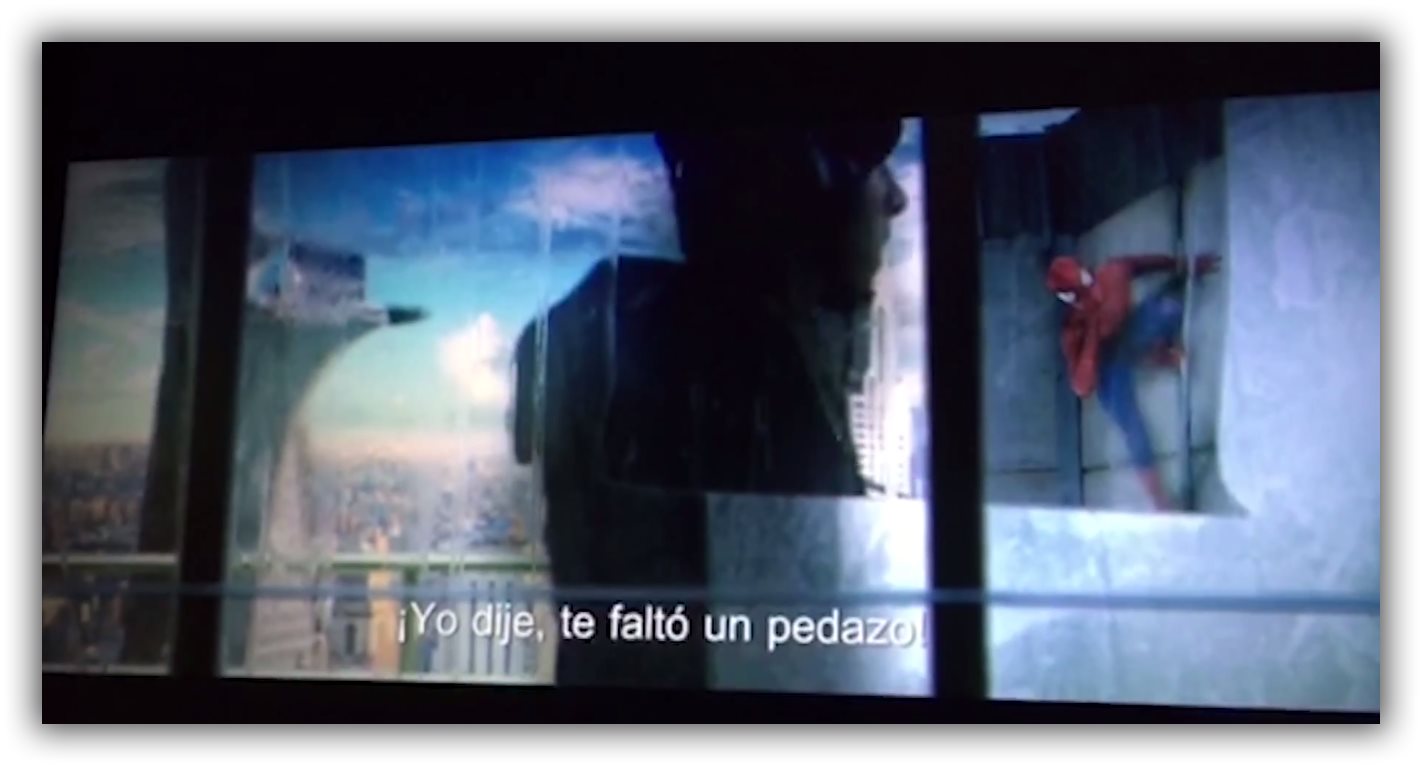
There was even evidence to support a cameo from your friendly neighborhood wallcrawler... but sadly, this video has been exposed as a skilled fake.
There was even evidence to support a cameo from your friendly neighborhood wall-crawler… but sadly, this video has been exposed as a skilled fake.

I just named enough random names in a row to sound like part of the book of Genesis.

For those wondering, the film has a running time of 141 minutes, or two hours and twenty-one minutes, which is not that long. To give a comparison, if I may; The Hobbit: the Desolation of Smaug ran 161 minutes… and that did not even contain the whole story of a children’s book. Damn.

And it works, that is the single most impressive thing I can say about Avengers: Age of Ultron. It does not always work well – indeed there are several sequences where the mass of the movie appears poised to explode out and bury the plot – but this never happens. In part because Whedon stuck again to basics (like he did in the first movie).

A major flaw in film stories today is that they fail to cram too much complexity into their two and a half hour run time. Whedon wisely sticks to doing this model well.
A story has a simple bone structure and Whedon is skilled at sticking to – and knowing when to pad – this frame.

Ultron is a simple villain, but still well done. His plan is not complicated, his emotions are not buried under layers of psychosis. He is a refreshingly human robot with a simple dream… a dream of killing all humans. The voice work of the wickedly talented James Spader helps bring the character to life, as well as a beautifully tragic birth sequence.

A simple main conflict allows Whedon time to work with his characters – and work he does. Rising tension between Captain America (Chris Evans) and Tony Stark (Robert Downey Jr.), fluttering eyelashes between Bruce Banner (Mark Ruffalo) and Black Widow (Scarlett Johansson), Thor (Chris Hemsworth) questioning his purpose and his actions, and arguably the best scenes of all saved for Hawkeye (Jeremy Renner) – and a path from villain to hero for Quicksilver (Aaron Taylor-Johnson) and Scarlet Witch (Elizabeth Olsen). Samuel L. Jackson‘s Nick Fury is the only returning star who feels a little left out in the cold.

Hawkeye may be lacking in cool powers, but Whedon knows the character well enough to bring out exactly why he is a member of the team.

Of course… this is a summer movie – and that means action. Those looking for it will get their fill. A castle raid, an oil tanker brawl, Hulk vs. Hulk Buster, Avengers vs. Ultron: the movie brings it all in spades. By the end, one might even be a little sick of slow motion sequences of our heroes beating up on robots… but one can also get sick from eating too much ice cream.

In terms of spectacle, it does not disappoint.

Joss Whedon has done the near impossible, wrestling this much comic book into one movie. Time will tell exactly how much of his background as a comic book writer and official super geek helped him achieve this – or whether others who don’t share this background can do the same (Marvel is certainly hoping they can). Whedon’s familiarity with the characters and source material has clearly helped him to do more with less in his past two mega superhero mash-ups.

It is simply too bad that he will not be returning for the sequels. Time will see if the Avengers can triumph without their real leader.

Hey Disney, why were your Female Villains so much more Emotive than your Heroines?

Let me say this right up front: I am not accusing Walt Disney Animation of being sexist in the present day, not with this article at least. Instead, let us look to that happy period of between 1937-1959. Here it was possible to do a story like Cinderella, a tale of a woman being abused and denied any real right to exist until she marries a man, and people’s only reaction was “that’s outrageous! Mice can’t talk!”

Thankfully times have changed.

This article is going to examine an interesting discrepancy I noticed when re-watching these films (namely Snow White and the Seven Dwarves, Cinderella, Alice in Wonderland, Peter Pan, and Sleeping Beauty). All of these films feature female characters in multiple roles. Specifically, in each film there is a positive woman character and a negative one. I’m stretching a bit for Tinkerbell but there you go. Let’s look at the levels of animation involved bringing their expressions to life, shall we?

Snow White and the Seven Dwarves

The first, the very first animated film done by Walt Disney and company: way back in 1937. For this film, there was no precedent, no manner to be like “just animate it like we did the one before.” So, they experimented, using a technique called rotoscoping for some of the animation. For those out there who don’t know, rotoscoping is essentially tracing the animation over preexisting live action footage. Specifically animator Grim Natwick used this technique for certain scenes involving Snow White. That helps explain how images like this exist:

Rotoscoping was called painting on film. It certainly leaves that effect.

It is worth noting that Natwick made his claim to fame by animating Betty Boop. So really, anyone who looks back at Snow White being like, “hmmm she seems kinda doe-eyed”

You don't say?
You don’t say?

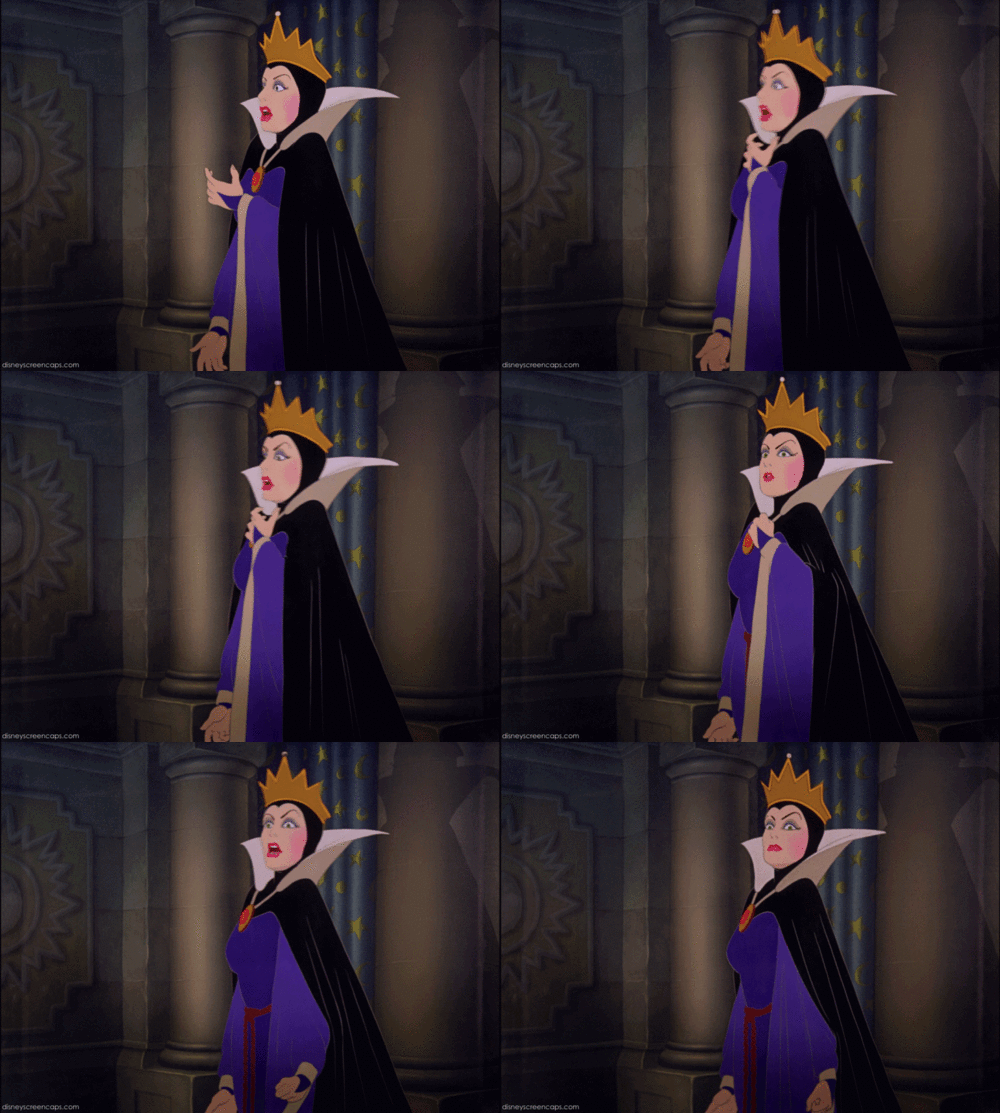
Anyway, it is worth noting that his style of animation was not used for every character. Art Babbit was the man placed in charge of animating the Evil Queen. (also known as Grimhilde). Let’s see how successful his animation was at bringing a character to life:

A simple animation but it proves a point. Grimhilde (in both her forms) offers much more in the way of emotion than does Snow White. This could be chalked up to the restrictive use of rotoscoping (a process that is only restrictive in price) but… let’s look elsewhere.

Cinderella

Fast-forward to 1950 and times have changed. Walt Disney Animation was no longer a brand new company new to the art of animation. No doubt the characters benefited greatly from this increased knowledge and experience. Let’s look at the titular character:

Okay this must be happy.

Cool, one emotion down, what else she got?

Good, surpise! What else?

Surely there are many other forms of emotion she includes. After all, she is the main character of the movie. Surely those aren’t the two primary… oh they are?

The weird combo of the two.

Cinderella does not do much besides smile and look pretty in her film. It took two people (Marc Davis and Eric Larson) to animate and… yeah, she smiles or cries – really only crying in one scene. It is worth pointing out that Davis also was involved in animating Snow White, another character who… smiled and cried a lot. Well, okay Frank Thomas had Lady Tremaine (the evil stepmother), let’s see what he did:

Disgust.
Disgust.
Shock.
Shock.
Incredible smugness.

Starting to see what I’m driving at? Disney had their villains showing off a lot wider range of emotions. Cinderella is the good guy, so she never looks mischievous. Why is it that Lady Tremaine gets to showcase more emotion? Let’s look at one more. I know I mentioned five movies in the beginning but the repetitiveness of this is getting to me. Plus it’s my blog so I can do what I want.

Sleeping Beauty

Nine years after Cinderella, and of course I have to mention this one. SPOILERS! Here is the face that Princess Aurora makes throughout most of the movie:

You thought I was going to show her sleeping, didn't you?
You thought I was going to show her sleeping, didn’t you?

Yes, when she isn’t in a magically induced coma, Aurora is wearing a smile across her lips. Literally, it is the first and only emotion she forms after waking up. Someone needed to tell Marc Davis (who else) that “good” women did occasionally make different expressions. They enjoy the same freedom as their “evil” counterparts.

Case in point.

Of course, what I’m ultimately trying to say is nothing new. I don’t think any of the animators I just mentioned were outright openly sexist, but this was the norm of the day. Again, thankfully times have changed. It is very interesting to note that Ariel was the first (grown) female protagonist in a Disney animated film to really break this mold. That is kinda sad for two reasons. One: that film was released in 1989. Two: have you really examined the plot and lessons that movie is teaching? Oh well, at least it was better from an animation standpoint. Since then, Disney hasn’t been doing many films that feature both a female protagonist and villain, so it is tough to say.

The most recent attempt at this was Frozen, and script changes stopped Elsa from being the bad guy. Instead audiences were treated to this.

Yay progress!