Marketing Method: "Based on a True Story"

As audiences, we see these words a lot. Recently, I was at the cinema seeing The Imitation Game and these were the first words to greet me on the screen. It gave everything in the film a sense of gravity and added weight. I was not watching fanciful creations but someone’s actual life, dramatized because of its significance… or so I thought. Afterwards, I immediately inquired further into the validity of The Imitation Game‘s information. There were inconsistencies to say the least. This is not to say anything negative against the movie as a film, or to single it out as the only culprit when it comes to twisting reality. This happens a lot. Books, movies, even video games all love to use the tagline: based on a true story. Well cool – what’s it mean?
Very little.

For those who do not know, Fatal Frame is a game where you take pictures of ghosts with a camera... yeah, cause that totally happens.
For those who do not know, Fatal Frame is a game where you take pictures of ghosts with a camera… yeah, cause that totally happens.

After some digging, I was able to find a legal definition in regards to the phrases “based on a true story” and “inspired by a true story.” Keep in mind, this is in regards to literature (although safe bet that similar stature exists for the other media types):

No difference of any legal consequence between ‘based on’ and ‘inspired by.’ Each of them suggests that there is a core of truth to the story but that you are embellishing or going beyond the factual record. This is something we call ‘faction,’ a conflation of fact and fiction and it can under some circumstances give rise to libel claims, but not if the story is about animals.

“A core of truth” does not go far to keep a story grounded in reality. Essentially, what that means is that one significant aspect of the story must be true. If one is making a film about a real life killer for instance – a killer will be in the movie. Does the movie killer have to be related to the actual killer? Look no further than Ed Gein vs. Leatherface for the answer to that one.

As the definition suggests, legal trouble can also arise from uses of the term. Families and living relatives often take issue with film portrayals of their ancestors (let’s use The Imitation Game again as an example). In the case of the atrocious film, The Fourth Kindmany newspapers and an entire city were angered over the film’s liberal use of “based on a true story.” Argo might hold some kind of record since it angered the majority of Canada by downplaying the country’s role in the “true” events depicted on-screen.
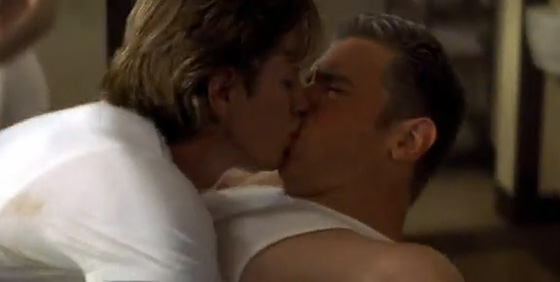
Remember that gay player from Remember the Titans? Not gay at all in real life. How would you feel about seeing an onscreen representation of yourself with a different sexuality?
Remember that gay player from Remember the Titans? Never happened in real life. How would you feel about seeing an onscreen representation of yourself with a different sexuality?

So, with all the trouble that can come of “based on a true story,” why do they use it?

Because we love it.

In many cases, this phrase appears associated with either drama or horror, leveraging that all important aspect of audience relatability. What could be scarier or more moving than something that actually happened? The chills of a “real-life” psychopath will get the adrenaline flowing better than any fictional boogeyman. Anyone experiencing either the rush or low of a relationship will take solace in knowing there are other people out there who went through similar situations.

The use of real life characters adds more weight to certain genres of storytelling.

Is it real… well does it need to be? “Based on a true story” is used to heighten emotional reaction. The upside is, this technique clearly works as more and more films adapt it into their hits. The (potential) downside: some people actually believe it while it further increases the cynicism of others.

The Internet: proof that some people will believe anything.

So who is responsible? While some blame Hollywood and publishers for their overzealous use of phrase, I believe that it is the audience’s responsibility to be informed. It is a lazy mind that takes everything it sees or reads at face value. That is not to say that they have the right to lie or slander individuals at will. Let’s keep those laws we have working for us.

If anything, “based on a true story” should be taken as an invitation to do some research. Heck, if you already thought the subject was interesting, why not look into it a little more?

Truth is Scarier than Fiction: The Town that Dreaded Sundown (1976)

Based on a true story.

These words usually mean the following: “Something sort of similar happened, but with a lot less spectacle.” It is the nature of Hollywood to be larger-than-life. Blockbusters would have no appeal if everyone wasn’t itching to see something so awesome in scope that it could not possibly be real. Ideas are escalated and exaggerated, all with the aim of creating a sensation. With the genre of horror, a terrible event is usually twisted away from reality to allow the audience more detached enjoyment. For example, Ed Gein was a terrifying person but nowhere near the hulking brutal monster, Leatherface, that he inspired. He only killed two people (we think), not the thirty that Leatherface hunted down. Make it bigger – that seems to be the Hollywood model of thinking.

And then there is The Town that Dreaded Sundown.

Released in 1976, this film is a rare pre-slasher (a film that features a serial killer as a main character but predates Halloween). The film was inspired by the real life “phantom killer,” a man credited with killing five people in Texarkana in 1946. Reading the description, one would think this is where the original design for Jason Voorhees emerged. The idea of this actually happening is terrifying – the fact that it did is horrible. And yet, in the strangest move ever, the Hollywood film downplayed how nightmarish the event actually was.

While he may look like the stuff of fiction, the phantom killer's depiction is true to witness accounts.
While he may look like the stuff of fiction, the phantom killer’s depiction is true to witness accounts.

The movie follows two police officers, Norman Ramsey (Andrew Prine) and J.D. Morales (Ben Johnson) as they attempt to hunt down and catch the phantom killer. The audience is first introduced to Ramsey, as he tracks and nearly catches the killer after his first two victims. The event is depicted as a hot pursuit, with the killer just barely evading capture.

… Only that didn’t happen.

The couple who were the first victims weren’t found right away. The killer was able to commit the heinous deed and escape before any police were aware of his crime. One could make the argument that the change was made to add action to the film – to give audiences the thrill of almost catching the killer, and then allowing them to feel sympathy for the heroic Ramsey. Likely this change was done to elevate the heroism of the authorities, but it is strange to see a horror movie making an event less scary, especially when it is “based on a true story.”

Most of the film’s major changes echo this effect. The killer is reduced to a being who appears to have simply gotten lucky in evading capture, while the police’s effectiveness is greatly exaggerated. This is one of the few times (that I am aware of) where Hollywood horror shied away from the terrible truth. The reality was that the phantom killer never came close to being caught. One, or possibly multiple, psychopaths held an entire town in the grip of fear for months… then vanished.

The film ends with the police shooting the phantom killer in the leg. In real life, no such confrontation ever took place.

There is one historical inaccuracy that is much more in line with typical Hollywood: timing. The murders are placed much closer together to help elevate the panic of the town and presumably create more atmosphere in the film. In reality, the murders were farther apart and not connected by a neat timed-sequence. It is strange that the filmmakers were okay with this change to ratchet up the horror, while at the same time downplays the hopelessness and lack of control present in the real events.

The movie also exaggerates in the brutality of the murders. Most victims were simply shot.

Real life does not always have the good guys or the laughs of the movies. Sometimes terrible events simply happen. It appears that director Charles B. Pierce wanted to show some respect for the past. He created heroes, falsified hope, and ended his film on a nonexistent victory.  History-based horror films usually commit the opposite changes. Was this a film with a conscience? Did Pierce have reservations of filming crimes that had only happened thirty years prior? Evidently, he was not conflicted enough to shy away completely from the material. Regardless of quality or intention, The Town That Dreaded Sundown was made unique by its adaptation. The film’s marketing, however, was much more in line with typical standards… and perhaps a little tasteless.

Still lurking? Really?
Still lurking? Really? The poster does more to inspire hopelessness than the entire movie. Yet perhaps it also crosses a line – after all, many of the survivors were still alive when this movie was released. I can’t imagine they appreciated the tagline.

Who knows what direction the remake will take.