Writer's Workshop – Star Wars: the Clone Wars

Right off the bat: I’m talking about the TV series (2008-2014), not the movie. The series is worth at least one post. The movie… we might get to that another time.

Star Wars: the Clone Wars is a fascinating and unique series. For one, it is the second animated Star Wars television series to chronicle the Clone Wars (the first can be found here, in all its glory). Arguably, this second series is far worse than the original, in terms of vision and storytelling ability. Yet it is that storytelling ability that I feel makes the Clone Wars into an interesting show. Is this the best series I’ve ever watched? Not by a long shot. That said, it is enjoyable and worth watching if you’re bored or one of those few Star Wars fans out there still brave enough to care.

What makes Star Wars: the Clone Wars interesting is its scripts. Some are pretty great (Rookies), some are terrible (Bombad Jedi) and others are a mixed bag (Cat and Mouse). Let’s talk about “Cat and Mouse” a bit more. This episode is at a level that many are in the series. Parts of it are well written. The episode introduces compelling characters, an interesting plot, and a cool action set piece. One of the best parts: Admiral Trench, this fetching fellow below.
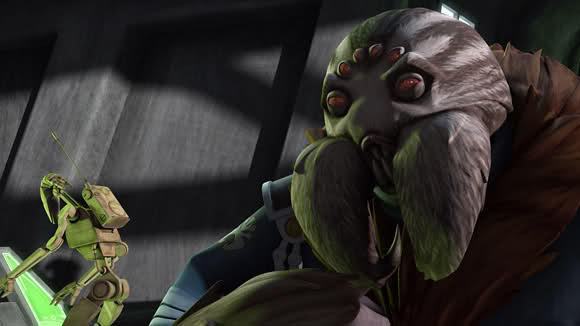
The Separatist Army: where even spiders can become generals.

Yes, his look in a little too evocative of a certain local life form for my taste. Nevertheless, Admiral Trench is charismatic and provides and entertaining shift from General Grievous and Count Dooku (two villains who the audience know must survive the series). Yet just as the writing does something right (although credit must also be given to Dee Bradley Baker, who provided the voice) in creating Trench, it falls short in describing him. There is a scene with Republic General Wullf Yularen and Anakin Skywalker where the two discuss the evil admiral. This scene is designed to inform the audience just how dangerous Trench is. Unfortunately the dialogue isn’t great. I don’t remember the exact lines but, if you have time to watch the episode, General Yularen essentially informs Anakin that Trench beat him in the past by… beating him in the past. Trench is supposed to be a tactical genius but his tactics are never revealed. This could be due to a lack of time in the episode, or it could be that the writers didn’t feel familiar enough with military tactics to write about them, and assumed that what they had was good enough.

Equivalent: clone troopers are great soldiers. They are so skilled because they are the best soldiers in the galaxy. How did that explanation work for ya?
Equivalent: clone troopers are great soldiers. They are so skilled because they are the best soldiers in the galaxy.
How did that explanation work for ya?

When writing: research is everything. To draw an example, I highly doubt that Timothy Zahn is a military genuis but he was able to write Grand Admiral Thrawn as one (seriously, if you haven’t read those books – do yourself a favor, the are the second best thing to come from Star Wars). In addition, the episode also creates arbitrary drama between Anakin and Obi-Wan (they’re arguing about… something, I guess it’s to spice up the plot) and undoes its greatest accomplishment in its finale.

Yeah, Trench dies… or does he?!

No, no he does not.
No, no he does not.

There are a lot of episodes like this in Star Wars: the Clone Wars. As a writer, I find it fun to watch them. Many series out there reflect either superb or non-existent writing, it is interesting to find one in the middle. This allows the audience to learn: both from what is done right and what could be improved. I’m not saying to go out and write Star Wars fan-fiction in an attempt to improve the show. Just keep in mind what works and what doesn’t. This is a great show for writers, especially writers who happen to be Star Wars fans.

The Wisdom to be Learned from Uncle Iroh (Avatar: the Last Airbender)

There is question to ask at the beginning of this that I feel is legitimate: can one learn anything from fiction? Fiction, by its definition, is not real, ergo how could it apply to real life? Short answer: yes. There is a whole article that I could write on the history of storytelling and the evolution of the fable… but that’s not the point of this article. To paraphrase a line from Tropic Thunder (I’m so cool, I know): “just because it’s made up doesn’t make it not true.”

With that in mind, let’s turn to Avatar: the Last Airbender. I could (and maybe will) write an article on every main character from this show, but let us instead just focus on Iroh (more commonly known as Uncle Iroh). First, a quick rundown of what Avatar: the Last Airbender is about – an ancient world (Eastern themed) where people control, and fight with, the elements. Iroh hails from the Fire Nation (the antagonists of the series). Despite this origin, he is not a bad guy, in truth he is the morale heart of the show. Iroh is the oldest main character that the audience follows. He was a general of the Fire Nation but retired after the loss of his son (killed in action). Iroh is the uncle of Zuko (the series’ first antagonist), hence the “uncle” association. How could a guy on the “evil side” be so good? Let’s discuss his character.

Iroh is like a father to Zuko. Zuko is actually the prince of his nation, but was banished (and scarred) for speaking out against his father. Zuko’s father… kind of a dick. Anyway, Iroh is Zuko’s role model, although it is against Zuko’s wishes. At the start of the series, the Fire Nation Prince reflects the spoiled nature of a teenager, and fluctuates between listening to and rebelling against his uncle’s advice.

Here is where the strength of Iroh’s character starts, with what might be his greatest virtue: his patience. Iroh does not have it easy in this show. In short: there is no one who treats him worse than Zuko. Hold on, you say, isn’t Iroh supposed to be a father to the prince? He is, but Zuko, as a character, is very confused (only slightly more decisive than Hamlet). Zuko is from a screwed up family. His sister is psychotic and so is his father. His mother… is gone. That leaves Iroh, and Iroh knows and, more importantly, understands the implications of this.

Iroh is an excellent role model because the writing for the show allows for real world situations to take place. In his relationship with Zuko, there are few moments where the prince acknowledges what an incredible influence his uncle is being. More than that, most of Iroh’s misfortune comes from Zuko’s actions. Yet Iroh is there for him, no matter what. It is the importance of family and of being there for the people who matter.

Iroh can be interpreted as many things. He is a man who sees beauty in the simplest aspects of life (especially tea). He is a man who values his family. He is a man with conscious who understands the weight of his actions. He is a father who lost his son. The audience never knows anything about Iroh’s wife (kinda strange now that I think about it) but when one understands that he lost his child: Iroh’s motivations become clearer and take on a more tragic light.

In watching the show, Iroh is a great man, but what makes him believable is his journey. He didn’t start out as a mystical Buddha with life figured out. He was broken, he lost the thing that mattered most to him, and it defined him. The good news, and I believe the lesson, of this is that Iroh had it define him in the best way. He could have been bitter and angry but he instead chose to live the remainder of his life to the fullest, in an attempt to avoid the mistakes and regrets from his earlier life.

I love Avatar: the Last Airbender because it is an excellent, albeit fantastical, look at humanity. Every character in that show is worth watching, but if one wishes to see the wonder and love in all things: look no further than Uncle Iroh (plus herbal teas are amazing, just saying).

Quote from the show. Corny words can still be true words.

It's Actually Better the Second Time Around: Korra and Mako

Like many people out there, I am a huge fan of the Avatar: the Last Airbender animated series. Also like many people, I was really excited when the creator’s of said show announced their new, sequel project, The Legend of Korra. However, you may remember in another article that I wrote, that I expressed my feelings on some rather serious concerns with this new series. Much of the great character writing that had highlighted the first show was missing and The Legend of Korra suffered quite a few problems that held it back from being anything close to great, at least in taking the first season by itself.

And then there's these two.
And then there’s these two.

One of my chief problems was the relationship between protagonist, Korra and non-existent character, Mako. I’ll try not to repeat myself too much here: I simply never felt the relationship worked. Mainly because Korra (being hot-headed, quick-tempered, loves-to-argue) did not make sense to match up with Mako (more serious, level-headed, dumps-his-first-girlfriend-as-soon-as-she’s-poor… didn’t-really-have-much-character-beyond-that). Yes, you could understand an initial attraction, but a long term relationship seemed a more outlandish idea than bending the elements.

Part of what makes this season an improvement is that they begin to define the character of Mako and give him some much needed personality.

So let’s get into season two, set a full six months after season one and Korra and Mako are still together… somehow. The audience gets the sense that not much conflict has happened in this time, which makes the idea of the two of them surviving together more believable. The peace is not long to last though as wild spirits show up and tensions arise between Korra and the two parental male figures in her life: Tenzin (her mentor) and Tonraq (her father).

In comes Mako to diffuse the situation… with expected results. Korra explodes at him and the two get into a heated argument, every time. Mako even admits that he doesn’t feel comfortable expressing himself around Korra, asking essentially if she would to hear his opinion or simply something she would agree with. The signs are there that the relationship is not in paradise but… it keeps going.

This is the common pose of the season for Korra and Mako.

Meanwhile Bolin has entered into a relationship with Eska, Korra’s cousin from the Northern Water Tribe. Eska is very obviously manipulative, controlling, and all-around crazy so Bolin naturally seeks advice on how to end the relationship. He goes to his older brother and the two have a conversation that is one of the smarter scenes in the entire season. Mako advises Bolin to simply break off, that dragging out a bad relationship is like allowing a leech to hang onto skin. Great advice but the audience wonders if Mako should be listening to himself talk.

Poor relationships are actually a common theme in the season as it is revealed that Aang did not have the best relationship with his children.

Here is where the great realistic writing reenters the series. Mako is communicating thoughts that he is already subconsciously feeling but having trouble expressing directly: his brother’s crappy relationship echoes his own but is not his, so he can see it clearer and be more objective.

It’s not hard to see where this is going: eventually Korra and Mako get into a serious fight and Mako announces that he is finished. Korra goes off and does some Avatar stuff (losing a chunk of her memory in the process… boy I hope that doesn’t arbitrarily create drama later) and Mako rekindles his relationship with Asami. Why Asami is so quick to take him back is beyond me but at least the two of them have some chemistry together.

The final argument that breaks up Korra and Mako. Told you it was a common pose.

But anyway, remember how I mentioned that Korra lost a bit of her memory? Guess which part exactly. So Korra comes back, thinking everything’s fine and Mako… rekindles that relationship as well, dramatically hurting Asami in the process.

Asami looking both hurt and angry at Mako's inability to be mature and decide his relationships.
Asami looking both hurt and angry at Mako’s inability to be mature and decide his relationships.

I know I prefaced this as “arbitrary drama” but I actually think that the writing staff deserves a lot of credit for accurately portraying bad relationships: sometimes they’re hard to get out of. Mako dodges the harder conflict in favor of an easier one but just ends up creating more problems for himself.

Korra, of course, regains her full memory at the end of season two and confronts Mako about the break up. Here is the first moment where Korra genuinely becomes the strong character she has been purported to be all series. She is the one to directly come out and state that they, despite loving each other, do not work as a couple and that they are romantically done.

“I think we both know that this… us… doesn’t work” – Korra “You’re right. I’ll always love you, Korra.” – Mako “And I’ll always love you.” – Korra

This is a powerful moment that shows how much Korra has evolved since the start of the series. She has matured and is learning to calm her temper, while also learning to trust her instincts as a person and not just as the Avatar. Mako, by contrast, is revealed as the less mature of the two: someone who still needs to learn how to be more direct with his feelings and take more responsibility for his actions.

Again, I cannot praise the romantic writing (at least in regards to Korra and Mako) enough this season. First and foremost: this is a show intended for all audiences and Korra is a wonderful role model this season. Too often media (television shows and movies in particular) goes only the dramatic route of ending relationships – just look at Disney’s Frozen for an example of that. The Legend of Korra takes the more complex approach: the idea that two people can love each other but not be right for one another. Korra and Mako are not done as friends and they are not done in each others lives.

There was no drama, no unnecessary turn of character traits. No one became evil. The Legend of Korra has started writing its characters as people, and that bodes really well for the remaining three seasons.

Also they brought back Uncle Iroh, that's just awesome.
Also they brought back Uncle Iroh, that’s just awesome.