Reaching for the Stars: an Interstellar Review

Christopher Nolan has long been in the upper echelon of film directors working today. He has built a reputation by adding just a little more to already established formulas. The Dark Knight Trilogy, for example, had layers of political subtext that most other superhero movies (Captain America: the Winter Soldier being the only exception) never even hint at. Inception was a heist movie dealing with the complexities of the human psyche. In the past, Christopher Nolan has been expertly walking the beaten path. Interstellar marks the director’s first departure from traditional Hollywood storytelling. Ambitious and bold, the film often soars nearly as much as its subject matter – yet like any first flight, it is far from perfect.

The visuals of Interstellar make it a movie made for cinema. This also marks the first major 4K release brought to theaters.

Interstellar opens in the not-too-distant future. Mankind stands on the brink of extinction as we have exhausted our food sources and are unable to save a planet that is clearly dying. How and why we are unable to beat a crop blight is never really addressed (Nolan does not want to directly address climate change, it seems). As humanity prepares for its final generations, Cooper (Matthew McConaughey) and his family receive mysterious messages compelling them to find the remnants of NASA, the organization which presents the last and best hope for humanity’s future.

Seems a wormhole has been opened in our solar system, a gateway to another galaxy where humanity might be saved. McConaughey, along with a team of scientists (notably Anne Hathaway and a Bill Irwin voiced robot named TARS) must journey through the wormhole to save mankind’s future… at expense of their own. This theme is where Interstellar shines brightest.
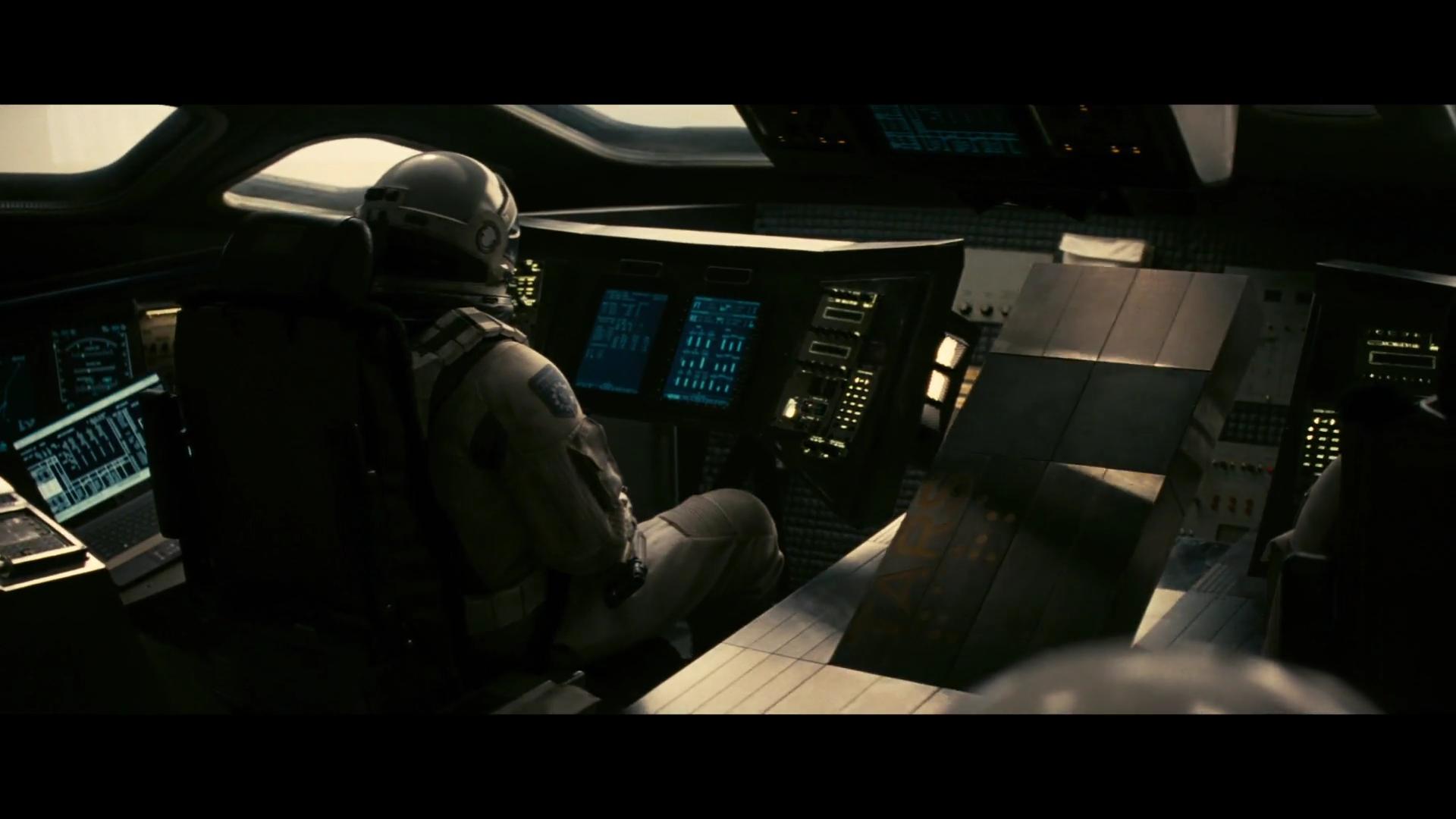
The realism of TARS' design coupled with the talent of Irwin's acting creates a being that is surprisingly human.
The realism of TARS’ design coupled with the talent of Irwin’s acting creates a being that is surprisingly human.

Christopher and Jonathan Nolan‘s script highlights both sides of the nature of humanity. The instincts for self-preservation, parental protection, and love are addressed well within the script and reflected by a cast of characters who each represent different points of these ideas on the same scale. The story of fathers (McConaughey and Michael Caine) doing whatever it takes to save their children (Jessica Chastain, Casey Affleck, and Hathaway) adds the relatable drama that propels the movie through the innermost depths of the science fiction drama.

Make no mistake, this is not a film that is science fiction in setting only. As Nolan intrigues the audience with his characters, he takes them to worlds and introduces theories most commonly left out of mainstream cinema. Don’t know anything about relativity? Well, prepare to get a lesson as this film is all about how time is anything but a constant. Refreshingly, the science seems solid. The audience believes that both Nolan brothers researched every idea of the film thoroughly in order to keep it grounded.
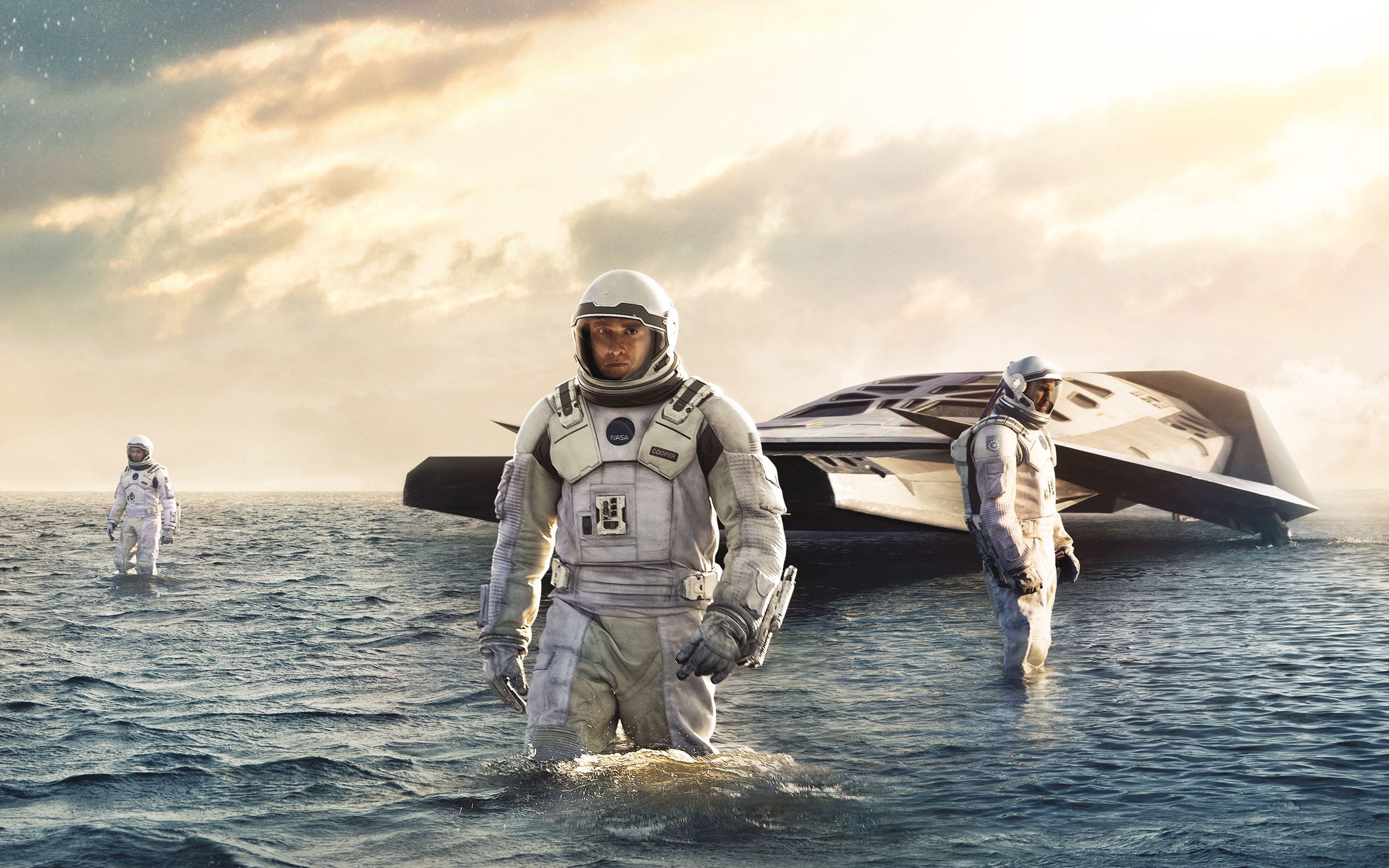
The planets in the movie seem too terrifyingly real to be fantastical.

Yet for the praise, there are criticisms. This is a film about reaching, and that is what the audience is sometimes asked to do. Not every logical turn falls perfectly into place. This is especially true at the movie’s climax where the audience is asked to take a serious leap of faith to help reconcile the plot. These jumps are not commonly found in Nolan brothers’ scripts. Likewise, this is the first Christopher Nolan film I personally have ever seen where I have questioned whether a cast member (click for spoilers) really added  anything to the plot.

Long a pioneer in visual storytelling, Christopher Nolan has managed to create an incredbly reflective and thought-provoking piece of cinema. Time will be needed to fully judge just how much of a success or failure Interstellar is.
Long a pioneer in visual storytelling, Christopher Nolan has managed to create an incredibly reflective and thought-provoking piece of cinema. Time will be needed to fully judge just how much of a success or failure Interstellar is.

Those expecting a perfect movie will walk away disappointed. This is not Christopher Nolan’s best film. That said, this is the type of movie more A-list directors should be making. Interstellar grows Nolan as a director by taking him outside his recent action blockbuster zone and allowing him to make a movie that is both very large and small at the same time. In a year of formulaic films, it is pleasing to see someone taking risks. Interstellar is a film that shot for the moon and missed, but that’s okay since it landed among the stars.



Defining Slasher or Five Films You Did Not Know Were Slashers

Before getting into this article, one definition must be clarified. Specifically: what is a “slasher” movie? What are the criteria, what makes them different from regular horror films? There are variations on the definition. This is the Wikipedia definition:

“A slasher film is a subgenre of thriller and horror film, typically involving a psychopathic killer stalking and murdering a sequence of victims in a graphically violent manner, often with a bladed tool such as a knife, machete, axe, scythe, or chainsaw.”

It is not a terrible definition, but personally I do not feel it covers the entire genre. Here is another from Urban Dictionary:

“A horror movie usually with one central homicidal maniac who usually uses cutlery to systematically slaughter his victims.”

Closer but I am still not on board with it. I guess my complaints at “slasher” definition come from the fact that the poor movies seem to have defined the genre. Critic Roger Ebert used to refer to slasher films as simply “dead teenager movies.” However, I feel to let the low-quality define is to do a disservice to the genre. It would be akin to defining dramatic films as “movies featuring multiple emotional breakthroughs, often done in an over-the-top, cathartic manner.” Are there more bad slasher films than good: absolutely. The ratio is probably similar to the amount of Spartans vs. Persians at the battle of Thermopylae. Still, let’s expand this definition a little.

In my mind, I have never considered the choice of weapon relevant to the “slasher” definition. “Slashing” simply refers to the high body count these movies typically have. This does not mean that many people have to die, just that a high portion of the cast is no longer present by film’s end – due solely to the actions of that film’s “slasher.” Hmm, actually – all this use of the word slasher is getting confusing. Maybe there is a better way to explain my point. Below are five films I feel are slashers – which are left off using the standard definition.

5. Predator

There ain’t no teenagers in this movie. Released in 1987, Predator stars Arnold Schwarzenegger and follows the struggle of a team of special forces against an alien with super-powered technology. This alien stalks the team one-by-one as they try to make their way through a savage and isolated jungle. There is no sex, no real drug use beyond tobacco, and no nudity to speak of. Yet, boiled down: Predator is a killer hunting people in the forest. It is not a stretch to label this film a slasher, even if it is in the realm of science fiction.

Oh look at that, he's even wearing a mask!
Oh look at that, he’s even wearing a mask!

4. The Terminator

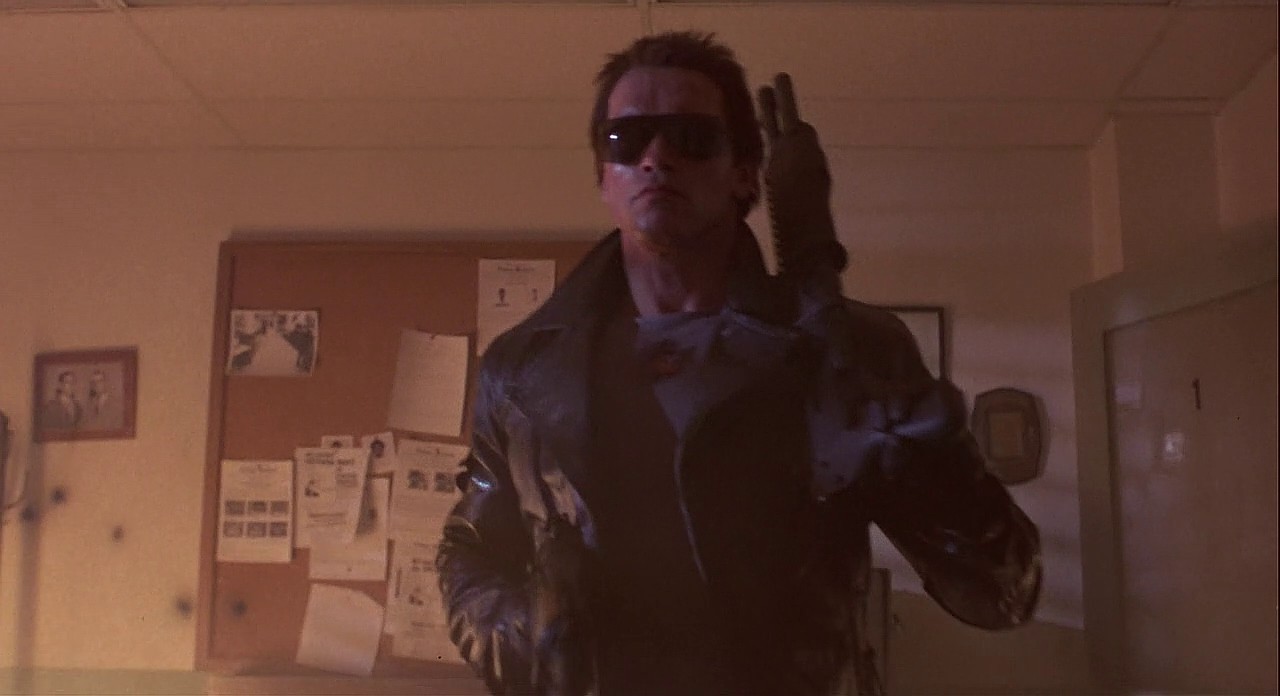
More Schwarzenegger, only this time he is the unstoppable superhuman killer. Arnold plays the terminator – a robot sent back in time to kill a young woman. The Terminator is perhaps the best example of a slasher movie embracing the “indestructible” nature of the killer. In the more traditional slasher films, the police are always seen as a source of safety. Once they arrive, it is all over. Later slasher movies would shatter this illusion of strength but none so effectively as The Terminator.

This is the most famous example of a killer walking into a police station and just demolishing it.

He does not ever use a knife, yet that metallic arm that reaches for Linda Hamilton‘s character at the end can be seen as an equivalent weapon, at least in terms of its threatening presence.

3. Alien

Well, if Predator was a slasher…

I have actually already talked about this movie at length in an article I wrote some time ago. To recap: Alien uses the isolation of space to put a superhuman antagonist against a group of unsuspecting people. Notice that this ‘superhuman’ nature of the killer is a definite recurring theme in all of these movies, as is the setting’s feeling of isolation.

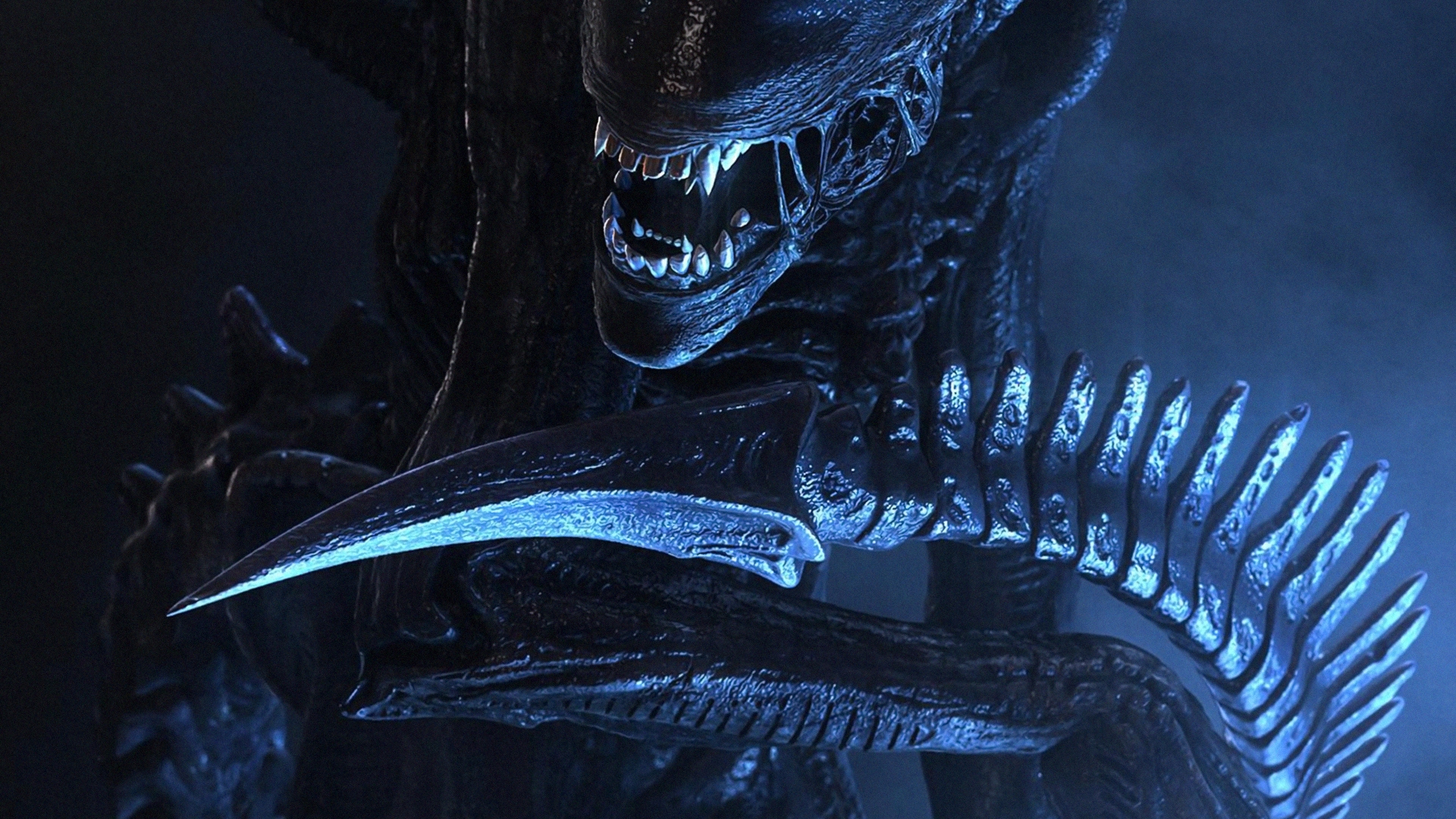
The scorpion-like tail can be seen as the alien's slasher weapon.
The scorpion-like tail can be seen as the alien’s slasher weapon.

2. JAWS

Made in 1975, Jaws predates Halloween by three years. The plot of Jaws is simple: a shark terrorizes an island and the local authorities have to respond. Yet it does appear to be a regular shark, made superhuman only by the fact that it is a great white in water. The true superhuman element comes from Spielberg’s directing. The shark is presented as both an animal and a thinking opponent. There is an intelligence to it that emerges in the second half of the film. The shark may not have a ton of actual screen time, but John Williams’ score makes it a presence throughout the movie. This is no simply shark, it is a slasher.

He's either very smart or very dumb.
He’s either very smart or very dumb.

1. Willy Wonka and the Chocolate Factory

So odds are, this is the one you’ve been waiting to read about. How could Willy Wonka and the Chocolate Factory be a slasher? It’s a family film, with wonderful heart-warming sequences like:

Yeah, this movie is terrifying. Willy Wonka is a superhuman individual who picks children off in his chocolate factory. The kids vanish, never to be seen again. Sure, Wonka says they are all right (and they probably are) but it does not matter. For all intents and purposes, he is murdering those kids in really over-the-top style. Willy Wonka is never clearly described as a good guy and actually, plot-wise, he functions as an antagonist of the film. Charlie must survive his challenges and pass his test.

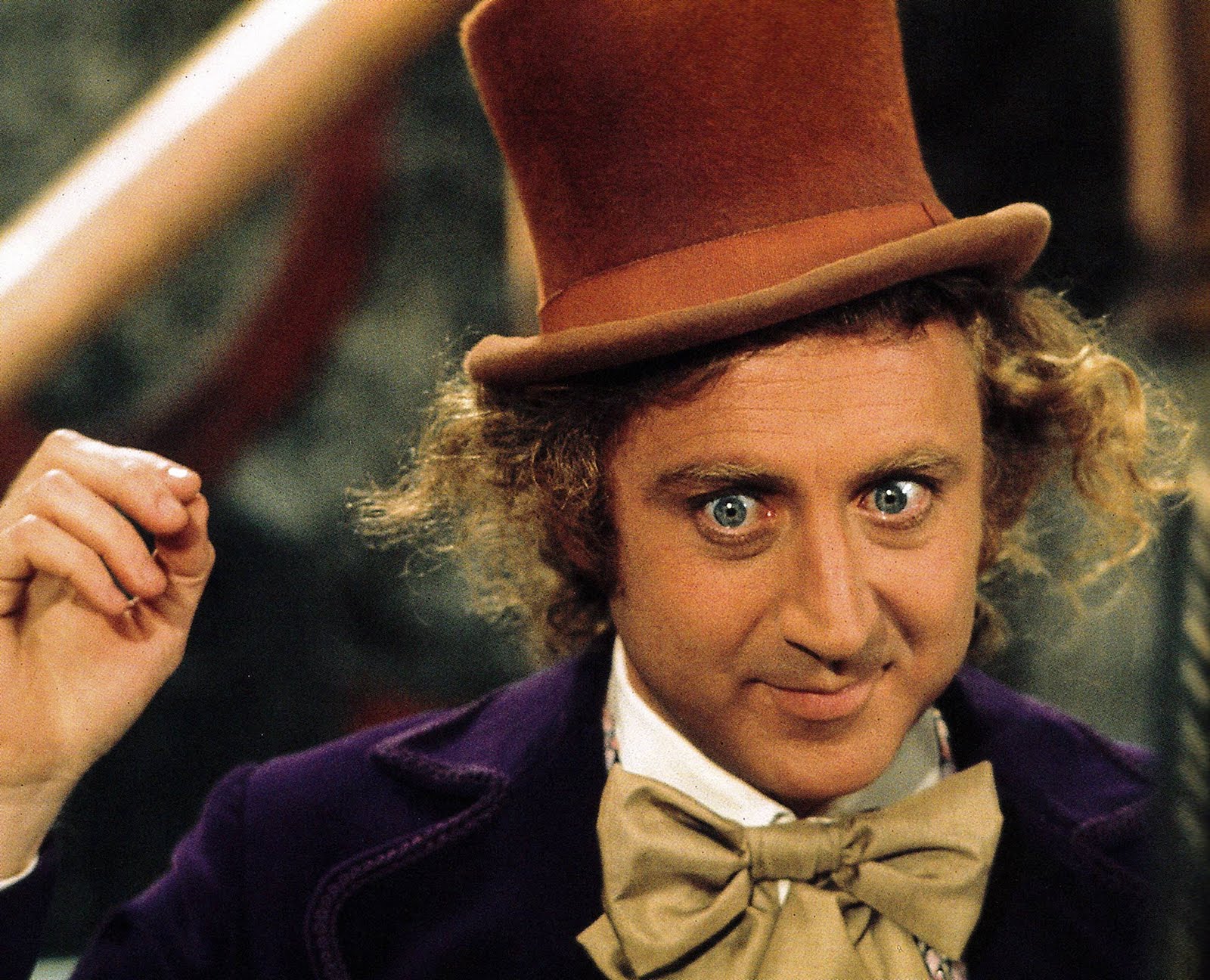
"I knew that from then on the audience wouldn't know if I was lying or telling the truth," - Gene Wilder on Willy Wonka's old and feeble introduction
I knew that from then on the audience wouldn’t know if I was lying or telling the truth,”
– Gene Wilder on Willy Wonka’s old and feeble introduction.

Made in 1971, this is the first slasher (that I know of).

So what is a slasher? Does it even have to be a horror film or is it just a set of guidelines?

Here, let me make right now the official Red Rings of Redemption definition of a slasher movie:

“A slasher film is any movie, usually set in an isolated area, that focuses on a superhuman antagonist who preys on a comparatively high number of victims.”

There we go. I might refine that as time goes on but for now – let it stand.

In Defense of After Earth

Let me say something right now before I defend this movie: it is a bad movie. It is really poorly made. I would not recommend that anyone watch this film. It was simple of a disaster of near epic proportions.

All right.

Anyone law-savvy take note: never begin a client’s defense like that.

After Earth is the latest movie from fallen star M. Night Shyamalan. The once brilliant master of suspense (The Sixth Sense, Unbreakable, Signs) has fallen to earth with more force than most comets, and appears fully determined to sink down right into the center of the Earth. Following up his first disaster (Lady in the Water) with entertainment turds The Happening and The Last Airbender, there did not appear to be any end in sight. How bad could Shyamalan get… just watch his next movie to find out. Until now.

Seriously, where did the talent go?

With each bad Shyamalan film, there was always a ‘silver lining’ way to view failure. Lady in the Water was an interesting (yet very flawed) commentary on storytelling. The Happening had a challenging concept that would have made Alfred Hitchcock go: “no way man, I’ll stick with birds.” The Last Airbender was his first and, to date, only movie where there was no such positive spin. Apart from composer James Newton Howard: nobody did their jobs well on that movie.

After Earth is a poorly written movie with a weak leading actor, but still possesses quite a few cool concepts.

For starters, let’s look at a potentially cool character conception that translated incredibly poorly to the screen. Cypher Raige (not kidding on the name) is, in concept, a super soldier. He is emotionally detached to the point of being a living weapon. Yet it does not appear that this was a man born without emotion. Throughout the movie, Rage makes hints to returning to a more human existence. He seems to be trapped in the emotionless void he created to survive. For instance: he has a son that he can only speak to as a soldier.

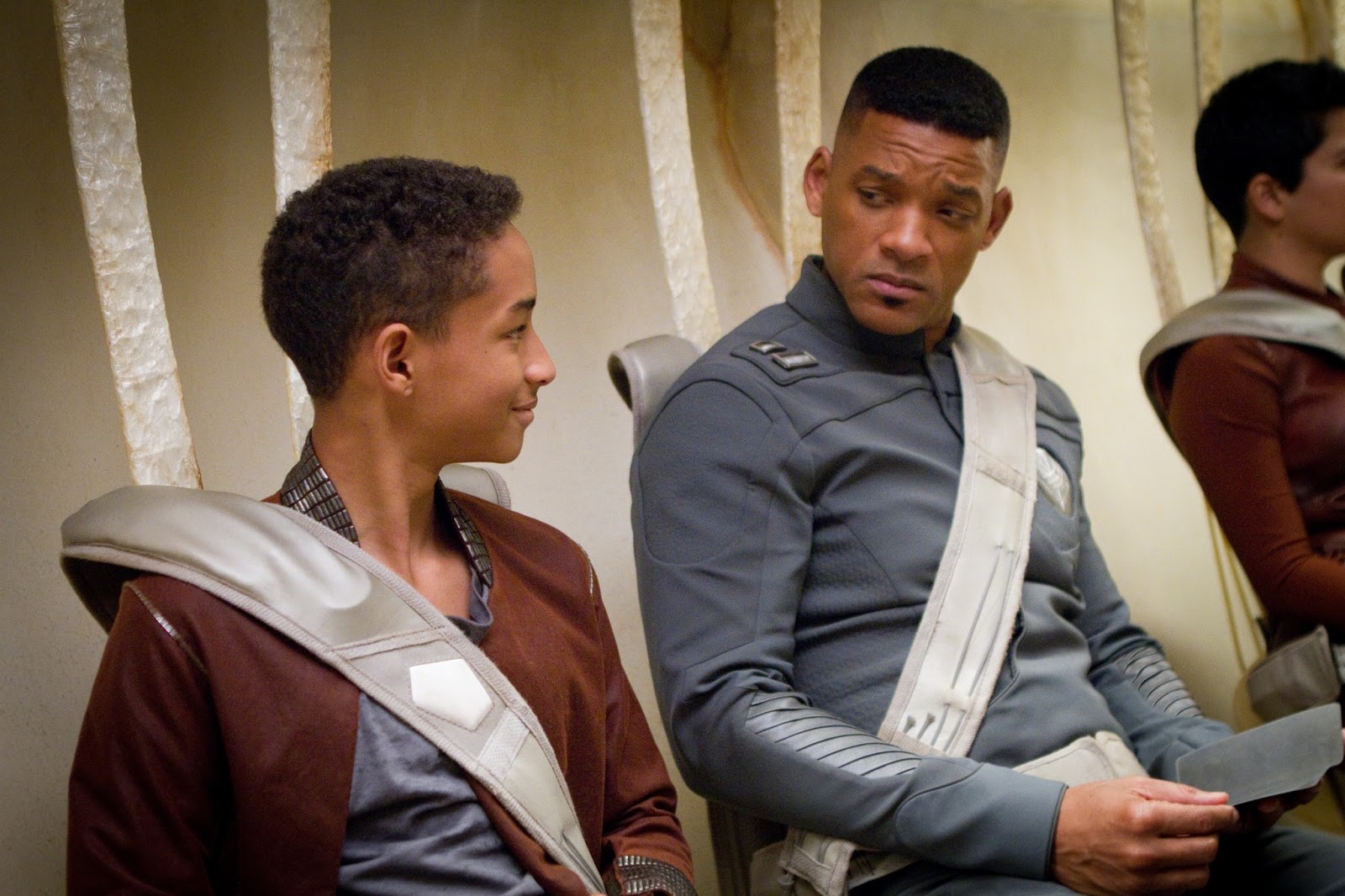
In the beginning, Raige shows some flickerings of emotion with his wife. After that, there was A LOT of deadpan with this face.

This has potential to be an interesting character arch. The danger of writing a character like this, however, is that if it is done poorly, the audience will be forced to endure a cold, emotionless robot as one of their main characters. Exactly what happened to Will Smith‘s performance in After Earth.

Another cool idea: a hostile earth. This realm of science fiction is already starting to come home to reality, but to create the idea of a human-abandoned earth sounds intriguing. Also, this does not appear to be a recent desertion either. The movie gives the audience a planet that has had time to revert to a complete feral state.  There are no real traces of cities or any human settlement left on the planet. The surviving animal species have been left on their own to evolve and adapt into incredibly dangerous and hostile versions of their former selves.

How exactly is this baboon any more or less dangerous to humans than a baboon of today?
How exactly is this baboon any more or less dangerous to humans than a baboon today?

Or not.

Again, another problem of the script breaks through to derail the concept. After Earth feels like two independent ideas sandwiched into one script. In one story, the animals of Earth have evolved to pose a very great threat to humans. In another, Earth has become a planet with extremely dangerous climate conditions. This latter idea dominates most of the movie, however all the set up is done stressing the dangers of the planet’s inhabitants.

“Everything on this planet has evolved to kill humans.”

Or not.

Also, great thing to tell your son before lecturing him on the importance of not being afraid.

Do not let this man become a motivational speaker.

There is no real animal threat in the movie, save for an Ursa, which is a chemically engineered non-native of Earth. That line works great in trailers but ultimately comes off as the exact opposite of intelligence.

The cgi rendering in this film: not super great.

Finally, the story itself. The idea of a father and son getting trapped together on a hostile world sounds promising. The fact that the two have a miserable relationship adds potential for characters. The injury to the father should help to prompt a sci-fi coming of age story that is worth watching. Sure, After Earth‘s plot is simple but there is potential there – just not for a summer action blockbuster.

The best moments of this movie are when it's not trying so hard to entertain. Maybe the expectations of a smaller, independent release would have suited this film better.
The best moments of this movie are when it’s not trying so hard to entertain. Maybe the expectations of a smaller, independent release would have suited this film better.

It fell apart in the script, and whether it was Shyamalan’s directing or Jaden Smith‘s acting, there was no strong performance to save it.

Should you watch this movie: only if you’re like me and you enjoy analyzing and critiquing stories. Otherwise, there is a lot of vastly superior science fiction to enjoy at the moment. The worst may be behind M. Night Shyamalan, but he still has a lot more climbing left to do.