South Park: the Stick of Truth vs Saints Row IV

Warning: Video links are NSFW (South Park ridiculousness)

Last year saw the end of one of the larger video game publishers, THQ. The company was responsible for such hits as the Saints Row series, the Darksiders series, and the Red Faction series. Further proof that producing successful games does not guarantee longevity in what can only be described as a cutthroat industry. When THQ went under, two enormous titles, South Park: the Stick of Truth and Saints Row IV, were still in development. The public was excited for both of these titles and, luckily, each found a home with a new publisher. South Park: the Stick of Truth was released courtesy of Ubisoft, while Saints Row IV found new life with Deep Silver. THQ’s last great games would be live to be played be the public. What makes these two titles very interesting, however, is the fact that they deal with similar subject matter. Both are games designed to parody other games. Well, as it happens with any two like products, the question becomes: which one is better?

Spoiler alert: I pick this one.

To begin, let’s examine the core games that each title is parodying. South Park: the Stick of Truth was molded to make fun of the traditional RPG (roleplaying game), where a silent protagonist teams up with a team of other, computer-controlled adventurers to complete an epic quest. Think old school Final Fantasy for this one. Heck, just look at how Canada looks in the game:

I love how Quebec is transformed into "the Caverns of Quebec."
I love how Quebec is transformed into “the Caverns of Quebec.”

The game also draws attention to the illusion of choice. There is one sequence in particular where the player character is ambushed by elves (kids dressed as elves). The elves offer a choice: fight or come quietly. Immediately after, one of the elves mentions that the fight is pointless and that the player will be forced to come along no matter what. There are several other instances throughout the game where the player is offered “choice,” and each one unfolds in a similar manner.

There is a point in the game where the player is asked to choose between Kyle and Cartman. This choice is also meaningless as both characters remain in your party.

I have already written and article talking about the Saints Row series but, just to reiterate: this is, at its heart, a spoof of the Grand Theft Auto series. Saints Row IV marks a large departure as series such as Prototype and Infamous become the primary draw for gameplay. While the core game focuses on spoofing those two series, Saints Row IV draws from several other key sources. The Mass Effect trilogy is evoked in two ways. First, Keith David is in the game as… Keith David. The character serves as a comedic stand in for his Mass Effect character, David Anderson.

2494030-keith+david+model

In addition, Saints Row IV pokes fun at Bioware’s relationship system. The idea that your player character is irresistible to everyone else and can have sex just by talking to another person. Where Mass Effect restricted it to one or two partners per playthrough, Saints Row IV allows the player to have sex with everyone in their party (minus Keith David), including one machine. This pokes fun at the idea that the only reason any player ever completed a relationship in a Mass Effect game was for the sex scene “reward” (there will be another, more serious article on this) at the end.

While both games are intelligent parodies, it is Saints Row IV that pulls ahead with simply better gameplay. It is the more fun game to play. While South Park: the Stick of Truth is hilarious, it is only meant to be played a certain way. The player is encouraged to directly complete quest after quest. Wandering (an element central to most RPGs) is discouraged. This is a short game with only a set amount in it. The repetition of things to do becomes apparent to any player who chooses to explore and (uselessly) grind against enemies. While this isn’t a huge knock against South Park, it is a limitation that Saints Row IV does not have (at least not as glaringly).

I feel that this difference is best showcased by comparing game maps, have a look:
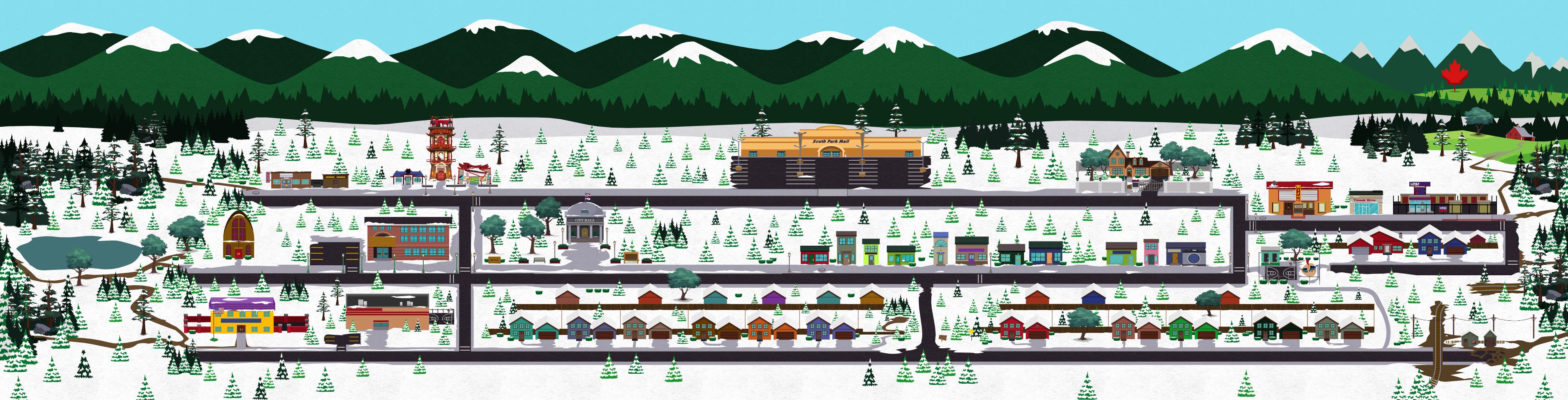
The South Park map is exactly what you would expect. There are never more than half a dozen quest markers on screen at a time.
Most of the map for Saints Row IV. There is a much greater variety in mission type. There is also a mode just to see collectables.

Another area where Saints Row IV excels is the intelligence of some of its make-fun segments. For example, there is the moment where Saints Row IV switches to a 2D beat ’em up making fun of Streets of Rage (the segment is called Saints of Rage I believe). It is short and fun and, most importantly, easy. The joke does not overstay its welcome.

South Park: the Stick of Truth is not so smart. Any gamer out there can tell you about the frustrations of button mashing sequences. They are as the name suggestions: hit a button as fast as you can and hope it is fast enough to work. Not big on the skill but high on the tedium. On one level, the South Park game makes excellent fun of this. There is a completely voluntary sequence where the player character can use the bathroom and the player must button mash to complete the task. Fun, easy, and short – all three things. There are also several sequences where the player must button mash to complete boss battles or advance the story. These are not always fun or easy and come dangerously close to exactly copying the games that they are trying to make fun of.

One last point that I will harp on: glitches can ruin games and there are far more game ending glitches in South Park: the Stick of Truth. I encountered one such glitch and the game was nearly ruined for me. I will not dive into this further as I am planning to do a full article on the game production patterns over at Obsidian (the developers of South Park: the Stick of Truth). Suffice it to say, this is not the first Obsidian game to be held back by technical slip-ups.

For players seeking a humorous game experience, neither title will leave you disappointed. However, there are simply more funny jokes in Saints Row IV that are done better. Trey Parker and Matt Stone are geniuses in the world of cartoons, but the good folks over Volition, Inc. have the edge when it comes to properly enabling comedy through video games. There are advantages to being more familiar with your craft.

The Beginning of the End for Assassin's Creed?

In the last generation of video game consoles, certain series dominated the sales charts. Halo, Call of Duty, Uncharted, Grand Theft Auto: all of these were powerhouse series that continue to push out installments at least every few years. For video game company, Ubisoft; the last generation represented a changing of the guard. Prince of Persia, a video game series once wildly popular, was dying down. Sales had diminished greatly in the last couple of games and even rebooting the series did not prolong its lifespan. For Ubisoft that meant one thing: move on. The outcome was Assassin’s Creed. If you owned an Xbox 360 or a PlayStation 3, odds are you tried out at least one of the Assassin’s Creed games. They were fun an addictive, with interesting story campaigns and competitive multiplayer experiences. Like any cash-cow: Ubisoft made a lot of them. In total (including the portables), sixteen games have been made in the series. However, as a new generation begins: the changing of the guard may be upon Ubisoft again.

Ubisoft's original wall-climbing, death-defying protagonist.
Ubisoft’s original wall-climbing, death-defying protagonist.

Let’s start with Assassin’s Creed III. Many fans of the series regard this game to be a miss-step in the series. Indeed, reviews were not overly wild when the game was released. This was also the first in the series to be released on a next-gen platform (the Wii U). However, despite the lukewarm critical reception, Assassin’s Creed III did very well for itself. It sold fast and became Ubisoft’s biggest game to date. Financially speaking: nothing to worry about. At least until Assassin’s Creed IV: Black Flag was released.

Assassin's Creed III marked a notable departure in both time period and setting. Ambition was not lacking in this game.
Assassin’s Creed III marked a notable departure in both time period and setting. Ambition was not lacking in this game.

Where Assassin’s Creed III was determined a step back, Black Flag triumphed; being mentioned on multiple lists for “Best Game of the Year“. It was released on two more platforms than its predecessor as the Xbox One and PlayStation 4 were released in time to receive ports. Critical reception went up, platform count went up: sales went way down. 60% down according to initial estimates. Assassin’s Creed IV: Black Flag did not have the quick start that Assassin’s Creed III enjoyed. The game has not flopped: selling 10 millions units since its release. That is impressive but down 2 million from what Assassin’s Creed III sold in the same time frame.

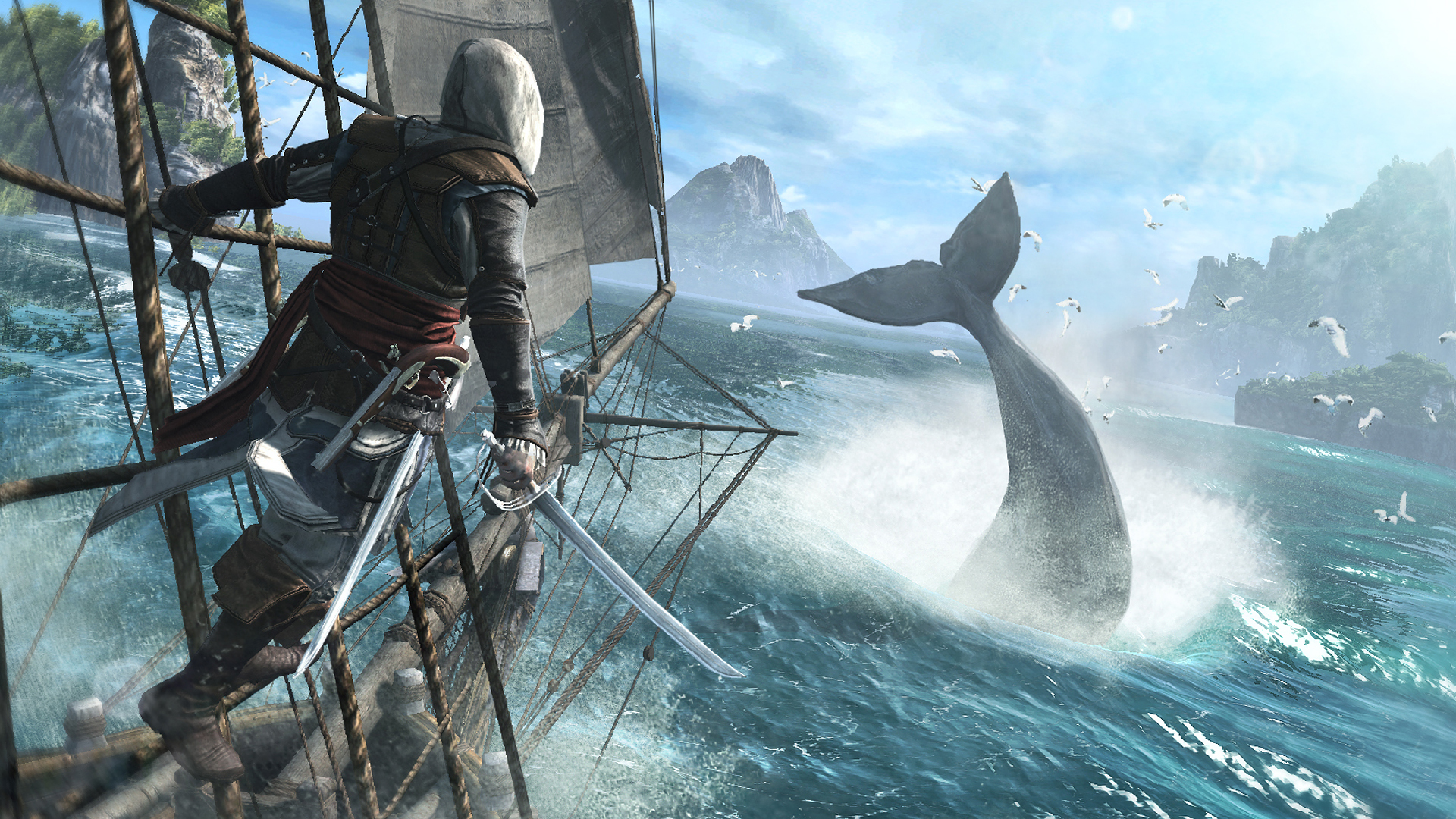
Assassin's Creed IV: Black Flag continues to mess with the formula. However, gameplay remains largely unchanged.
Assassin’s Creed IV: Black Flag continues to mess with the formula. However, gameplay remains largely unchanged.

What does this mean for the franchise? Nothing… yet. Ubisoft blamed poor sales on the incoming consoles. Ubisoft’s CEO, Yves Guillemot, felt that the initial slow start was caused by people waiting to purchase the game on new consoles. Consoles that, in many homes, likely weren’t entering the picture until Christmas. True, Black Flag was not the only major game to hit this slump. Call of Duty: Ghosts and Battlefield 4 were also affected. However, Call of Duty: Ghosts received less than overwhelming reviews and Battlefield 4 had significant technical issues. This was not the case with Assassin’s Creed IV: Black Flag.

New consoles: bad for business in the short term, but essential for innovation.

Ubisoft may be facing another problem: fans might just not care as much as they once did. Assassin’s Creed III enjoyed quick sales… but those sales came mostly from pre-orders (people feeling confident spending $60 on a game before hearing any critical feedback… you know, morons). How many of those games were sold back in less than a week or only played for a few minutes before being banished to the shelf? Ubisoft doesn’t care about those numbers because they don’t reflect the bottom line. They made their money: the product was profitable.

Sixteen games is a lot for any series. Granted, ten of those are not associated with the major releases so let’s just say six. There have been six major releases for Assassin’s Creed in the past six years: that’s a lot. That is Madden like levels of production. Eventually fans will say: is a new one worth $60? They may have already started. How many unique, worthwhile, assassin adventures are out there? If Ubisoft is producing a title every year (not leaving much time for experimentation) are these games really so different from one another?

Every series can only survive for so long.

Ubisoft has spoken of ending the series, before backtracking on their statements. It is unclear just what higher plans, if any, they have. That must lead one to think that there is only one bottom line: money. For as long as Assassin’s Creed is profitable, there will be new games. That time might just be running out.

Assassin's Creed will expand to the cinema next year.
Assassin’s Creed will expand to the cinema next year.

How Mass Effect 2 Failed the Trilogy

The Mass Effect Trilogy stands as an unparallelled achievement in video game history. A closely joined story arch that spanned three games and included a multitude of different scenarios, characters and outcomes based on player action. On the whole there is little emotion I can express for this work other than admiration. However, Mass Effect was not perfect. Mistakes were clearly made. Many people out there will tell you that the largest failure came in the ending, with Mass Effect 3. I do not share this belief. Yes, Mass Effect 3 is likely the worst game in the series (which is not to label it “bad” by any stretch) however I will argue that the greatest failings, at least in terms of character and story development, came in Mass Effect 2. I know: the game that is the best in the series is also the worst.

The question of how that is possible is best broken into three parts: character, story, and construction. I will address them in that order. Anyone familiar with Mass Effect will tell you that one of the highlights of the trilogy is its characters. Commander Shepard is an incredible protagonist who maintained his/her own identity despite the player influence. The first Mass Effect also introduced its audience to an incredible squad makeup that included Garrus Vakarian, Liara T’Soni and Tali’Zorah nar Rayya (just Tali for short). The squad wasn’t large, only six members total: including one destined to not finish the game alive. The result created a very personal atmosphere with clearly defined characters who each made a powerful impact. This is the squad size in Mass Effect 2:

masseffect2squad

Clearly there are more to be counted. Compared to the six in the first game, twelve potential crew members filled out this roster. There were also certain decisions in the game that could be made to give the player alternatives to certain squad mates (Samara OR Morinth). Expanding the central cast is always a dangerous move when designing a story. Any writer will tell you that there should never be more characters than necessary. The characters in Mass Effect 2 are well-written, realistic and flushed out creations, they are in large part what made the second installment the best. However, when their place in the trilogy is determined, nearly every character introduced in Mass Effect 2 has little to no impact on the overall story. This is a failing in writing and has largely to do with Mass Effect 2‘s construction, so I’ll come back to it.

Miranda Lawson is one of many characters introduced as a major new presence, only to simply lose significance in Mass Effect 3.

Let’s examine the story in Mass Effect 2: a suicide mission against the threat known as the Collectors. Commander Shepard must assemble the most dangerous people in the galaxy to stop the Collectors before it is too late for humanity. That’s a compelling story on its own but already there is a problem: no mention of the Reapers. The Reapers are the main threat of the Mass Effect Trilogy. They are hulking, nigh-indestructible ancient machines that have periodically extinguished all civilized life in the galaxy. Yes, the Collectors are working for the Reapers and yes, the Collectors pose a threat to humanity but the Reapers are bigger than that. The first Mass Effect concluded on a larger scale with one Reaper nearly eradicating the hub of galactic civilization. It was a bizarre move to lower the scale and try to tell a smaller story in Mass Effect 2. The result is that everything of real importance happens in Mass Effect 3, causing the final game of the trilogy to have to rush at a mad pace to try and resolve everything on its own.

The Collectors, even with the influence of Harbinger, are simply not vital to the main story in any way.

It isn’t that the story in Mass Effect 2 isn’t entertaining, it just doesn’t matter. Nothing, from the cybernetic rebirth of Commander Shepard, to the Tali mission concerning a dying star, to the reveal of a human Reaper, really impacts the trilogy. Every question raised in Mass Effect 2 goes unanswered. Worse still, most of the questions: such as how the galaxy will react to the Reaper invasion (a question raised at the end of the first Mass Effect) are left for Mass Effect 3.

Cool final boss fight: check. Adding significance to the plot: ...
Cool final boss fight: check. Adding significance to the plot: …

This all comes down to construction. The writers of Mass Effect 2 set out to tell a small story of a man who assembles a team and stops a threat. The game succeeds brilliantly at telling this story but, was it the story that should have been told? In many ways, Mass Effect 2 would have worked better as a first game rather than a middle installment. The “suicide mission” mechanic would ultimately prove disastrous for Mass Effect 3. In a game with the largest squad possible: any person could die. Even Commander Shepard, if the player did not prepare enough, could meet his/her end during the finale. The problem with “anyone could die” is that it leads to this: “everyone can live“. Meaning, from a game design perspective, that there are twelve what-ifs that people will care about in the final game. None of them can impact the story too drastically (because they might not be there) but all of them must be mentioned in some way. So everyone was treated to bizarre cameos in Mass Effect 3 where the character returned but never really did anything. The result was unsatisfying and sadly: easy to see coming. Rather than design an achievement structure which rewarded saving everyone, Mass Effect 2 should have instead opted for more scenarios like the first game: certain people have to die whether the player likes it or not. It was supposed to be a “suicide mission” after all.

Boldly left with nothing to do.

On its own, Mass Effect 2 is a brilliant game. In the trilogy, it was a foolish mistake. Yes, one can argue that if EA had not rushed Bioware in the development of Mass Effect 3, the writing staff may have found a way to better rationalize the two. However, the writers at Bioware did nothing to help themselves out. Mass Effect 2 was simply too low scale in an epic trilogy. It’s great to personalize the characters but not at the price of the story. Its a fundamental problem that largely prevented one of the most towering achievements in video game history from reaching even greater heights.

The final Mass Effect 2 DLC "Arrival" had more to do with the main plot than anything in the central game: think about that.
The final Mass Effect 2 DLC “Arrival” had more to do with the main plot than anything in the central game: think about that.