In Defense of Russell Crowe's Javert

Just going to give a head’s up that this article will be a very complete character examination of this man below (this includes full plot breakdown and ending spoilers):      les-miserables-poster-russell-crowe

Oh my god, we’re talking about Russell Crowe. More specifically I’m going to defend his performance of Javert in the recent musical hit, Les Misérables. Many people saw this and many people liked it. The film was nominated for eight Oscars; winning three of them (Anne Hathaway’s well-deserved win as Best Supporting Actress among them). So in short, Les Misérables was a critical success. There was only one performance that a lot of people took issue with. Yeah – our boy, Russell.  Many critics found Crowe’s singing to be… less than stellar. Well, when The Onion devotes a video to you, less than stellar may not be adequately summing it up:  http://www.theonion.com/video/russell-crowe-praised-for-stunning-portrayal-of-ma,30839/. Youtube even had Hitler weigh in on Russell Crowe, both as an actor and as a singer (warning, Hitler uses naughty German language): http://www.youtube.com/watch?v=Xt-m9dT_jwc.

Okay maybe that last video was overkill but point is: people, in large part, hated Russell Crowe in Les Misérables. He was labeled as the one awful performance amidst a sea of gems (Hathaway, Jackman, etc.). Now I have no comment on Russell Crowe as a human being (never met the guy) but I feel like he has been treated too harshly in regards to Les Misérables. Crowe’s performance in the film isn’t only one of the strongest, it would probably rank as author Victor Hugo’s personal favorite as I believe it is the truest performance to the character that has been portrayed thus far. 

And that's the way they all became the Javert Bunch!
And that’s the way they all became the Javert Bunch!

Before I get into Javert, a quick summary of the Les Misérables plot for those who may be unfamiliar: Wolverine steals a loaf of bread and Gladiator sends him to prison. After prison Wolverine goes on the run and adopts Catwoman’s daughter from Borat and Bellatrix Lestrange. Gladiator continues to pursue Wolverine but everyone runs into a 99% rally and a lot of people are killed. It may be comical but it is strangely accurate. Anyway, couldn’t resist having this in here. Back to Crowe’s Javert.

As said in the above poster, he is the law. That’s putting it pretty simply. In describing the character, many people have labeled Javert as a legalist. I’m going to use Wikipedia’s current definition of legalism, as I feel it is very adequate: “usually pejorative term referring to an over-emphasis on discipline of conduct, or legal ideas, usually implying an allegation of misguided rigour, pride, superficiality, the neglect of mercy, and ignorance of the grace of God or emphasizing the letter of law over the spirit. Legalism is alleged against any view that obedience to law, not faith in God’s grace, is the pre-eminent principle of redemption.” Woah, that does sum up Javert pretty well.

One of the few times in the film that Javert shows life is in his pursuit of the law.

Okay so that’s great about Javert but people had problems with Crowe’s performance. In particular he was called wooden and his singing style was described as awkward and not as emotionally free as the other characters. I would agree with the latter part of this criticism but I would not agree that it is criticism. Another way to put that: I believe that Russell Crowe’s singing style is completely intentional (just not comically bad as The Onion suggests).

It all starts if you accept Javert as a strict legalist, which I do as it makes full sense with his character. Now while Javert may be strict in his philosophical beliefs (as he is with everything else) there becomes present a very clear and dividing doubt within the character. Javert sees the world’s morality in terms of black and white: Jean Valjean stole so he is a bad man, the revolutionaries are rebelling against order so they must be bad people – that sort of thing. Problem for him is that Les Misérables is full of gray area. Yes, Valjean stole but he is also a noble man. Yes the revolutionaries resist the law but theirs is a noble cause. Javert is not stupid, he sees all this an it baffles him. Essentially Les Misérables can be watched as the slow breaking of Javert’s mind.

Javert is comfortable when secluded with the law. In his palace of police, there is no outside world presence.

You see this in Crowe’s performance. People have described it as a detractor. The fact that Crowe’s Javert has an almost constant expression on his face (the one pictured in the poster). He never looks certain as many people feel that Javert should. This is true, he does not look certain. He appears in conflict. While Javert is the face of the law, sworn to uphold it – Crowe’s Javert very clearly does not agree with the word of the law, despite his insistence otherwise. It is a psychological condition of denial that gives the otherwise villainous character of Javert a real human depth.
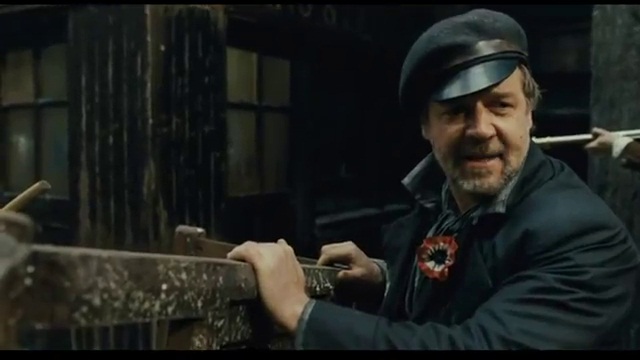
The only time Javert expresses happiness in the film is in the subversion of the law.

There is a sadness that Crowe imbues the character with that makes the audience feels for him. Look at that picture above. I’m not lying, that’s the only time in a nearly three hour film that Javert cracks a smile. In everything else: grim uncertainty. Yet if the fact that Javert is not happy in his work does not do enough to instill a sense of sympathy. I invite a contrast, look at how comfortable he looks above. Okay, now look below:

One of the most powerful character moments for Javert: among the dead revolutionaries.

Russell Crowe portrays Javert as more than out-of-place in this scene. There is genuine horror and dawning realization upon his features. It is only at this point in the film that Javert’s last illusions of black and white crumble away. That medal, which has been displayed so proudly on his chest in previous scenes, guess what is the first thing Javert does with that medal afterward:

Yep.
Yep.

Javert pins his medal on the dead body of the boy who identified him as a police inspector. For that crime, Javert was supposed to hang. The only reason he did not was through the actions of Jean Valjean.

Okay, you’re saying, right now I’m saying there’s a lot of strength in the character of Javert but I’m not doing much to showcase the strength of Russell Crowe’s performance. Audiences are fine with Javert, it’s Crowe that they have the problem with. True enough but while I have been focusing on Javert’s character, I have been doing that to highlight the pains and constraints by which he is acted. Javert is not a character who will give a tearful rendition of his thoughts and emotions. Well, he does do that once – right before he kills himself. Yeah, there is emotional repression. You know how that looks? Watch the subtleties of Crowe’s acting. Heck, just look at the way he carries himself on the pivotal balcony scenes:

Like a hanged man dangling without the rope.

Les Misérables is not a subtle movie. Really Javert is the only character in it who is not comfortable in self-expression. When you consider that, his character must then have a completely unique style of portrayal. Yes his performance should stand out, but it is not wooden. The Onion was right. Russel Crowe should be commended on his performance. It is the perfect portrayal of a man who walks the line between law and chaos, right and wrong, and what happens when he finally stumbles and falls.

Russell Crowe’s own defense of his performance: http://www.youtube.com/watch?v=vnAhVVPUdGU
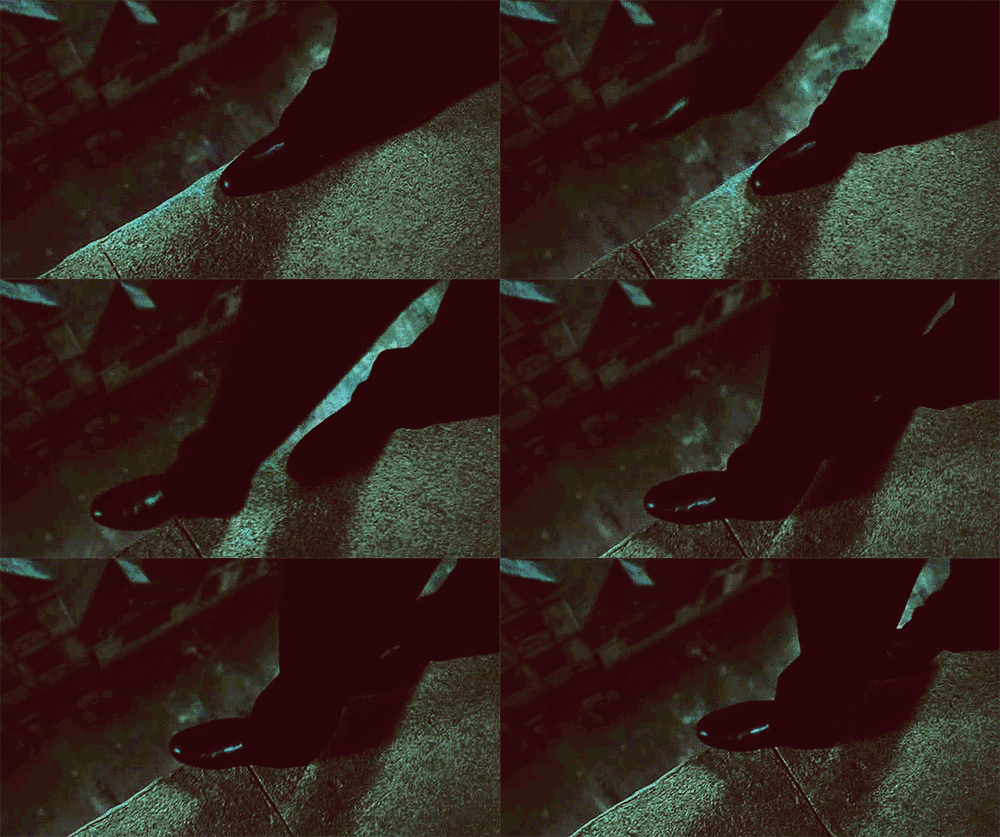
Walking the line. One side is visually simple while the other is complex. A whole character reflected in a sequence.

Thoughts? Comments? Am I full of shit or onto something? Let me know now in the feedback section of this article.

Marketing Method: Man of Steel

Who doesn’t love hype? By its very definition it instills excitement. Some directors are better at it than others. Probably the best out there at the moment is J.J. Abrams (who doesn’t remember trying to figure out what was in the train for the trailers to Super 8, let alone the mad race right now to discover Benedict Cumberbatch’s identity in Star Trek into Darkness). Good marketing lays the foundation for blockbuster film. However marketing, like any tool, can be a double-edged sword. There are plenty of good films that suffered from poor trailers (Stardust, Scott Pilgrim vs the World) which failed to properly convey the tone of the upcoming film. Many times these poor trailers try to capitalize on another popular property rather than focus on the strengths of the film they should be trying to promote. There is no better example that comes to my mind for this than Beowulf. Neil Gaiman and Robert Zemeckis’ thoughtful deconstruction of the heroic ideal was instead neglected in favor of conjuring a 300-esque style of masculine action (“I am Beowulf” is used to the exact same effect as “this is Sparta” in the trailers). This style of marketing always does a disservice to the movie it represents. Sadly, something similar to Beowulf is currently occurring with the upcoming blockbuster, Man of Steel.

Watch the trailers for Man of Steel. There are three of them, the teaser: http://www.youtube.com/watch?v=wArmHSPIvlQ, the first trailer: http://www.youtube.com/watch?v=KVu3gS7iJu4, and the one that was very recently released: http://www.youtube.com/watch?v=T6DJcgm3wNY. I’ll wait.

Looks good doesn’t it? Let’s talk about that teaser though. Kinda bizarre right? Clearly designed with the intention of not immediately revealing its identity right away. Looks more like a trailer for Superman: Deadliest Catch rather than the high-flying epic of Man of Steel. I joke of course but the fact remains: the teaser is constructed in such a way as to convey that you are watching a personal drama first and a superhero movie second. As I stated before, the fact that he’s Superman isn’t made abrupt until the final seconds of the teaser. Interesting approach… wait, hasn’t it been done before? http://www.youtube.com/watch?v=lu2ecPMX0kI

Yep. Looks like the Man of Steel is using the same agent as the Dark Knight. Really, in terms of emulation, you could do a lot worse than Nolan’s Batman trilogy. Also there are a lot of similarities in terms of creative staff. While Zack Snyder is directing Man of Steel, the script was penned by Jonathan and Christopher Nolan, with final version coming from David S. Goyer. That is essentially the exact same writing team as Nolan’s Batman films. Also, all movies were made using Nolan’s own studio: Syncopy Films. Oh and Hans Zimmer is once again in charge of music (although that has only effected the marketing of the most recent trailer).

I know this is a fan mockup but it does shed light on similar design used for promotional photos.

So this is a good thing, right? Equating Snyder’s Superman with Nolan’s Batman? Yes. As I said before, there are a lot worse marketing strategies for Man of Steel to emulate. There is sense in comparing Superman and Batman, DC Comic’s two star superheros, as similar people. Both Batman and Superman went on a journey, both grew as people. Both faced challenges in a world that was unsure of how to receive, both… actually they are very different people.

Don’t get me wrong: Superman and Batman are both heroes, both stand for good and both do everything in their power to make the world a better place, yet their methods are completely opposite. Any good drawing of Superman will have the Man of Steel bathed in sunlight, standing proudly over a grateful city. Drawings of Batman put the Caped Crusader in the shadows; he is hiding from the public eye, doing a job that he feels must be done regardless of public opinion. These two approaches visually reflect the characters’ different philosophies.

So while comparing Snyder’s Man of Steel to Nolan’s Dark Knight trilogy is good on certain levels (superhero movies that are more than just superhero movies), there is a danger. These trailers, especially the first two, give the impression of serious realism. Inherent problem: Superman is not realistic. When you’re dealing with a character who can fly into outer space and blow up a comet with his laser vision after taking a nuclear missile full to the chest – you’re not dealing with something that can happen every day. That is a strength of Superman.

Let me stop right here before people go assuming: realism is not necessary in order for the character to be relatable. Grounding the fantastic in the real world always helps, and Man of Steel definitely appears to be doing that. The two later trailers make it clear that the main focus of this film will be Superman adjusting to and being accepted by the real world (what General Zod is doing intruding into these trailers is beyond me – guess we need that villain fight).  But Superman himself is fantastic, that is part of his identity. Too much of an attempt to make him into your average everyday man is not going to work out well.

What do I mean by that? Superman was raised as a human, he does have emotions so of course he is average. No. First two points are valid. Superman is raised as Clark Kent, he does feel but he is anything but average. The character of Superman goes beyond his red cape and boots. He is the ideal best of humanity in a physically superhuman package. Does that mean he doesn’t struggle, of course not but it is internal. Superman is never going to go on a bender or sink into month long depression. He is more subtle than that. This is partly what makes Superman a very hard character to present on screen. The challenge is essentially the same as presenting the fully human yet fully divine character of Jesus Christ.

If you think representing Jesus on film is easy - please name all the successful Jesus films.
If you think representing Jesus on film is easy – please name all the successful Jesus films.

So everyone has a challenge. The filmmakers have a challenge and marketing has a challenge. How do you portray Superman? They have elected to go the route of Batman. The result has been a trailer evolution that started off with us being introduced (in the teaser) to a man who was unrecognizable as the Man of Steel. Only now, in the most recent trailer, does Superman begin to emerge. Still there are aspects of the newest trailer that seem counterproductive to the nature of the film. The black and white text that punctuates certain frames now looks out of place whereas before it enhanced the sombre mood of the first two trailers. Speaking of that: why is Superman sombre? Batman is sombre, Superman is hopeful. It has taken them three trailers to get that right.

One last thing that speaks to these early trailers not doing the film justice comes in the form of the early review. Check out this first review of Man of Steel (don’t worry, there’s no spoilers): http://www.joblo.com/movie-news/scoop-early-screenings-of-man-of-steel-reveal-more-about-the-tone-action-and-superman-kicking-all-kinds-of-ass. Any time one of the bullet points is “it’s not nearly as dour and serious as the trailers suggest”, that pretty much declares that marketing has made a mistake.

Christopher Nolan has already proven himself a visionary in terms of storytelling. He and his brother have also shown a tremendous amount of understanding in relation to the characters they portray. They understood Batman, they knew what was essential to his character and what was not. That is how they were able to create their own Batman universe that felt every bit as ture to the character as the comics. I have full faith that they possess the same understanding of Superman yet Man of Steel‘s marketing has not convincingly shown that. So far what has been demonstrated is that they understand Superman in Batman’s terms, using Batman’s tools. Not the smartest way to go.

As I said before, trailers are no indication of film quality. A great film can have a crappy trailer likewise a poor film can be very well marketed. So please don’t mistake my critiques of Man of Steel‘s marketing to be any more than that. I don’t hate Superman, I don’t think Man of Steel will be a shitty movie and you shouldn’t be excited to go see it. I simply feel that these trailers have not presented Superman in the best light because they’re too busy sticking to the Dark Knight’s shadows.

Oooh so dark and edgy. Superman should never be defined by darkness.

Thoughts? Comments? Am I full of shit or onto something? Let me know now in the feedback section of this article.

Evil Dead (2013): Sequel or Remake?

As this post deals with a recent release, I shall do my solemn best not to include any spoilers in the following text. I will just say right now that I am a huge fan of this Evil Dead and I fully recommend it to those fans of horror movies who can stand being grossed out by a lot of fake blood. If gory scares aren’t your thing: stay away.

However, this is not a review but rather an interesting question that entered my mind while I was watching the film. Was I watching a remake of Sam Raimi’s 1981 horror classic or merely a new entry into the Evil Dead series? The marketing has definitely pitched this one as remake. It has the same cabin and same basic plot that The Evil Dead possessed back in 1981. However, as I concluded the movie I became convinced that what I had just witnessed was a sequel and not a remake.

For starters: the title. I know the word “the” can be seen as insignificant yet I feel that this is one instance where it matters. Sam Raimi’s first film in the series is titled The Evil Dead whereas this new film is simply titled Evil Dead. As I stated, I don’t feel this really makes a strong case, by itself, that the new film is a sequel. It is not the first time that a remake/reboot/re-imagining has reworked the title (like all the “re”s in that sentence?). One need look no further than Matt Reeves’ 2010 remake Let Me In, which changed its title a fair amount from 2008’s Let the Right One In. Let Me In, despite the different title, was definitely a remake and it had many more differences in its name than just missing the word “the”. So I will acknowledge that, by itself, this reason falls flat.

Good thing it’s not the only factor supporting the sequel notion. Most remakes recreate the iconic moments that made the original so well-remembered. For instance, while the 2009 remake of Friday the 13th was very different from its original (a lot more Jason this time around), the iconic character of Jason returned. The Magnificent Seven, a loose remake of Seven Samurai, still includes the titular seven defending protagonists. The Evil Dead was known for its main character Ash and his battles with the possessed bodies of his friends. The Evil Dead series is different from other horror movies in the fact that its protagonist is the star. We don’t come to see a Jason Voorhees or a Freddy Krueger, we come to see Ashley Williams blow the snot out of some demons.

Ash is not recreated in this new Evil Dead. In fact, none of the characters in this film share the same names as anyone from the original. The argument can be made that one of the new characters embodies the spirit of Ash from the initial series but the reality remains that this “remake” does not feature the iconic element that made the series so famous. Instead the audience is introduced to a new cast of characters with no prior knowledge of the horrors they are about to unleash upon themselves.

Which brings me to the cabin:

The Happy Cabin.
The Happy Cabin.

This screenshot is from Sam Raimi’s Evil Dead II.

The "new" Happy Cabin.
The “new” Happy Cabin.

Looks kinda similar doesn’t it? Like exactly the same? I know, I know what you’re saying: “it’s a remake, they’re supposed to look the same.” True but it does allow the possibility of the films sharing the same universe. Sam Raimi’s films were all contemporary meaning they took place in the 1980s. In the new film, two of the characters mention the fact that they spent time in this cabin as children (who wouldn’t want to). This would mean that they probably first came to it in the 1990s (they don’t look that old). By that point, Ash has already been teleported out to his medieval world in Army of Darkness. We never see the cabin destroyed or sucked into the portal at the end of Evil Dead II, it could very well have survived only to be discovered by a new family years later.

Now we’ll come to the book. Naturom Demonto (or the Necronomicon if you want to go by the sequels), the book of the dead. We see this book in every movie. It is the wonderful vehicle by which our characters experience pain and suffering. Some would argue that, since we see the book destroyed at the end of The Evil Dead, this new movie is automatically a remake as the book is once again present and completely not burned to a crisp. This is a valid point. Except that Evil Dead II introduces an intriguing idea: additional pages are discovered in Evil Dead II that are believed to belong to the Naturom Demonto. So, if there can be additional undiscovered pages, why not an additional undiscovered book?

The new Naturom Demonto looks significantly different from the book in Sam Raimi’s films. Gone is the face on the cover, leaving instead a rather blank looking tome… bound in human flesh. Why would Evil Dead deviate so much in book design after sticking so closely to the look of the cabin? Possible answer: same cabin, different book. This theory would also explain the slightly altered appearance and capabilities of the possessed in Evil Dead.

Ew. Imagine touching this and not washing your hands immediately afterward. Just ew.

If the book was a different version of the Naturom Demonto, than the translations would be different and therefore so would the effects of the incantation. The possessed in Evil Dead look different than those in The Evil Dead (they still have pupils for example). Also (and this can be read as a spoiler so be warned) the possessed in Evil Dead do not need to be bodily dismembered in order to stay dead, they drop if you bash the hell out of them (ha, horrible pun).  This could mean that this different version of the book had a weaker translation that the first, meaning that its subsequent demons are not as strong.

Weaker or not, I would not want to be locked in the cellar with this.

As you can no doubt tell, I’ve put way too much thought into this. I’m a huge horror fanatic and I owe it all to The Evil Dead. I grew up with that movie (let the scariness of that fact sink in a bit) and I was initially horrified at the idea of someone other than Sam Raimi taking the reigns. Evil Dead surpassed my highest expectations and whether the film is intended as a remake or a sequel, it’s fun that they allowed enough wiggle room for the idea to be tossed around. I eagerly await any future films from Sam Raimi or Fede Alvarez: both of whom have proven to be masters of The Evil Dead.

PS – If you do see the new movie, make sure you stay until after the credits. There is a scene which may or may not definitively solve this argument.

Thoughts? Comments? Am I full of shit or onto something? Let me know now in the feedback section of this article.