"I AM KING UNDER THE MOUNTAIN!" – 'The Hobbit: The Desolation of Smaug' Review

Eleven years ago, New Line Cinema released The Lord of the Rings: The Two Towers. The second chapter in Peter Jackson’s Lord of the Rings trilogy found incredible critical acclaim and took home two Oscars. However, departures from the source material, including the delay of Shelob, the character change of Faramir and the presence of elves at the battle of Helms Deep, angered some of the more diehard Tolkien fans. To those people I have one thing to say: STAY AWAY FROM THIS MOVIE. Of course, if you sleep with The Hobbit on your nightstand and hold the word of Tolkien as law, then you probably already walked away from this new trilogy in disgust last December. Peter Jackson’s The Hobbit: The Desolation of Smaug is a bold departure from the source material and… a pretty good movie… I think? I’ll get into it.

(MINOR SPOILERS TO FOLLOW)

The Desolation of Smaug essentially picks up right where the first film left off. As you may remember, Bilbo Baggins (Martin Freeman) and company are on the edge of Mirkwood. The orcs are still right behind them and the eagles have left to return to the realm of Deus ex Machina. Yet there is also flashback scene to ease us into our fifth return to Middle-Earth. Returning to the famous “Prancing Pony” Inn from Fellowship of the Ring, we witness the initial meeting between Gandalf (Ian McKellen) and Thorin (Richard Armitage). This scene, as well as many of additions/changes to the source material, exists for one purpose: there are bigger things going on in Middle-Earth than Smaug.
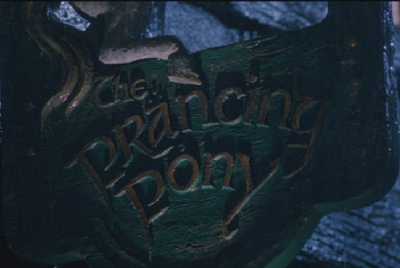
Get ready, there is a lot of Lord of the Rings in this movie.

This is grand departure. While Jackson’s Hobbit trilogy employees Bilbo Baggins as its chief protagonist, its identity is not that of the simple children’s adventure story. These movies represent the beginning of the war of the ring.

Did you hear that? Every diehard Hobbit book fan just groaned.

Yes, it is true, that little band of gold is as much of a star in this movie as Martin Freeman or Ian McKellen. Really, it is arguably a larger star than Freeman, who sadly takes a backseat in this second installment. Personally I felt that one of the strongest plus factors going in An Unexpected Journey was the strong characterization of Bilbo Baggins. Evidently Jackson and co. felt entitled to a pass this time around.

Bilbo Baggins is as much a part of the scenery in this movie as those blue butterflies.

So, amidst the gathering doom of greater forces, the little dwarf quest continues – and is a lot more fun this time around. The film only really falters at the beginning with the interjection of Beorn (a were-bear who will no doubt come back into play in the third installment) before hitting its stride in Mirkwood. We get spiders and elves and a barrel chase and it is all great fun. The addition of Evangeline Lilly as Turiel, an elf guardsman, is welcome and breathes life into the movie. Really her performance and subsequent subplot with the dwarf, Kili do a lot to improve the pacing and give the audience a breather from the one-track Thorin (this dwarf needs his mountain something fierce) and the somber beginnings of Sauron (one of two villains this movie voiced by Benedict Cumberbatch).

It's Evangeline Lilly as an elf. Damn.
It’s Evangeline Lilly as an elf. Damn.

The result is a pace that feels at a thrilling rush and gets us to Lake-town feeling jazzed to see what comes next. What comes next: the audience is introduced to Luke Evans (good performance) and Stephen Fry (Republican performance) before it’s off to see the dragon!

Now, about that dragon… here come my spoilers. Those out there wishing to see Smaug die, you’re not getting your Christmas present this year. Peter Jackson, possibly trying to emulate the Hunger Games: Catching Fire, has gone the root of the abrupt cliffhanger leaving all resolution for the Hobbit: There and Back Again. The result is a jarring ending preced by a greatly expanded upon confrontation between Bilbo and Smaug (voiced by dragon-Sherlock aka Benedict Cumberbatch).

Pretty accurate.
Pretty accurate.

I said at the beginning of this review that I wasn’t sure how to feel about the movie and that’s why. This doesn’t feel like a complete story. Unlike the chapters in the Lord of the Rings trilogy, not much is resolved at the end of the Desolation of Smaug. There is no victory at Helms Deep, no breaking of the fellowship: the movie just ends. Yes, one can argue that the climactic expulsion of Smaug (yes, he gets forced from the mountain in this movie) is enough but that dragon is still alive and in good, fire-breathing shape.

Ironically this tale feels more like part one-of-two than part two-of-three. As a piece of a film, it is entertaining and fun… but it only a piece of a film. The final word on Peter Jackson’s trilogy will come next December. Until then, The Hobbit: the Desolation of Smaug is a solid blockbuster rich in Tolkien lore. I just hope that all of this buildup has a payoff… other than the Battle of Five Armies.

Verdict: Worth seeing at full price.

PS – For those curious about my thoughts on the first movie, click here!

Why Aren't We Getting David Fincher's 20,000 Leagues Under the Sea?

The year: 1954, the movies: awesome. Seriously, so many of my favorite films came out in that year, it’s not even funny. While Disney’s 20,000 Leagues Under the Sea may not make my top ten list, it was still one of my favorite movies to watch as a kid. Before I was old enough to appreciate the characters or the themes, I had the giant squid scene – and boy did I have fun with that.

I used to fast forward my VHS copy to just watch this scene. I think I saw the giant squid sequence at least 50 times before I ever watched the full movie.

Anyway, as time passed, I began to appreciate the more mature values of Richard Fleischer’s film. The bitter determination of Captain Nemo stuck out to me and I found a fascination with the character that encouraged me to read Verne’s novels (20,000 Leagues Under the Sea and its quasi-sequel, Mysterious Island). Captain Nemo is still one of my favorite literary figures of all time. However, when I read the novel, one thing became clear to me: there are big differences between the page and the film treatment. Verne’s novel reads more like a fantastical scientific journal while the Walt Disney production is an action-adventure epic with anti nuclear war undertones. It makes sense, as with any good adaptation the film version was adapted to fit its time (things change between 1870 and 1954).

Still, that version was 70 years ago and I for one am ready to see Disney try again… too bad it doesn’t look like that is going to happen.

The original is a classic in its own right but time has taken it out of the public perception.

Well, scratch that. We’ll probably get one soon but I don’t know what kind of quality we can expect. After months of trying, an update came today that none other than David Fincher (Se7en, The Curious Case of Benjamin Button, The Girl with the Dragon Tattoo, Fight Club, Alien  3 (can’t resist putting that one in there)) has left the project. As a movie fan, that sucks to hear.

Fincher is a filmmaker known for creating dark, moving atmosphere with smart scripts and talented actors... pretty good fit for 20,000 Leagues Under the Sea.
Fincher is a filmmaker known for creating dark, moving atmosphere with smart scripts and talented actors… pretty good fit for 20,000 Leagues Under the Sea.

While I can’t say I’m the biggest fan of Fincher’s work – I personally would rate Se7en as one of the most overrated films I’ve ever seen – I cannot deny his ability. He’s just a good fit for the project, anyone familiar with the original source material would attest to that. There’s certain combinations that just sound like a good fit. Remember when Gore Verbinski (The Ring, Pirates of the Caribbean) was going to do a Bioshock movie? Well, that was also a good fit that didn’t happen.

Anyway, the question then becomes: why? David Fincher is a critically successful director who produces commercial success. Even a big budget (and apparently he planned a big budget) shouldn’t frighten Disney away from the idea of a remake. It didn’t, it was a casting problem.

I know what you’re thinking: Nemo. Of course, the iconic character. One of the greatest creations ever given birth by the pen. Yes, who would play Nemo? Clearly Disney and Fincher must have had some debate over which way to go with the most important piece of the puzzle. Well, fact is they never got to Nemo. Couldn’t get past replacing this guy:

Kirk Douglas as Ned Land.

Ned Land marked the biggest change between the book and the original Disney movie. In the novel, he’s a fairly minor character who doesn’t make much of an splash (I’ll stop) on the plot. In the movie… well, he was Kirk Douglas. The fact that the casting of Ned Land was the first priority is telling. Clearly this remake intended to follow closer to the film original than to the book. This was not necessarily a bad thing.

Here’s what happened: initially David Fincher intended Brad Pitt to play the role. Again this fits as Pitt has a similar acting style to Douglas. However, Pitt wasn’t interested (for some reason or other) and the role went to both Daniel Craig and Matt Damon for consideration. While both were interested in the part, neither wanted to abandon their families for a 140 day shoot in Australia (the proposed location for the film). Good news about approaching veteran actors – they’re mostly good. Bad news – they mostly have families they don’t want to leave for long periods of time. So three great ideas for a replacement Ned Land, come and gone. Fincher decided to change tactics and proposed the much longer Channing Tatum for the role. Disney was… not on board with this.

Remember that big budget I mentioned? Well, David Fincher may be a good director name but Disney felt it needed a dynamite actor name to guarantee big box office money. They were fine with Pitt, Craig or Damon, but Tatum? In his (much shorter) career, he has not had the commercial success of the other three. So they said no and instead offered the idea of Chris Hemsworth (Thor) for the role. It was at this point that David Fincher left the project.

Personally I don't see much difference in acting ability between the two actors but Fincher evidently does.
Personally I don’t see much difference in acting ability between the two actors but Fincher evidently does.

So that’s it. Forget Nemo, the studio couldn’t even agree on a Ned Land. This marks yet another dismal chapter in the 20,000 Leagues Under the Sea remake development. Oh yeah, Disney’s been trying to make this film for a while. Several directors have been either rumored (Sam Raimi) or attached (McG… thank god that one didn’t happen) to the project. Will 20,000 Leagues ever see the light of day? Of course, there is money to be made. However, it might not be good. Films that exist for long stretches in the dubbed “developmental hell” stage of production rarely turn out to be gems (other films on the list include The Wolfman, Prometheus and Alien vs Predator).

Regardless, the film will one day see the light of day. Who knows, Fincher may even return to the project in the future (unlikely but possible). But whether it is Fincher or (shudder) McG, 20,000 Leagues Under the Sea is too good a story to remain dead in the water for long.


Sources: 1, 2, 3

"Nobody Calls Me Chicken!"

If you’re from the eighties or nineties, odds are that you’ve seen the Back to the Future trilogy. They’re awesome films filled with memorable characters and quotable lines. The first of the trilogy, the original Back to the Future, was released in (you guessed it) 1985 with the two sequels coming in 1989 and 1990 respectively. Wow, those sequels sure got pumped out quickly. There’s a simple explanation for that: they were shot back-to-back. This is not the only time such a technique has been done. Other examples include the Pirates of the Caribbean films (two and three were shot back-to-back, we’ll talk about those another time) and The Matrix (two and three shot back-to-back). The most famous example is obviously The Lord of the Rings where all three films were shot one at the same time. Anyway, let’s talk a bit more about theses Back to the Future sequels.

They were not made for the story. Director Robert Zemeckis is on record as saying that the original film was not envisioned with sequels in mind. Pretty obvious really, despite the film’s classic cliffhanger ending. Back to the Future is a quirky family comedy built around the mechanic of time travel and what it would be like to see your parents in their teen years (turns out it’s really disturbing). That’s great material for a single movie but doesn’t work so well stretched into three. Good thing they didn’t do that. The sequels have their own moral lesson that is spread over the two films and that is: a person chooses their own future. A lesser moral lesson is don’t mess with time travel.

Yet whenever there are unplanned sequels (that happen due to a studios financial desires over a director’s creative ones), the writing always takes a hit. Characters get deeper, they have more emotional traits than we’ve seen before (and not always for the better). Plots can get needlessly convoluted and interesting aspects of the original run the risk of feeling tired after three movies. Casting problems can also drastically effect shooting (for better or for worse). The Back to the Future trilogy suffers from all four of these afflictions.

When this baby gets two sequels, you're going to see some serious shit.
When this baby gets two sequels, you’re going to see some serious shit.

Let’s start with Marty. As my title implies, he develops a pretty serious character flaw. Mainly, calling him chicken is the key to getting him to do literally anything. From fighting to drag racing, there is nothing Marty McFly won’t do if someone (doesn’t really seem to matter who) calls him chicken. The problem: Marty looks really stupid. Seriously, the person didn’t even swear at him and he flies off into a completely unrealistic and cartoonish reaction. This is a strong departure from the Marty McFly of the first film who essentially played the straight man (comedy term) in a world that’s gone topsy-turvy. That Marty was identifiable and likeable.

In the sequels, the audience is expected to still feel those emotions for Marty, who in the future is a ruined wreck of former ambitions. What happened to screw his life up? Somebody called him chicken… so Marty recklessly raced him and got into a major car accident. It’s like asking someone to feel sorry for Aaron Hernandez right now. Yeah something bad happened, but the character totally deserved it. (I do not mean to accuse Marty McFly of something as serious as murder, he may be an idiot but at least he’s not a psycho) There is no sign of this trait in the first movie. Granted, no one calls him “chicken” but to have such a complex would warrant additional bizarre behavior. Like I said before: Marty is the normal guy in Back to the Future.

The sequels needed to artificially create a flaw in Marty that could be solved at the end.

So that didn’t work out so great for the sequels. Another problem (and on this one the movies themselves agree with me): don’t mess with time travel. Any writer will tell you this. Unless every aspect of plot has been painstakingly thought out, there will be problems. Even in the first film – not everything makes sense. It’s okay then because the plot is never grievously affected. Let’s look at Back to the Future Part II.

Biff

Old Biff and the time machine. He takes it, that’s fine. How Doc and Marty get it back? Biff returns to the current future timeline (the one that Doc and Marty are in) despite the fact he has just radically altered past events. I know: it’s a movie. But this movie draws attention to the concept of its timeline in a later scene.

Doc forgot to add variable "X" for plot holes.
Doc forgot to add variable “X” for plot holes.

Right there, Doc is saying that old Biff created a new timeline in the past. So how was he able to return to the old one? Come to think of it, the plot in Back to the Future Part II feels the weakest of the three movies. Sure there’s the cool future scenes but those are sadly over and done with in about twenty minutes. Then there’s a brief stint in a hellish nightmare version of 1985 (also interesting) before the finale returns to (at this point worn out) 1955. That’s two movies about time travel that center the bulk of their story in the same year. The audience saw 1955 in the first movie, they didn’t need to see it again.

There is an explanation for this. Really simple one too:

george_savesday

Crispin Glover did not return to reprise the role of George McFly. They wanted him to – it wasn’t a writing choice. It was a financial one. When Glover could not return, Back to the Future Part II was rewritten to largely remove his character. So, because of the casting department, no one out there will ever know what the original plan for the sequel would have been. It’s really too bad as Glover is such a presence in the first film and is missed in the other two. Michael J. Fox and Christopher Lloyd are great, don’t get me wrong, but Glover is arguably the third best actor in the first movie. He is missed in the two sequels. Also missing:

jennifer-parker

This was a problem of a different sort. The original Jennifer (Claudia Wells) could not return to the sequels for personal reasons. The role was recast with Elisabeth Shue filling her shoes. The problem: Shue is not a great actor. She doesn’t have a lot of presence or comedic timing. Really, one can’t be sure if Wells would have been better but Jennifer was a much smaller role in the first movie. As they had to recast anyway, don’t you wish they could have gotten someone a little better?

Oh, and not to leave Back to the Future Part III free of criticism. The sole reason the old west was chosen for the setting was because Michael J. Fox thought it would be cool. Turns out he was right. That’s not the criticism, this is:

Timetrain

Remember that whole moral lesson that time travel was bad? Doc was the one preaching it. Frequently in the two sequels, Doc outlines his plan to fix things and destroy the time machine. Yet at the end of the trilogy, what does he do? He builds another time machine. Don’t worry, this time it’s a flying train so it’s so much less conspicuous than a delorean. This action completely flies in the face of the Doc character that the sequels have been establishing. It creates a confusing ending that only makes sense if…

Yeah, they were leaving the door open for Back to the Future Part IV. It never happened. Still, this is what happens when things are done solely for dollars. Everything else is sacrificed to produce cash revenue. For the record: I really like the Back to the Future trilogy. I grew up with it and, despite the plot holes and other logic gaps, I find them to be funny and entertaining movies. That’s the most important thing. They still work. It’s just sad they were made for the dollar first.

On the plus side, we did get to see Michael J. Fox in drag.

Thoughts? Comments? Am I full of it or onto something? Let me know now in the feedback section of this article.