How to Tell a Story: Why How to Train Your Dragon Works so Well

It seems that Dreamworks Animation has always been the animation company in Pixar‘s shadow. While Pixar was creating films like Ratatouille and Wall-E, Dreamworks produced Shrek the Third and Kung Fu Panda. Not to say that Kung Fu Panda was bad (unlike Shrek the Third), it was just a much more simple story. Dreamworks simply was not producing animated films that contained the same amount of layers as their Pixar counterparts. In 2010, Dreamworks Animation made How to Train Your Dragon while Pixar created Toy Story 3. Yes, Pixar made the better film that year. That said, Dreamworks Animation took a giant step forward as How to Train Your Dragon became one of their greatest films produced. The story was just as simple and uninspired as any of their animated products, yet How to Train Your Dragon proves that quality is found not just in the story, but in how it is told.

First, what is the story in How to Train Your Dragon? As I said before, it is very standard: at its heart, How to Train Your Dragon is about an outcast boy growing up and learning to accept/believe in himself, and how that belief and acceptance catapulted him into much stronger social standing. This is a plot that has been before in animated films. At least once:
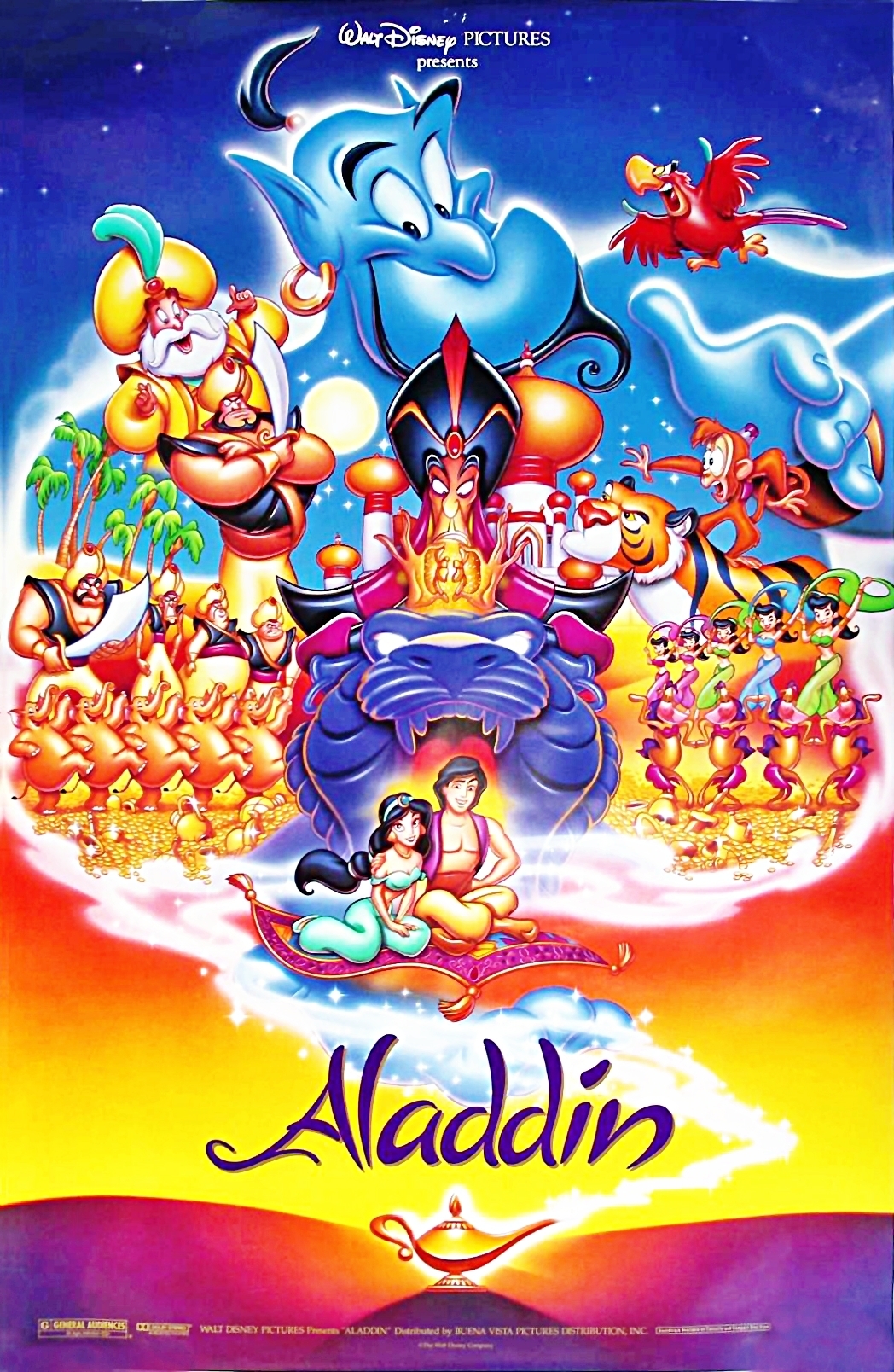
An outcast street-rat learns the value in being true to himself and becomes sultan of a fictional land (with some non-human assistance in the form of a genie.)
An outcast street-rat learns the value in being true to himself and becomes sultan of a fictional land (with some non-human assistance in the form of a genie).

Or twice:

An outcast learns to accept the true strength of his character in order to become a hero (with the non-human assistance of a satyr).

And like, say by Dreamworks the year before:

An outcast learns to be true to himself and becomes the dragon warrior/hero (with the non-human assistance of a turtle and a red panda).

So stories like this are nothing new to the world of animated feature films. Yes, every one of the movies mentioned dresses their story in a different way but all of those films share the same heart. However, these three films also help to illustrate my point: it matters how the story is told. It is possible to like only one of those movies and detest the other two. With How to Train Your Dragon, the strength of the movie lies in its character relationships.

Every story needs vehicles in order to function. The protagonist, the antagonist, the supporting characters, the conflict: every story possesses (at least most of) these traits. The difference between good stories and bad ones is how well these vehicles are disguised. A good writer/storyteller can dress fiction to be real life. In my article criticizing Star Wars Episode II, I (endeavored to) explained that the main reason that the relationship between Anakin and Padme failed was because it appeared as a plot focus and not as an actual relationship between two people. How to Train Your Dragon avoids this pitfall.

One of the main triumphs to examine is Stoick (voiced by Gerard Butler). He is Hiccup’s father and one of (if not the) main antagonist in the story. In a children’s movie, where simple storytelling is sometimes favored, it would be very easy to leave Stoick as simply that: the antagonist. Hiccup’s father who never listens, a bloodthirsty viking looking to kill dragons. Instead, writers William Davies, Dean DeBlois, and Chris Sanders create a complex relationship between Hiccup and Stoick that feels very real (even in a movie that is about taming dragons).

Hiccup has the revelation of where his mindless violent tendencies lead…

At the heart of their conflict is not an argument over what direction to take the plot (to kill dragons or not to kill dragons) but instead the simple problem of communication. Stoick and Hiccup do not know how to communicate with one another. They are both headstrong and stubborn (illustrating similar qualities helps enforce the family connection) and they simply have a hard time relating to one another. Yet throughout the movie it is illustrated that, while the two have their differences, they are a family who loves each other. This adds weight to the conflict and enhances the scenes between them.

…Much earlier than Stoick does.

Another strong point is, obviously, the relationship between Hiccup and Toothless. Both Chris Sanders and Dean Deblois created Lilo and Stitch and it is no surprise to see the same quality of human-sentient animal relationship in this film. Toothless is not simply a dragon but brims with personality, which allows Hiccup to exhibit personality as well. If Toothless were simply a dragon (a beast without intelligence), the plot of the film could still proceed but its content would have been weakened greatly.
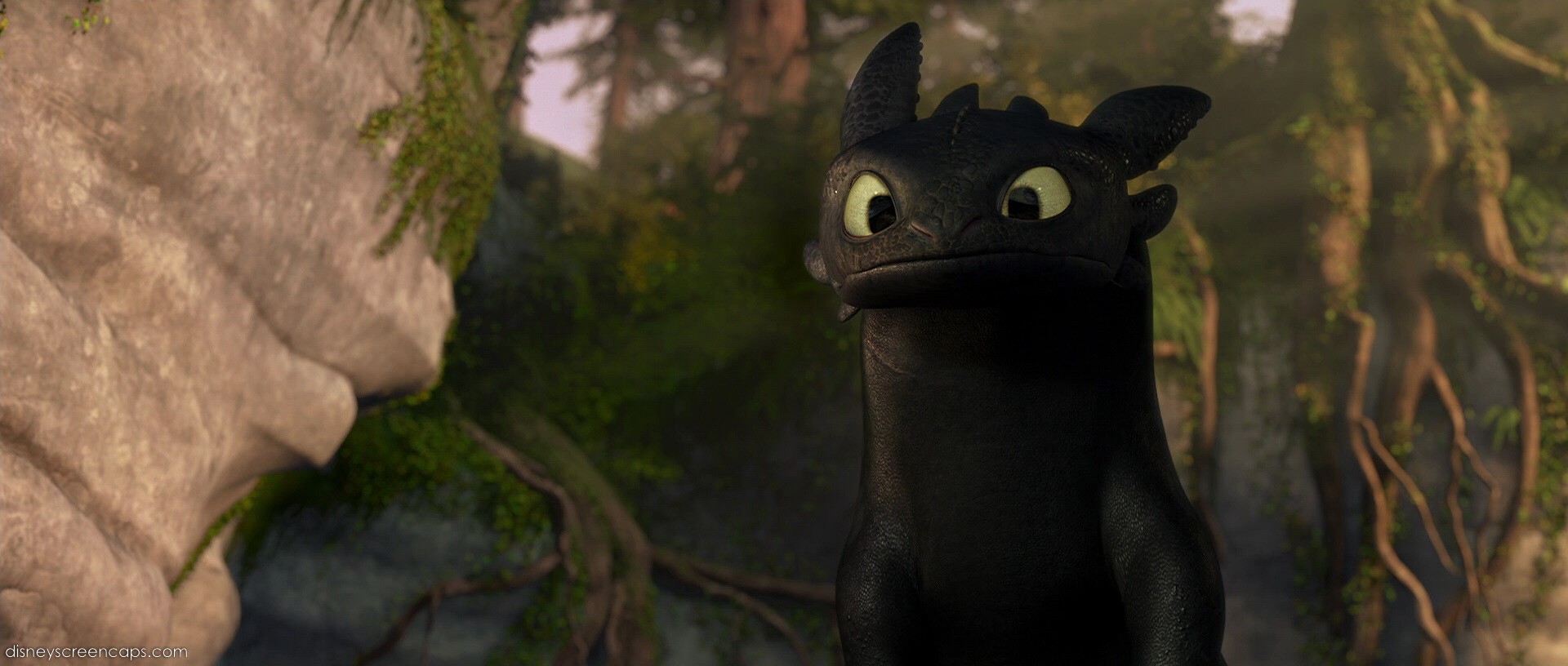
The animators realized a creature who could fully communicate without speech.

One final relationship I will mention is Hiccup’s relationship with Astrid (voiced by America Ferrera). Yes, Astrid does serve as the love interest, but she is also a character with her own personality. She is revealed to be determined and methodical. There are also several scenes demonstrating her capabilities as a warrior. This gives her personality so that, when she does fall in love with Hiccup, the audience can understand the reason why.
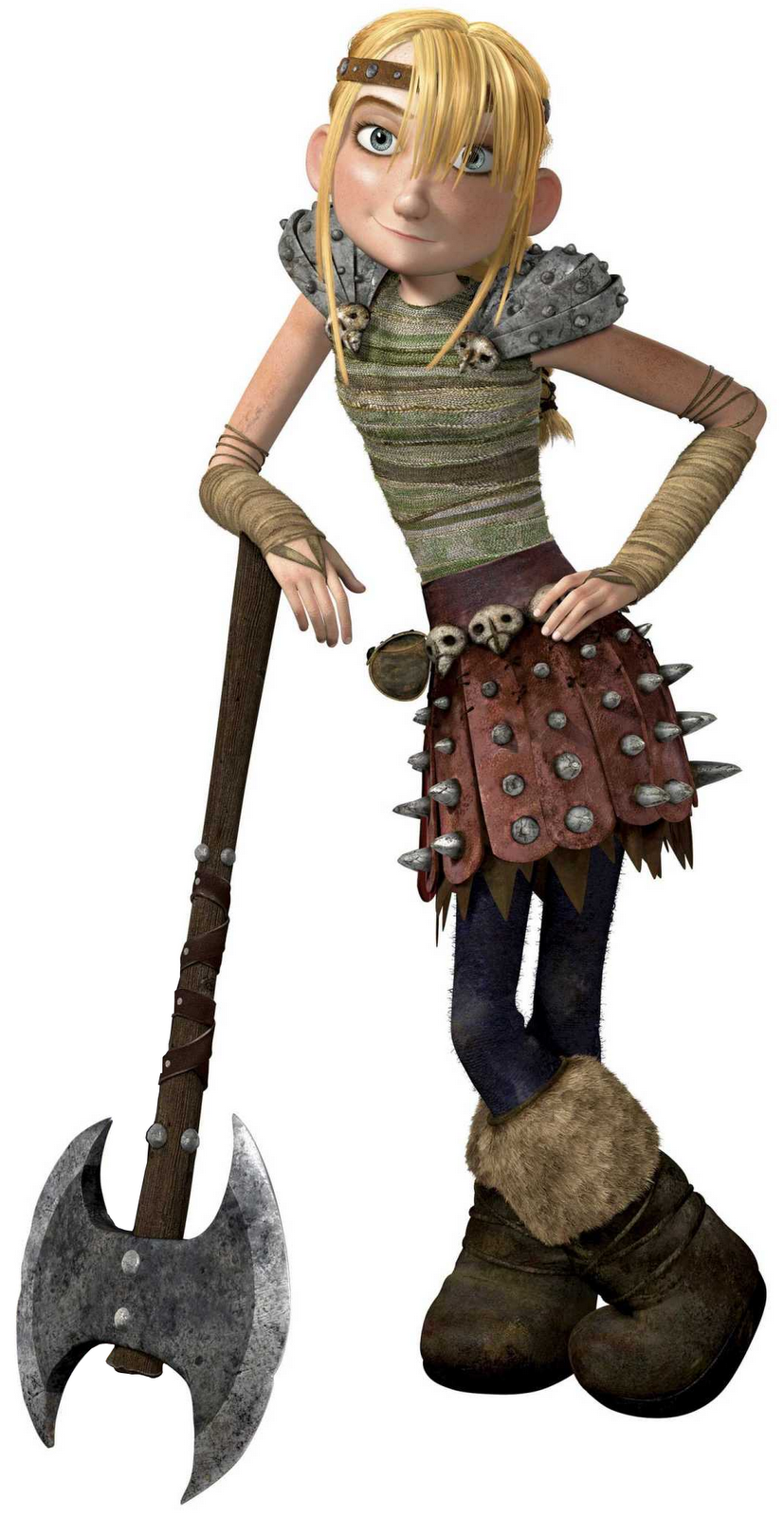
Astrid spends most of the movie with axe in hand.

How to Train Your Dragon is not the best animated film ever by a long shot, but it is a well-made film. There is much more here done right than wrong. The film never panders down to its child audience, never embraces the more flashy-dancey tendencies of other Dreamworks’ films, never does anything to sacrifice story or character. It is part of the proof that it matters more how a story is told, rather than what its content is.

PS – the sequel isn’t bad either.

Mutants are Powers, Not People: A Critical Look at the X-Men Film Franchise

There have been seven mutant movies: seven. Five “focusing” (use the word lightly) on the X-Men, and two centered (even more) on Hugh Jackman – I mean, Wolverine. The latest of these, X-Men: Days of Future Past, was released this past Friday. This latest installment serves as a series reboot in a similar vein to J.J. Abrams’ 2009 Star Trek. The timeline is changed, but with reverence given to the original material… which may have been a mistake. Warning: the following contains spoilers regarding the plot of X-Men: Days of Future Past.

Abrams did not want to undo the original movies so I created a cool idea to reboot them. Apparently Bryan Singer loves the first two X-Men movies more than anyone else on the planet.
Abrams did not want to undo the original movies so I created a cool idea to reboot them. Apparently, Bryan Singer loves the first two X-Men movies more than anyone else on the planet.

First, a brief history regarding the X-Men films. They began in 2000 with the release of X-Men, the first of the blockbuster superhero movies. Bryan Singer directed this movie, beginning his long involvement with the series. Singer would return to direct X-Men 2 (or X-Men United or X2 or whatever you want to call it) in 2003. This installment was hailed as superior to the first and it seemed like the X-Men series was gaining momentum. That said, Singer’s success with the X-Men had been noticed and he was offered the chance to direct the new Superman reboot (what would turn into Superman Returns). He abandoned the X-Men series and Fox sought another director. What we ultimately got was Brett Ratner and X-Men: the Last Stand… things had gone wrong very quickly.

Oh awesome! A movie with cool action that focuses too much on Wolverine. You're amazing, Bryan Singer!
Oh awesome! A movie with cool action that focuses too much on Wolverine. You’re amazing, Bryan Singer!

But were they ever right?

Oh damn, a movie that focuses too much on Wolverine AND has only mediocre action scenes! Cruse you, Brett Ratner!

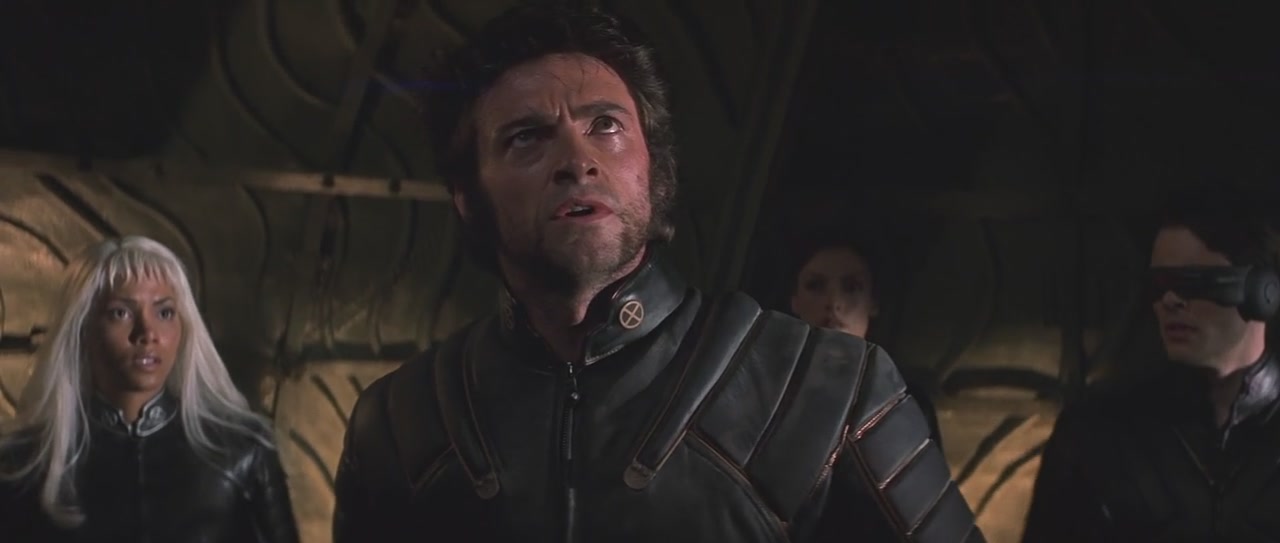
X-Men 2, X-Men: First Class, X-Men: Days of Future Past – these are hailed as the “good” X-Men movies. That said, as someone who grew up watching the X-Men in the 1990s and who has read Joss Whedon’s Astonishing X-Men (seriously, if you ever read a superhero comic book, read these), I have always found the films disappointing. Here, look at this:

Okay, this intro gets the X-Men right more than the movies do. I say that for two reasons: the team, and the handling of Wolverine. There have been five X-Men movies: who has the team been? Well in the first one you had Cyclops, Wolverine, Jean Grey, Rogue, Ice Man, Storm, and a couple others. The second movie added Nightcrawler and moved the plot away from the team and more onto Wolverine (dealing with his past). The third movie lost Nightcrawler and Cyclops (for all intents and purposes) while adding Angel, Beast, Colossus, and Shadowcat (and moving even more focus onto Wolverine). First Class was a prequel and couldn’t have anyone important besides Prof X, Magneto, Mystique, and Beast. You get my point: there’s a lot of fluctuation. This is easy to do in television and comics, where there is a lot more time, but very unwise in movies.

Even in the comics (or TV series), there is almost always a core group that remains unchanged. This allows whoever is writing to focus strongly on these characters.

The result is that the audience never gets too familiar with who is on screen. Everyone out there knows the film iteration of Wolverine. He is by far the most defined character in the film series (he has two films that do not pretend to focus on other people AND he is the large focus of two of the X-Men movies). Yet who is the next most defined character, Professor X? Well he is the founder of the X-Men so that makes sense. Then who… Storm? She has weather powers… Cyclops shoots things from his eyes… Jean Grey is the telekinetic love interest…. starting to see my point?

Scott Summers has existed since 1963 with no real changes made. His power isn't the coolest... so that's not what keeps him around. There is more here than just "that dork with glasses who dates Jean Grey."
Scott Summers has existed since 1963 with no real changes made. His power isn’t the coolest… so that’s not what keeps him around. There is more here than just “that dork with glasses who dates Jean Grey.”

There aren’t people in the X-Men movies, there are powers. Does say, Ice Man, possess certain qualities. He does: he liked Rogue and then Shadowcat. Primarily though… he is the ice guy who beat up the fire guy. There’s also a lot of cameos… a lot of sequences created to showcase powers. Look at Nightcrawler in X-Men 2… does anyone remember anything about him other than his really cool teleporting sequence at the beginning of the movie? I feel like the same can be applied to Quicksilver in X-Men: Days of Future Past (his action piece is arguably the coolest thing in the film).

Man, there's a lot of tension here with the mutants facing extinction. I really care about... wait, who are these guys? I'm saying this after seeing the movie... seriously, who were these people?
Man, there’s a lot of tension here with the mutants facing extinction. I really care about… wait, who are these guys? I’m saying this after seeing the movie… seriously, who were these people?

This works for creating entertaining movies but ultimately eliminates the chance for a great movie. Wolverine is the only member of the X-Men that anyone cares about, and that was made clear in X-Men: Days of Future Past. In that film, they are fighting to save the future: to make sure that the X-Men are not wiped out by the sentinels, and to make sure that X-Men: the Last Stand never happened (Singer appears to hate that film more than anyone else). And they succeed! Huzzah, the future is saved. X-Men: Days of Future Past ends with a sequence – Wolverine walks through the halls and sees all the old X-Men back alive. This, more than anything else, draws attention to how little the audience really knows any of these characters. It also shows how old everyone is (2000 was 14 years ago).

While Days of Future Past isn't boring, First Class should have been the reboot film (it was initially intended to be). That would have made more sense and made it so we didn't have to sit through a movie populated by boring no-names who we know make no significant contribution.
While Days of Future Past isn’t boring, First Class should have been the reboot film (it was initially intended to be). That would have made more sense and made it so we didn’t have to sit through a movie populated by boring no-names who we know make no significant contribution.

Great, there was a reboot movie to fix the old timeline… which wasn’t worth saving. After seeing a fantastic team movie like the Avengers, which shows the coolness of the powers AND the strength of the characters (Steve Rodgers, Tony Stark, and Bruce Banner are far more interesting than just guys in costumes), the X-Men films just come off as flat. Audiences have seen seven movies of Wolverine and the X-Men… how about seeing the X-Men once. They are a team of people… not a team of powers.

Godzilla Raids Again: A Review of Godzilla 2014

Godzilla is back.

Whether you love the new movie or hate it, there is no denying that the creature on the screen is the King of the Monsters. 1998, you are forgotten. This new movie is not the Jurassic Park-wannabe disaster that Roland Emmerich created. That said: do not set expectations fifty stories high. While Director Gareth Edwards has succeeded in creating a new narrative that tells a unique story in the Godzilla universe, this is not the definitive film that some of the early trailers led audiences to believe. For that honor: 1954 still reigns as king.

The plot and focus of the movie draw attention to one of my larger criticisms: I do not feel that this film should have simply been called Godzilla. My review title is in reference to Godzilla Raids Again, the second film of the Showa Series that was released in 1955. This is the Godzilla film that Gareth Edwards’ vision most closely resembles. The good news is that this iteration is much better than what was released nearly sixty years ago.

Fun fact: the United States changed the title of Godzilla Raids Again to Gigantis: the Fire Monster. They didn't think anyone would want to see a 2nd Godzilla movie. Thirty films later...
Fun fact: the United States changed the title of Godzilla Raids Again to Gigantis: the Fire Monster. They didn’t think anyone would want to see a 2nd Godzilla movie. Thirty films later…

The film opens with the discovery of MUTO. Two eggs are discovered in the Philippines, one of which has just recently hatched. The newly hatched monster heads straight for the first nuclear energy source, which as it turns out is a nuclear plant in Japan under the supervision of Joe Brody (Bryan Cranston). Muto arrives and wreaks havoc, resulting in a family tragedy. Fast forward fifteen years and Brody’s son (played by Aaron Taylor-Johnson) is grown and with a family of his own. He is a military man returned from service who is trying to connect with his family. The problem: Joe Brody has become something of a conspiracy nut in the past fifteen years. He keeps insisting their was something more to the nuclear disaster, something that the military is hiding.

Meet Muto, Godzilla's newest bug bad guy.
Meet Muto, Godzilla’s newest bug bad guy.

Of course, the audience can guess where it goes from here. Brody recruits his son and the two arrive at the old wreckage just in time to witness a full grown MUTO hatch. They meet Mr. Serizawa (Ken Wanatabe) who lets them in on a little secret: MUTO is not the only giant monster out there. Yes, it turns out that Godzilla still showed up in 1954, only this time he did not destroy Tokyo. Enter one of the film’s main weak areas: Godzilla’s origin is glossed over. The audience learns that he appeared in 1954 and that nuclear weapons were used to try and kill him (Godzilla is some type of ancient animal from the day’s when the world was a lot more atomic in nature). The weapons didn’t work and Godzilla has been doing… something for the past sixty years. Don’t worry though, the military has wisely been using that time to not prepare any contingency plans, should Godzilla ever grow aggressive.

The plot doesn’t allow any time to dwell on this rather bizarrely timed bit of exposition. Muto is heading for Hawaii and our heroes must give chase. Notice the problem so far: Muto is driving the story action. This never really ends throughout the movie. Muto is the main monster of the plot. This echoes other Godzilla movies where the antagonistic monster is more closely tied into the story. The problem is that the studio decided to call this film Godzilla, creating a set of expectations that he would be the main presence. Godzilla is in the movie to be sure, but he is not the sole star.

The plot revolves around trying to stop the spread of Muto eggs.

Go back to my title, Godzilla Raids Again. This was the first movie that Godzilla shared with another monster and both kaiju drive the plot forward. That said, Godzilla Raids Again was also attempting to be an incredibly personal story about one family in the midst of this epic monster battle. Edwards’ Godzilla is like this also. The audience follows Johnson’s character, Ford Brody, really from start to finish. Every shot of the movie is at the human level. This is both a strength and a weakness as this film provides some of the most breathtaking perspective in the series, while at the same time some of the fights feel restricted. There’s no areal view to show everything like in Pacific Rim.

The things they are able to do with CGI. This really is a gorgeous film.

Godzilla is an epic, and there is human drama aplenty to carry the film through its 123 minutes. Things never drag and the story maintains a slow, methodical pace (similar to the hulking steps of Godzilla). People seeking monster brawls and plentiful amounts of the big G might be disappointed. The final fight is cool but it isn’t overly long.

This image was from the initial teaser. Evidently there was a monster design that went unused.

Overall Edwards movie isn’t a classic but it isn’t a disaster. It is somewhere in between. If this is to be the first in a series then mission accomplished: the King of the Monsters is back, and I can’t wait to see who else he is going to fight.


The king has returned.