Hallo-what? How Michael Myers Became a Jason Voorhees Knock Off

Right now all the horror buffs out there read the title and exclaimed: “Impossible! Halloween came out two years before Friday the 13th, and Jason wasn’t even the killer until Friday the 13th Part 2!”

First off: calm down.

Let the lines be drawn. Which silent psychopath is the best?

Secondly, yes it is true. While Michael Myers began the modern-day slasher genre of films, he did not have the personality or the ability to adapt the way Jason Voorhees did. This is a similar scenario to the Gobots (1983) and the Transformers (1984). While Gobots did it first – Transformers created the characters that audiences remember.

For the record, Michael Myers still enjoys a standard that Jason Voorhees has never really come close to. John Carpenter’s Halloween (1978) is a classic that established a genre. It is a really well-made film that showcases the importance of tension, presence, and use of soundtrack. In this movie, Michael Myers has his own style. He is the boogeyman, seemingly everywhere at once. His kills are not gory, in fact there is barely any blood in the first film. What makes them far more effective (than kills in virtually any other slasher film) is the build-up. The audience knows what is coming, and we all still cringe.
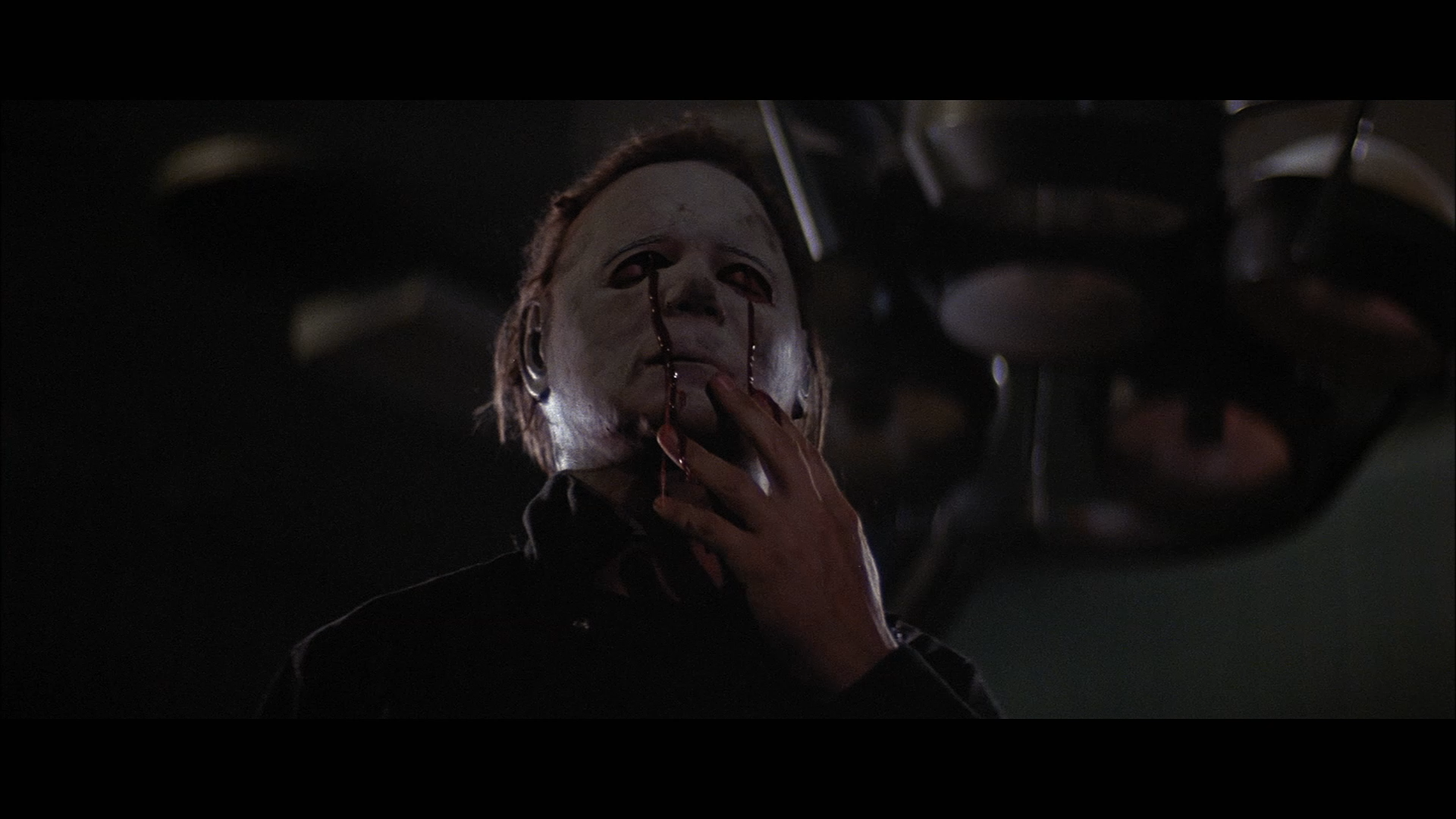
Michael Myer's mask was not the only thing to get bloodier in subsequent films.
Michael Myer’s mask was not the only thing to get bloodier in subsequent films.

The problem was that this minimalist style ended with the first movie. Halloween II (1981) brought Myers back… but he was not the same boogeyman. The kills were gorier, and the body count was far higher than the original. It was a different kind of film.. one very similar to a series that began in 1980 (and had its first sequel released in 1981).

Yes, even though Jason Voorhees did not take center stage until Part 2, Friday the 13th began as a series heavy on the gore and light on the character development. People just appeared onscreen to die, with the kills always involving creativity and gore.
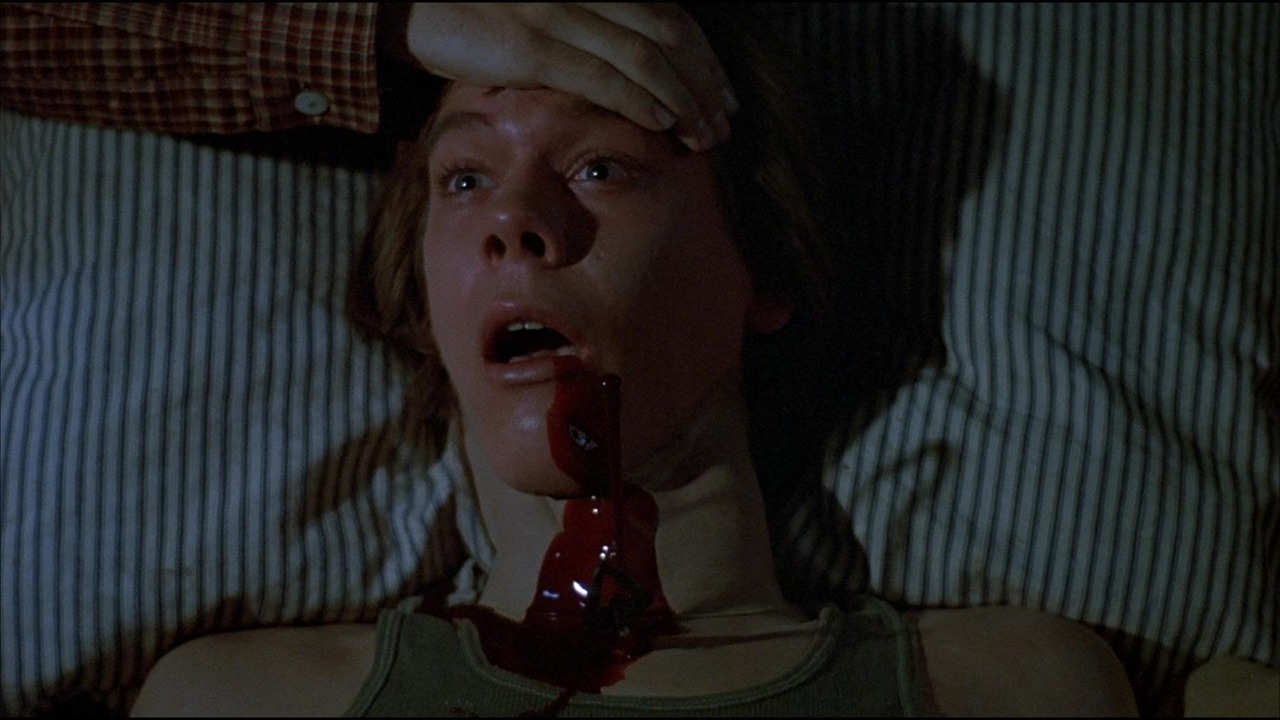
Kevin Bacon getting killed by arrowhead through the bed in Friday the 13th Part One. Gory and creative.

The style of killing was not the only thing to change in the Halloween series. Michael Myers was also known as “the Shape” in Carpenter’s Halloween, one of the actor’s is listed as such in the film’s ending credits. That “shape” would change substantially as the series progressed. Here is the shape in the first film:

HalloweenHere he is Halloween: the Curse of Michael Myers:

Incidentally, he fights a very young Paul Rudd in this movie. Don't get your hopes though, that is not nearly as fun as it sounds.
Incidentally, he fights a very young Paul Rudd in this movie. Don’t get your hopes though, that is not nearly as fun as it sounds.

“The Shape” sure filled out over the course of four sequels (Myers is not in Halloween III: Season of the Witch). He got bigger, stronger, and more brutal. Sound familiar?
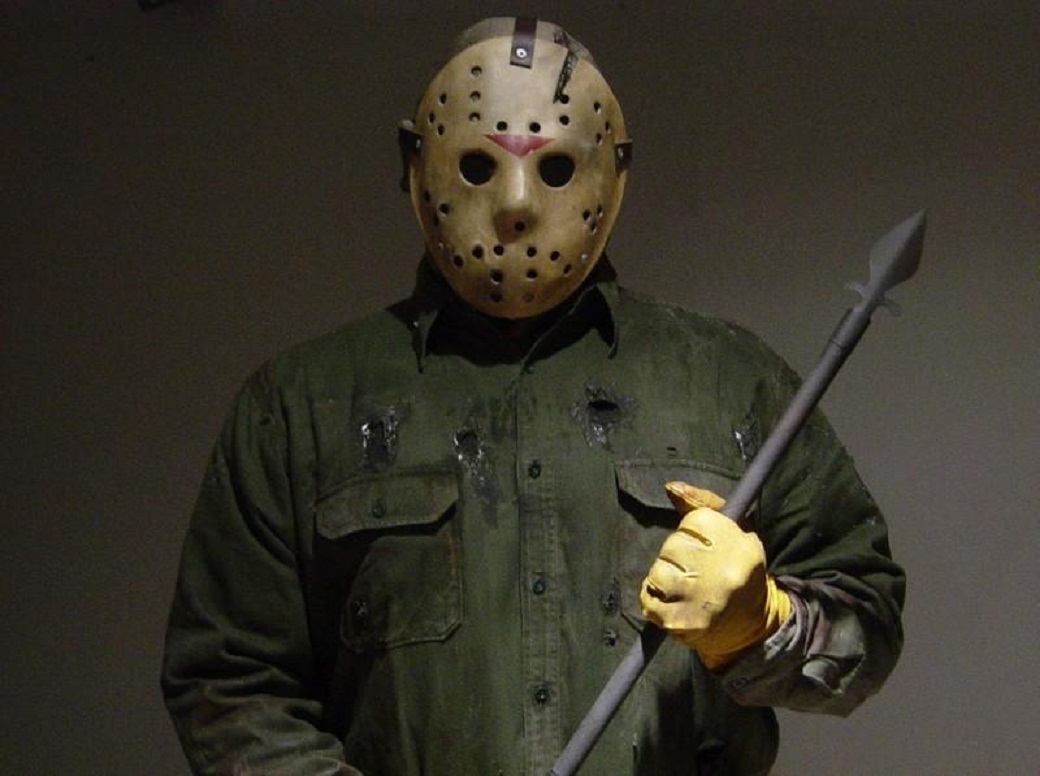
Why hello there!
Why hello there!

By the time Curse of Michael Myers rolled into theaters in 1995, there were already nine Friday the 13th movies released. Jason had long been established as the hulking immortal brute with a thirst for killing teenagers. Michael Myers was years late to that party.

The last comparison I personally feel is the most tragic. Michael Myers became more like Jason Voorhees in motivation. There was a reason for his killing sprees. Jason always existed as the vengeful ghost of Camp Crystal Lake: a drowned child who watched as teens decapitated his insane mother. It made sense for him to return to destroy any who disturbed the lake.

In the original Halloween, Michael Myers was the boogeyman. He was evil in human form. He did not have reason for the horrible things he did – he simply did them. It added to his terror and made Michael truly unpredictable. However, in the first sequel, Myers’ motivation was established. The random killing spree in the first film was not random at all! Rather, Myers was looking to kill all of his family, with the last surviving member being the Jamie Lee Curtis character, Laurie Strode.

Really.

Talk about reducing the fright factor. Psychopaths don’t need motivation – it is part of what makes them psychopaths. Monsters don’t need motivation either. Myers would carry that family-driven desire throughout every sequel to follow, and into the reboots. Since when would absolute evil care about relations? While one killer murdered to avenge his family, the other killed to finish his off.

For the love of god people, stop going here!

So yes, it is sadly true. While Carpenter created the slasher genre, his creation could not keep his unique personality. Myers became both a mockery and a parody of his original self. Michael Myers (in everything except the original film) is nothing more than the poor man’s Jason Voorhees… and that is really saying something.

How Merchandising Killed the Alien

In 1979, one of the most iconic monster designs hit the screens. Ridley Scott’s Alien brought a creature never before seen. An unholy mix of insect, snake, scorpion, and human skull – the alien looked nothing like anything ever before made. The work by artist H. R. Giger in creating the alien cannot be overlooked. It was terrifying, it made people scream and today… today it is one of the most mainstream, tired looking creatures out there. Wow, how the mighty have fallen in the past thirty-five years.

Close ups and shadow shots allowed the alien to remain largely unseen throughout most of the first movie. A great way to enhance the terror.

The destruction of the alien’s ability to terrorize did not happen overnight and is not determined by any single factor. For one thing, and this is true of any creation: the novelty wore off. Alien was brand new in 1979, but the creature has reappeared in five (kinda six) sequels since. Some of those films, such as Alien: Resurrection and AVP: Alien vs. Predator belong more in the action genre than in horror, so the alien was not always portrayed in the same terrifying way in those films. Horror sequels always suffer from the basic principle of ‘it’s never as scary the second time you see it.’

Yet there is another factor, one that separates the alien from many of the other iconic horror figures of the last forty years: merchandising. Merchandising that began back in 1979 with the release of this toy from Kenner:

alien+box_lgYes, there is no better way to undermine terror than to put it into the hands of a child. Yet this in itself was not the downfall. The toy did not receive a wide release and has become something of a collector’s item. Obviously parents were less than thrilled with the creation of an action figure for an R-rated movie and… well, it also does not look like a thing that most young kids would want to cuddle with at bedtime. So this toy, while it is the first, is not the creation responsible for taking the terror out of Alien. It is simply where the merchandising began.

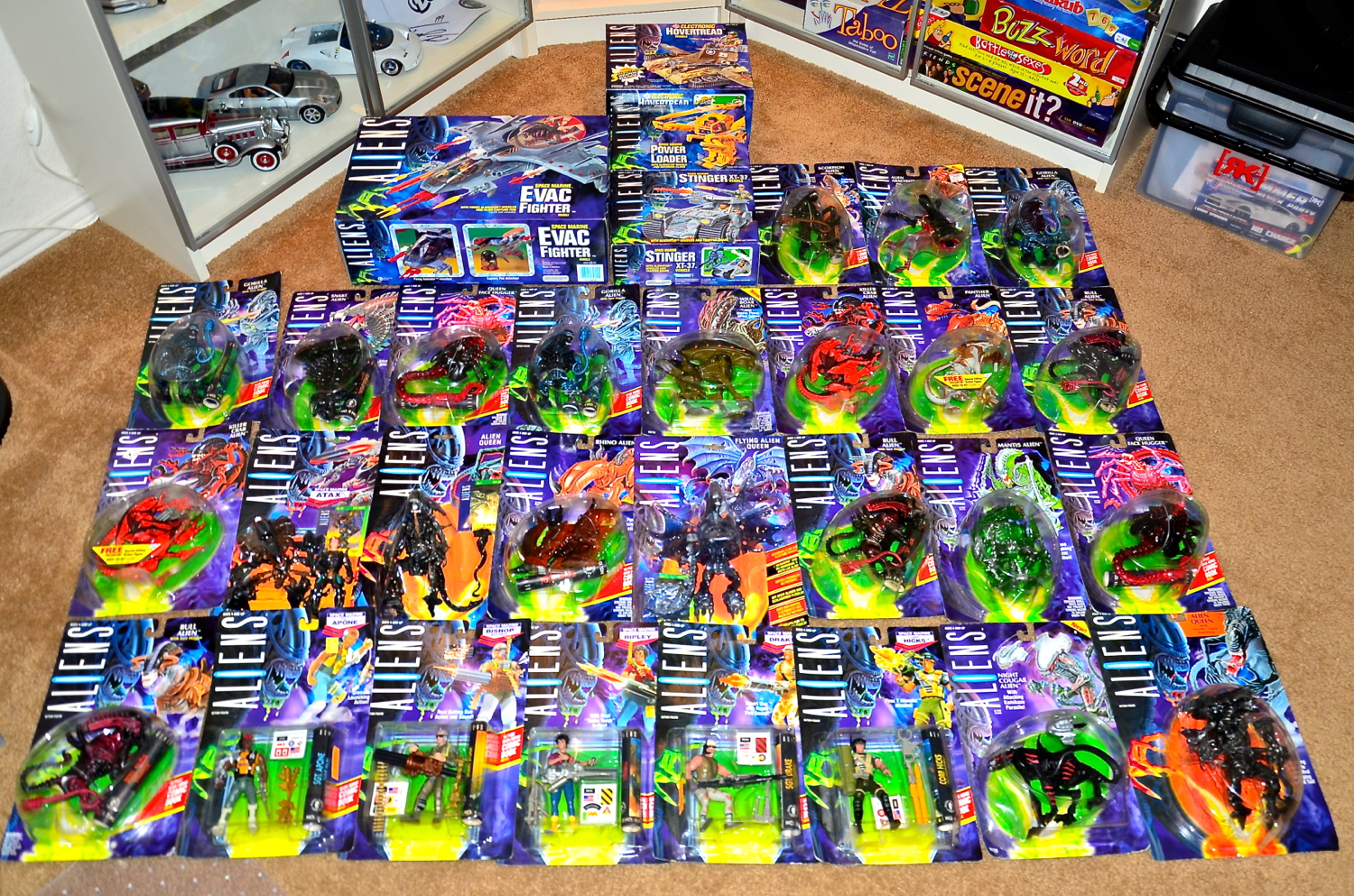
New Alien figures would not exist again until 1992. This time Kenner released a whole slew of toys, ones that included very obvious changes. The Alien was not scary anymore. Nothing could make that more clear than this:

This is series 1 of Kenner's launch of Alien toys.
This is series 1 of Kenner’s launch of Aliens toys.

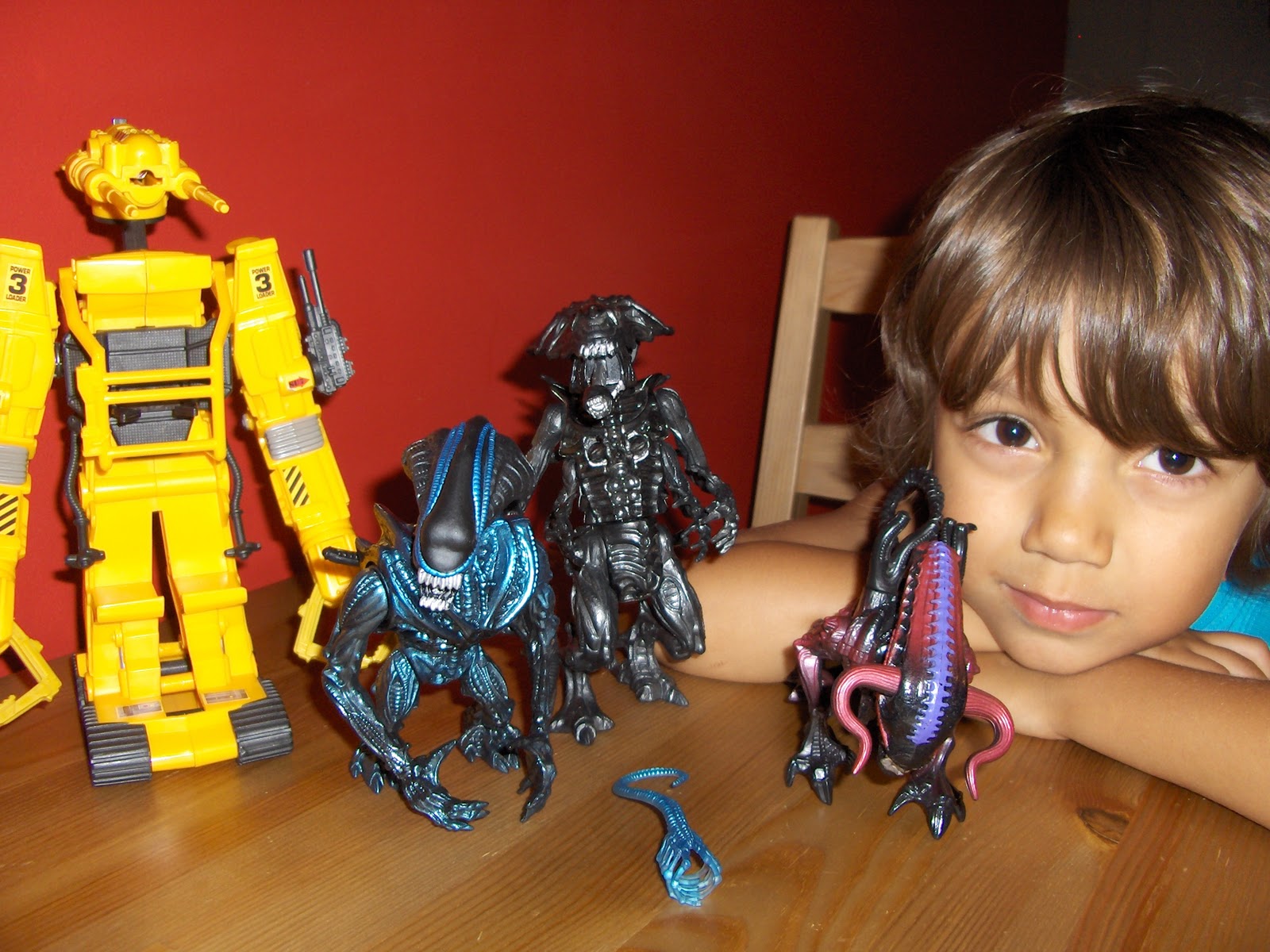
Based off the second movie, this line featured the gorilla alien, the scorpion alien, and the bull alien: all designs that were never featured in any movie. They were created in admittance of one thing: the original alien design was looking kinda old at this point. To keep kids interested, Kenner would have to continually reinvent the image, adding a new animal every time. This line of logic is nearly identical to Hasbro’s Transformers line. Yes, by 1992 – Aliens were the new Transformers. It did not stop there. Kenner would continue to create toys over the next few years, eventually bringing in the Predator franchise as well (years ahead of the crossover films).

I don't think this is every toy... but you get the idea.
I don’t think this is every toy… but you get the idea.

With the Alien image already gone, the merchandising eventually shifted away from children’s action figures to video games. There are twenty games based off the Alien franchise alone – without involving the Predator. For the most part, this video games were geared toward an older audience. Kids who had grown up playing with Kenner toys (like myself) could now take their experience interactive. The franchise has enjoyed several really well-made video games, with my personal recommendation having to be 2001’s Alien vs. Predator 2. The series has also suffered through low moments. Well, just look at Aliens: Colonial Marines

Behold the terror!

It is interesting to note that this year features the first Alien ‘horror’ experience in quite some time. Alien: Isolation tries to recreate the horror of the first movie, with the player taking on the role of a human who is trying to avoid and survive a single alien. The game has received wildly mixed reviews, with some calling it the return to horror that the franchise has been needing and others calling it a second Colonial Marines. Personally, I have not played the game so I cannot give it a review. It simply appears that the developers are trying to do the impossible. After all –

alien_isolation_6-100371845-origHow can this really be scary anymore? Just look at how terrifying Giger’s mighty alien has already become:

That child looks soooo afraid... that he won't get another toy.
That child looks so afraid… that he won’t get another toy.

If it wasn’t as scary the second time, how can it still be scary the fifty-second time?

Truth is Scarier than Fiction: The Town that Dreaded Sundown (1976)

Based on a true story.

These words usually mean the following: “Something sort of similar happened, but with a lot less spectacle.” It is the nature of Hollywood to be larger-than-life. Blockbusters would have no appeal if everyone wasn’t itching to see something so awesome in scope that it could not possibly be real. Ideas are escalated and exaggerated, all with the aim of creating a sensation. With the genre of horror, a terrible event is usually twisted away from reality to allow the audience more detached enjoyment. For example, Ed Gein was a terrifying person but nowhere near the hulking brutal monster, Leatherface, that he inspired. He only killed two people (we think), not the thirty that Leatherface hunted down. Make it bigger – that seems to be the Hollywood model of thinking.

And then there is The Town that Dreaded Sundown.

Released in 1976, this film is a rare pre-slasher (a film that features a serial killer as a main character but predates Halloween). The film was inspired by the real life “phantom killer,” a man credited with killing five people in Texarkana in 1946. Reading the description, one would think this is where the original design for Jason Voorhees emerged. The idea of this actually happening is terrifying – the fact that it did is horrible. And yet, in the strangest move ever, the Hollywood film downplayed how nightmarish the event actually was.

While he may look like the stuff of fiction, the phantom killer's depiction is true to witness accounts.
While he may look like the stuff of fiction, the phantom killer’s depiction is true to witness accounts.

The movie follows two police officers, Norman Ramsey (Andrew Prine) and J.D. Morales (Ben Johnson) as they attempt to hunt down and catch the phantom killer. The audience is first introduced to Ramsey, as he tracks and nearly catches the killer after his first two victims. The event is depicted as a hot pursuit, with the killer just barely evading capture.

… Only that didn’t happen.

The couple who were the first victims weren’t found right away. The killer was able to commit the heinous deed and escape before any police were aware of his crime. One could make the argument that the change was made to add action to the film – to give audiences the thrill of almost catching the killer, and then allowing them to feel sympathy for the heroic Ramsey. Likely this change was done to elevate the heroism of the authorities, but it is strange to see a horror movie making an event less scary, especially when it is “based on a true story.”

Most of the film’s major changes echo this effect. The killer is reduced to a being who appears to have simply gotten lucky in evading capture, while the police’s effectiveness is greatly exaggerated. This is one of the few times (that I am aware of) where Hollywood horror shied away from the terrible truth. The reality was that the phantom killer never came close to being caught. One, or possibly multiple, psychopaths held an entire town in the grip of fear for months… then vanished.

The film ends with the police shooting the phantom killer in the leg. In real life, no such confrontation ever took place.

There is one historical inaccuracy that is much more in line with typical Hollywood: timing. The murders are placed much closer together to help elevate the panic of the town and presumably create more atmosphere in the film. In reality, the murders were farther apart and not connected by a neat timed-sequence. It is strange that the filmmakers were okay with this change to ratchet up the horror, while at the same time downplays the hopelessness and lack of control present in the real events.

The movie also exaggerates in the brutality of the murders. Most victims were simply shot.

Real life does not always have the good guys or the laughs of the movies. Sometimes terrible events simply happen. It appears that director Charles B. Pierce wanted to show some respect for the past. He created heroes, falsified hope, and ended his film on a nonexistent victory.  History-based horror films usually commit the opposite changes. Was this a film with a conscience? Did Pierce have reservations of filming crimes that had only happened thirty years prior? Evidently, he was not conflicted enough to shy away completely from the material. Regardless of quality or intention, The Town That Dreaded Sundown was made unique by its adaptation. The film’s marketing, however, was much more in line with typical standards… and perhaps a little tasteless.

Still lurking? Really?
Still lurking? Really? The poster does more to inspire hopelessness than the entire movie. Yet perhaps it also crosses a line – after all, many of the survivors were still alive when this movie was released. I can’t imagine they appreciated the tagline.

Who knows what direction the remake will take.