The F*ck am I Watching? We're Back! A Dinosaur's Story

Everyone has that movie – you know the one I’m talking about. You watched it over and over again as a kid, loving every minute of it… and then you grew up. Said movie disappeared, either sold at a yard sale or recorded over (talking some VHS nonsense here) or just plain lost. Years passed and you forgot that this piece of your childhood ever existed, until one day it’s mentioned at a party or you see a clip on Youtube or flipping channels. Then it’s a joyful act of rediscovery! Right?

… Not always.
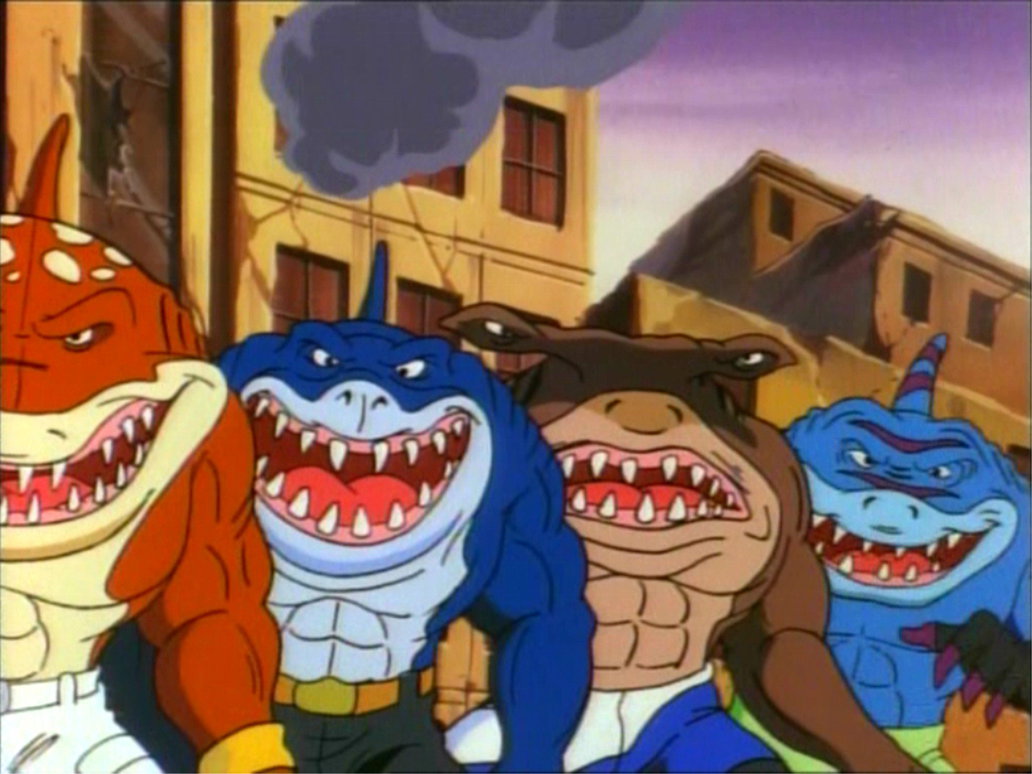
Stay dead, Street Sharks! You're the poor man's Ninja Turtles... and that is saying something right now.
Stay dead, Street Sharks! You’re the poor man’s Ninja Turtles… and that is saying something right now.

We’re Back! A Dinosaur’s Story was that type of movie for me. I loved it to pieces as a kid. This is the movie that came out in 1993 alongside Jurassic Park… but was more for the kiddies (not that we all didn’t watch Jurassic Park anyway – cause f*ck the police). As a young boy, I couldn’t get enough of this movie. There was a talking T-Rex, hot dog-eating dinosaurs, a wish radio… an evil screw-eyed professor (with an actual screw for an eye)… dancing dinosaurs on the streets of New York…
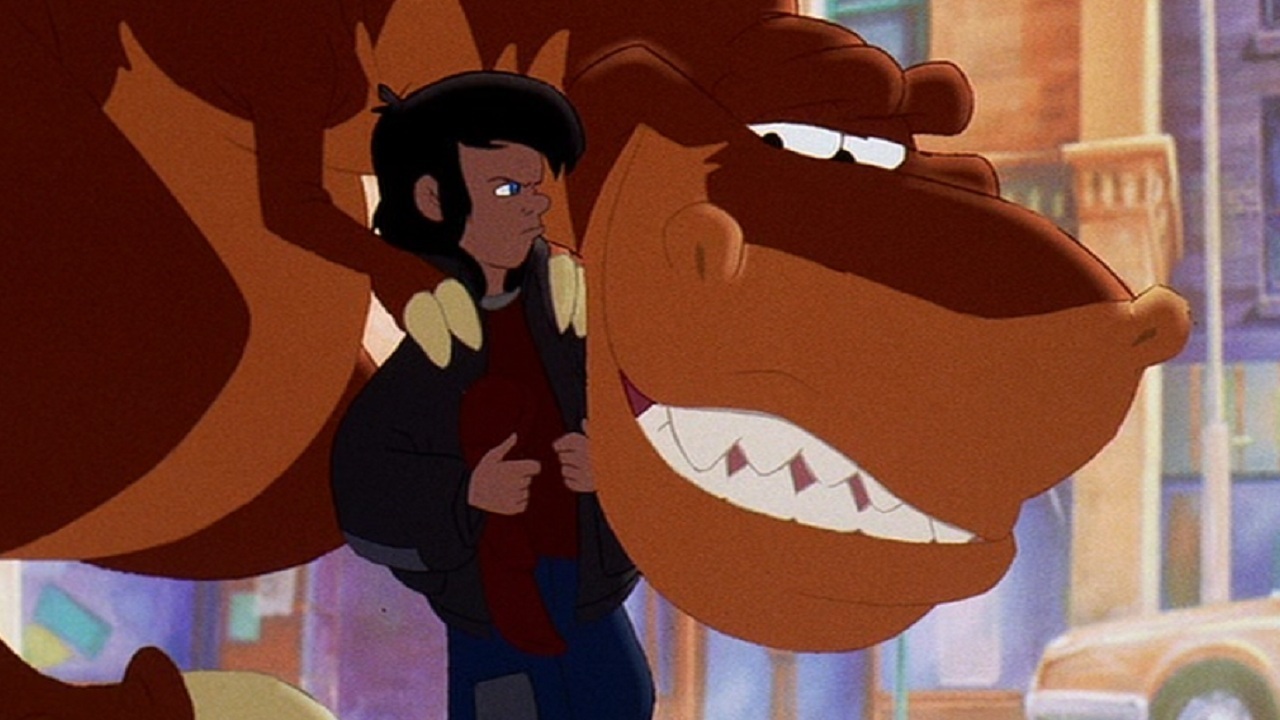
The movie also features this. I believe it speaks for itself.

What the f*ck am I watching?

Yes, We’re Back! is incredibly creative, which is probably one of the things that made it so appealing to children – that and dinosaurs. Watching the film today, however, is a different experience all together. Is it still creative? Sure – but let’s get to the plot.

Okay so the movie opens with young birds in a nest. One of the birds is getting picked on by his siblings and wants to leave the nest (he’s going to run away and join the circus – a logical career move for a bird). Out he goes onto a branch and, regrettably, it’s not long before he topples off. But that’s okay because he’s saved by Rex (voiced by none other than John Goodman), a dinosaur who’s playing golf.

What?
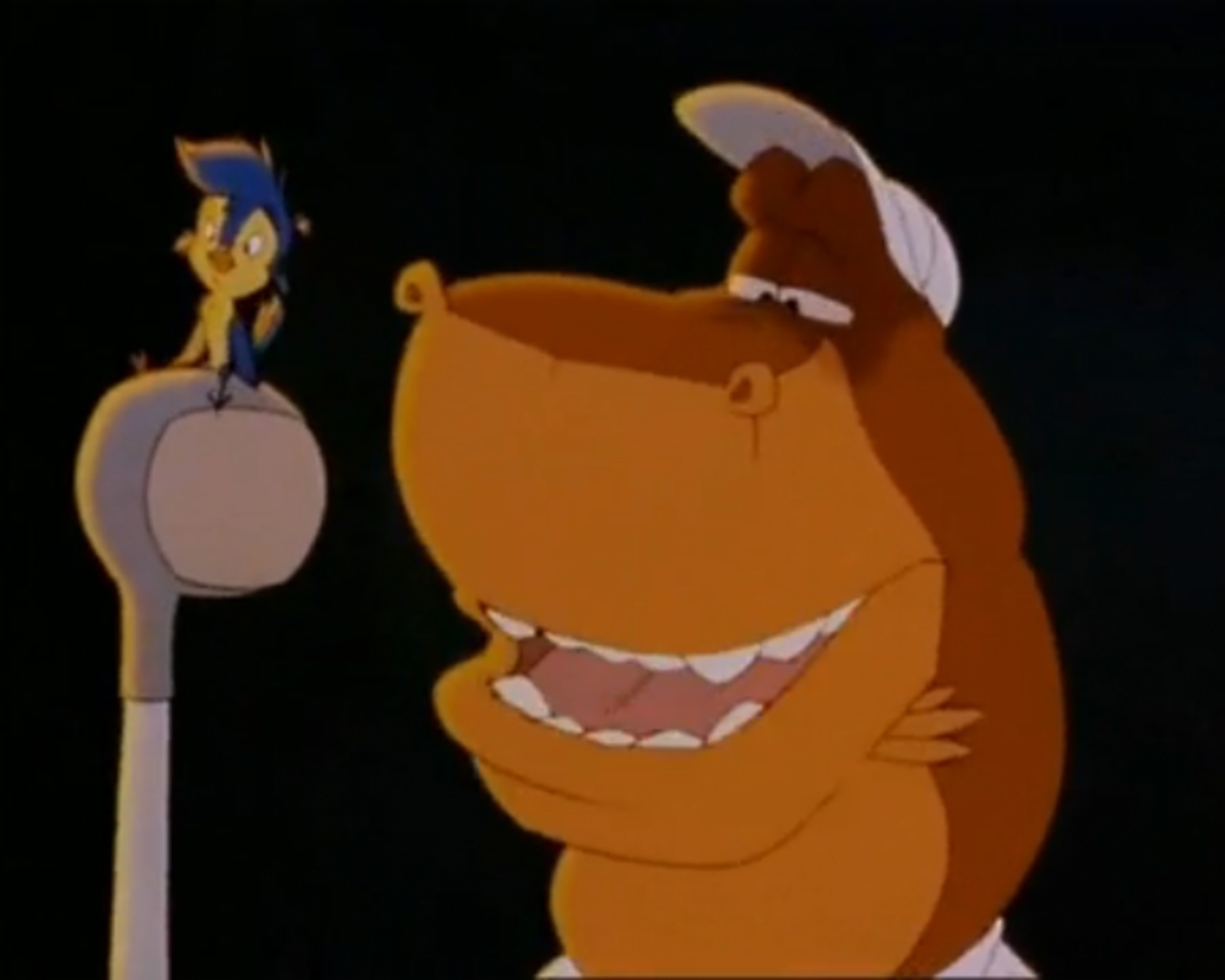
He's one white dinosaur.
He’s one white dinosaur.

No no, we’re nowhere near strange yet. Anyway, so John Goodrex has some advice for the would-be run away. He tells him the story of another little boy who ran away to join the circus. But of course, he can’t start the story without explaining a couple of big questions – how did he get to present day New York and why is he so smart?

Are you ready for this?

Okay, so Rex was your average dumb T-Rex. He ran, ate other dinosaurs – all that good jazz. Then his alien named Vorb (voiced by Jay Leno) comes down and snatches him up into this flying ship thing. Vorb gives him “Brain Grain,” a breakfast cereal designed to make him smarter! It also makes him look more cuddly and gives him the ability to talk! Shortly thereafter, Rex is introduced to the other dinosaurs who have been genetically modified. There’s a triceratops, a pterodactyl, and a… an… a duck-billed thing (probably an edmontosaurus). They’ve also been given Brain Grain and now spend their days eating hot dogs… cause why not?

Anyway, that’s the basic introduction. One thing I will mention now (that I never noticed as a kid) is how much the pterodactyl hits on Rex. She seriously has several bizarre lines and seems to get off on him checking out her “wingspan.” Now, I wasn’t there in the days of the dinosaur but… pretty sure the Bible says something against inter-dinosaur romance – check Leviticus.
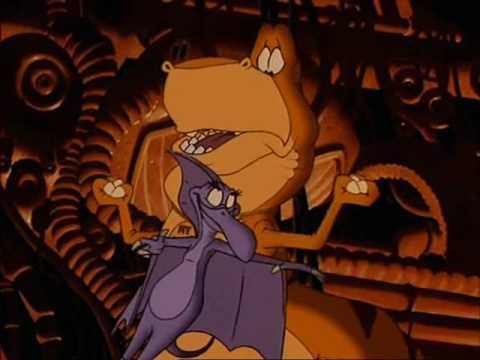
No means no, regardless of species involved.

The Dinosaurs are introduced to Captain Neweyes (voiced by Walter Cronkite – not kidding), the man who invented the Brain Grain and the time-traveling flying spaceship that they’re all on. Captain Neweyes has also invented a “wish radio” that he uses to see what people want. What people want in the 90s is apparently dinosaurs (a way to solve world hunger would have been great too – Captain Neweyes is kind of a jerk when you think about it).

This man could stop Hitler if he wanted to.

So, the Captain’s plan: bring dinosaurs to modern day New York and then air-drop them into the city. Tell them nothing about the world besides that they have to go to the Museum of Natural History and to avoid his evil brother, Professor Screweyes (a time traveler who uses his amazing technology to run a circus). Sounds like a great plan, what could go wrong?

Oh, right… dinosaurs in New York. Of course, the dinos meet up with two kids who want to go to the circus and get sidetracked with Professor Screweyes. The Professor possesses his own “Brain Drain” that can de-evolve people… why is he just running a circus again?

I won’t spoil the ending… let’s just say it involves a feast for crows.
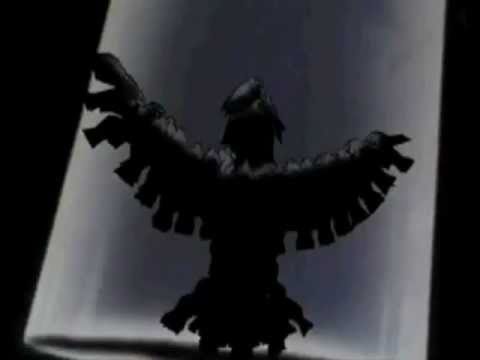
See what I did there?

What a weird movie. Seriously, I can understand an animated movie about dinosaurs. Who doesn’t love The Land Before Time? But… really? Why… everything else?

Turns out this movie is based off a book (so it wasn’t entirely the crazed director’s ideas), but the movie adds in characters like Captain Neweyes and Professor Screweyes.

To be fair, it’s not just the plot that’s strange. The cast is a bizarre collection too. At the time, John Goodman had never done animation before, and Walter Cronkite was never known for voice acting. Oh, Julia Child is in this too as the museum curator. Again: why not?

Fun fact: during the parade scene, there is numerous advertising for Jurassic Park. Parents objected to the material and were promptly ignored.

Is the movie good? It’s… hard to say. You’ll be entertained, I can guarantee that. It sure is creative. If one can ignore all the problems (and there are many) that come with time travel, there is fun to be had. It is an odd movie… a really odd movie, but one with a heart, even if that heart is lusting for inter-dinosaur romance.

What the f*ck am I watching: We’re Back! A Dinosaur’s Story.

OH – BEST PART: the whole thing is on Youtube. Enjoy!

Sequels We Didn't Need: Cloudy with a Chance of Meatballs 2

In 2009, Phil Lord and Christopher Miller brought Cloudy with a Chance of Meatballs to the screen. The film told the charming story of Flint Lockwood and how his weather-to-food invention changed his life and the lives of those around him. Using visual, vaudeville-style humor and endearing character development, Lord and Miller were able to bring a soul to Cloudy with a Chance of Meatballs that elevated it beyond a mediocre 3D effects fest. It is a great little movie and worth a watch to anyone out there who hasn’t seen it (and still has enough of a child’s wonder left to appreciate food falling from the sky). Fast-forward to 2013 when Cloudy with a Chance of Meatballs returned to the screen. The aptly named Cloudy with a Chance of Meatballs 2. It is a sad realization to understand that Hollywood’s response to anything successful is this: make more until it isn’t. Sequels are just an inevitability these days. As audiences, we can only hope that they’re good. Cloudy with a Chance of Meatballs 2… is not such a sequel.

Wait, what went wrong? It is such a dynamite concept! I mean, food falling from the sky – that’s at least eight films right there…

3 could be about the evolution of food people and 4 could be about them leaving Earth to find their own planet! And then you have a trilogy of fighting food aliens! Brilliant.

Yeah, for anyone who hasn’t seen the first film, I will just say that it ends without the feeling that there is something more to tell. Certain movies, like Back to the Future and the Incredibles, close with a tease: the promise of more exciting adventures to come. Flint Lockwood’s story was done at the end of Cloudy with a Chance of Meatballs. He had grown up, realized that he didn’t need to prove himself to everyone when the people who mattered already supported him. The weather-to-food machine (yes, I’m aware it has a more creative name) is destroyed and life returns to normal. There and back again: adventure complete.

Things literally ended with sunshine and rainbows.

That is not to say that all sequels to complete stories are bad. Look at the Toy Story trilogy: each one of those is a complete adventure on its own. Yes, they use the same characters but there is no overarching plot. It is just three separate toy stories that work really well together. So Cloudy with a Chance of Meatballs 2 was not dead in the water. It even gained a fun life in its new idea: a Jules Verne-style island of living food. Sort of a next mutation phase to Flint’s invention.

Where Cloudy with a Chance of Meatballs 2 falls off is its continuing character development. Here in lies one of the greatest pitfalls for sequels. You can always tell if a sequel is driven by writing or by marketing. For instance, in a sequel driven by writing (Toy Story 2), not every character returns from the first movie. There is no desire to create a “hey, do you remember how cool this was last time?” moment, since the story has enough to tell on its own. In a sequel driven by marketing, everyone comes back regardless if they have anything to contribute to the current story. Case in point:

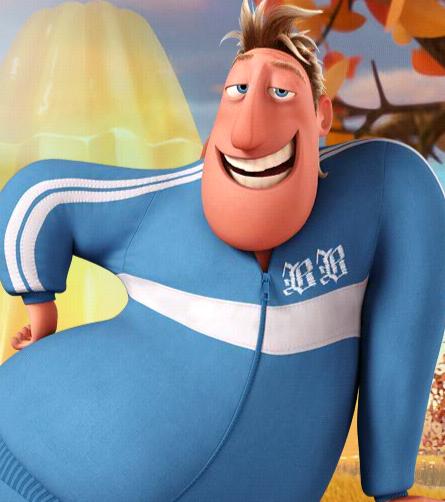
This guy.
This guy.

Brent was a character who had a purpose in the first movie: he was the guy Flint Lockwood wanted to be. He was popular and people liked him. The first film was also clever enough to showcase the failings of Brent’s type of “popularity” (no one really cares about him as a person, just about one thing he did) and use it to teach Flint what true acceptance was. In the sequel… he’s just there. Really, there isn’t anything that he does that is vital to the plot. I love Andy Samberg but… yeah could have done without him.

The real failing though is with Flint Lockwood. Like I said, his journey in the first film was one of acceptance. He felt like he had to prove himself and didn’t realize that he was already cared for. There was an evil mentor figure (the Mayor, voiced by Bruce Campbell) who led Flint along: pushed him to do more than he was comfortable with, to betray his own instincts just to satisfy others. Luckily by the end of the movie, Flint knows better. He is not looking for acceptance from the wrong places anymore and knows that there is more to life than pleasing everyone. Well, good thing that’s over and done with… right?

Certainly this will never happen again.

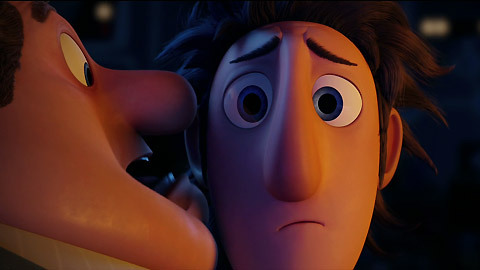
Wrong. The sequel re-does that same character growth. The new villain, Chester V (voiced by Will Forte) is essentially the Mayor from the first movie. Wait, no: he’s Flint Lockwood’s childhood inspiration… wait, I thought that was his mom? No matter, rather than evolve Flint – the film regresses him back to a place of insecurity that is well, boring. We already saw that movie.

And it happened again.

This writing decision prevents any of the other characters from growing as well and basically keeps the movie in an unnatural holding pattern that exists solely to move the plot along. There was potential here as Chester V comes off in the vein of Steve Jobs. A more clever film would have examined the idea of selling scientific advancement for profit vs. knowledge for the good of all mankind. Sadly, this is what we got.

So if you haven’t seen the first Cloudy with a Chance of Meatballs, do yourself a favor and give it a watch. If you have, liked it, and want to see more: watch the original again. The sequel is just the same story… that, like a joke, isn’t as great the second time that you hear it.

Also Sam is a non-character in the sequel. I mean, to be fair she's already been a love interest so what more is there... right? Sigh...
Also Sam is a non-character in the sequel. I mean, to be fair she’s already been a love interest so what more is there… right? Sigh…

How to Tell a Story: Why How to Train Your Dragon Works so Well

It seems that Dreamworks Animation has always been the animation company in Pixar‘s shadow. While Pixar was creating films like Ratatouille and Wall-E, Dreamworks produced Shrek the Third and Kung Fu Panda. Not to say that Kung Fu Panda was bad (unlike Shrek the Third), it was just a much more simple story. Dreamworks simply was not producing animated films that contained the same amount of layers as their Pixar counterparts. In 2010, Dreamworks Animation made How to Train Your Dragon while Pixar created Toy Story 3. Yes, Pixar made the better film that year. That said, Dreamworks Animation took a giant step forward as How to Train Your Dragon became one of their greatest films produced. The story was just as simple and uninspired as any of their animated products, yet How to Train Your Dragon proves that quality is found not just in the story, but in how it is told.

First, what is the story in How to Train Your Dragon? As I said before, it is very standard: at its heart, How to Train Your Dragon is about an outcast boy growing up and learning to accept/believe in himself, and how that belief and acceptance catapulted him into much stronger social standing. This is a plot that has been before in animated films. At least once:

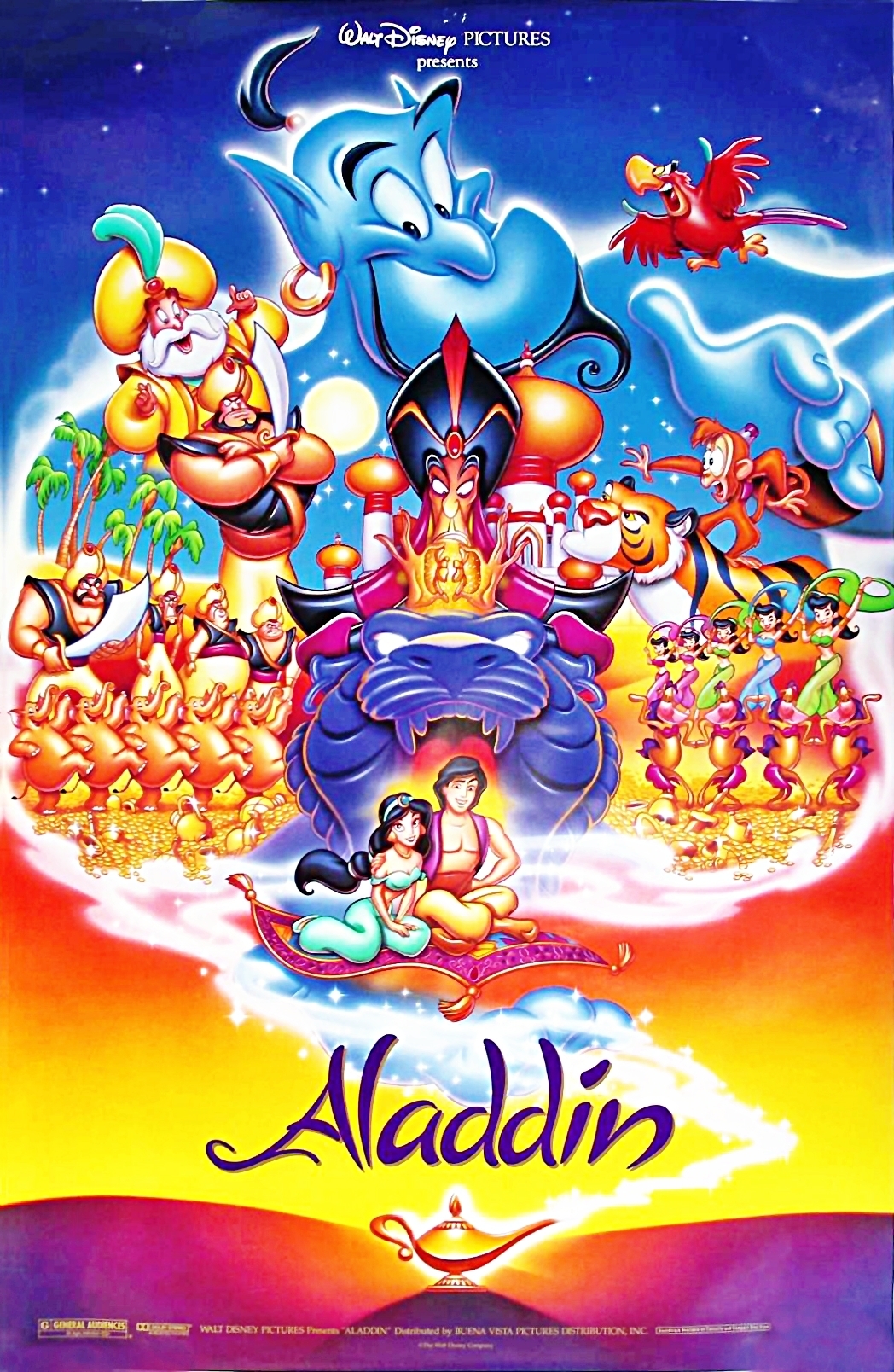
An outcast street-rat learns the value in being true to himself and becomes sultan of a fictional land (with some non-human assistance in the form of a genie.)
An outcast street-rat learns the value in being true to himself and becomes sultan of a fictional land (with some non-human assistance in the form of a genie).

Or twice:

An outcast learns to accept the true strength of his character in order to become a hero (with the non-human assistance of a satyr).

And like, say by Dreamworks the year before:

An outcast learns to be true to himself and becomes the dragon warrior/hero (with the non-human assistance of a turtle and a red panda).

So stories like this are nothing new to the world of animated feature films. Yes, every one of the movies mentioned dresses their story in a different way but all of those films share the same heart. However, these three films also help to illustrate my point: it matters how the story is told. It is possible to like only one of those movies and detest the other two. With How to Train Your Dragon, the strength of the movie lies in its character relationships.

Every story needs vehicles in order to function. The protagonist, the antagonist, the supporting characters, the conflict: every story possesses (at least most of) these traits. The difference between good stories and bad ones is how well these vehicles are disguised. A good writer/storyteller can dress fiction to be real life. In my article criticizing Star Wars Episode II, I (endeavored to) explained that the main reason that the relationship between Anakin and Padme failed was because it appeared as a plot focus and not as an actual relationship between two people. How to Train Your Dragon avoids this pitfall.

One of the main triumphs to examine is Stoick (voiced by Gerard Butler). He is Hiccup’s father and one of (if not the) main antagonist in the story. In a children’s movie, where simple storytelling is sometimes favored, it would be very easy to leave Stoick as simply that: the antagonist. Hiccup’s father who never listens, a bloodthirsty viking looking to kill dragons. Instead, writers William Davies, Dean DeBlois, and Chris Sanders create a complex relationship between Hiccup and Stoick that feels very real (even in a movie that is about taming dragons).

Hiccup has the revelation of where his mindless violent tendencies lead…

At the heart of their conflict is not an argument over what direction to take the plot (to kill dragons or not to kill dragons) but instead the simple problem of communication. Stoick and Hiccup do not know how to communicate with one another. They are both headstrong and stubborn (illustrating similar qualities helps enforce the family connection) and they simply have a hard time relating to one another. Yet throughout the movie it is illustrated that, while the two have their differences, they are a family who loves each other. This adds weight to the conflict and enhances the scenes between them.

…Much earlier than Stoick does.

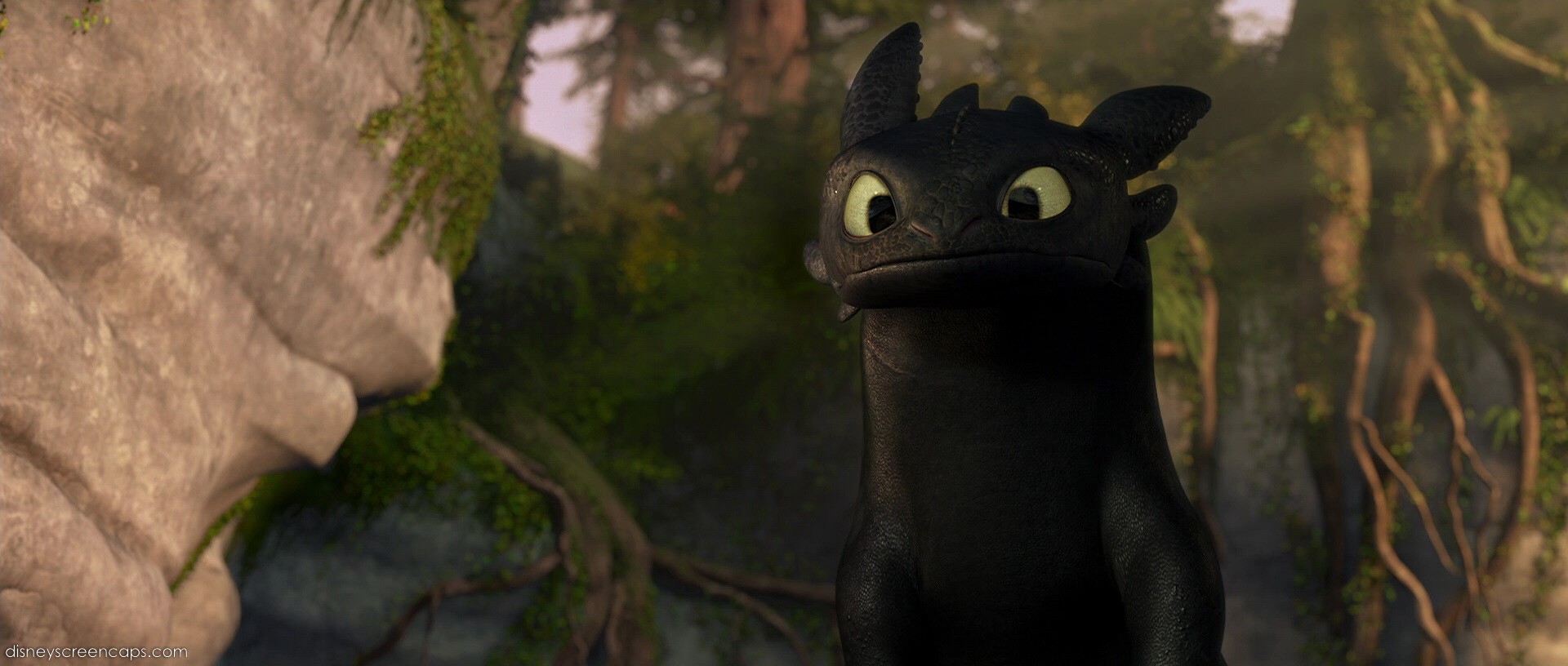
Another strong point is, obviously, the relationship between Hiccup and Toothless. Both Chris Sanders and Dean Deblois created Lilo and Stitch and it is no surprise to see the same quality of human-sentient animal relationship in this film. Toothless is not simply a dragon but brims with personality, which allows Hiccup to exhibit personality as well. If Toothless were simply a dragon (a beast without intelligence), the plot of the film could still proceed but its content would have been weakened greatly.

The animators realized a creature who could fully communicate without speech.

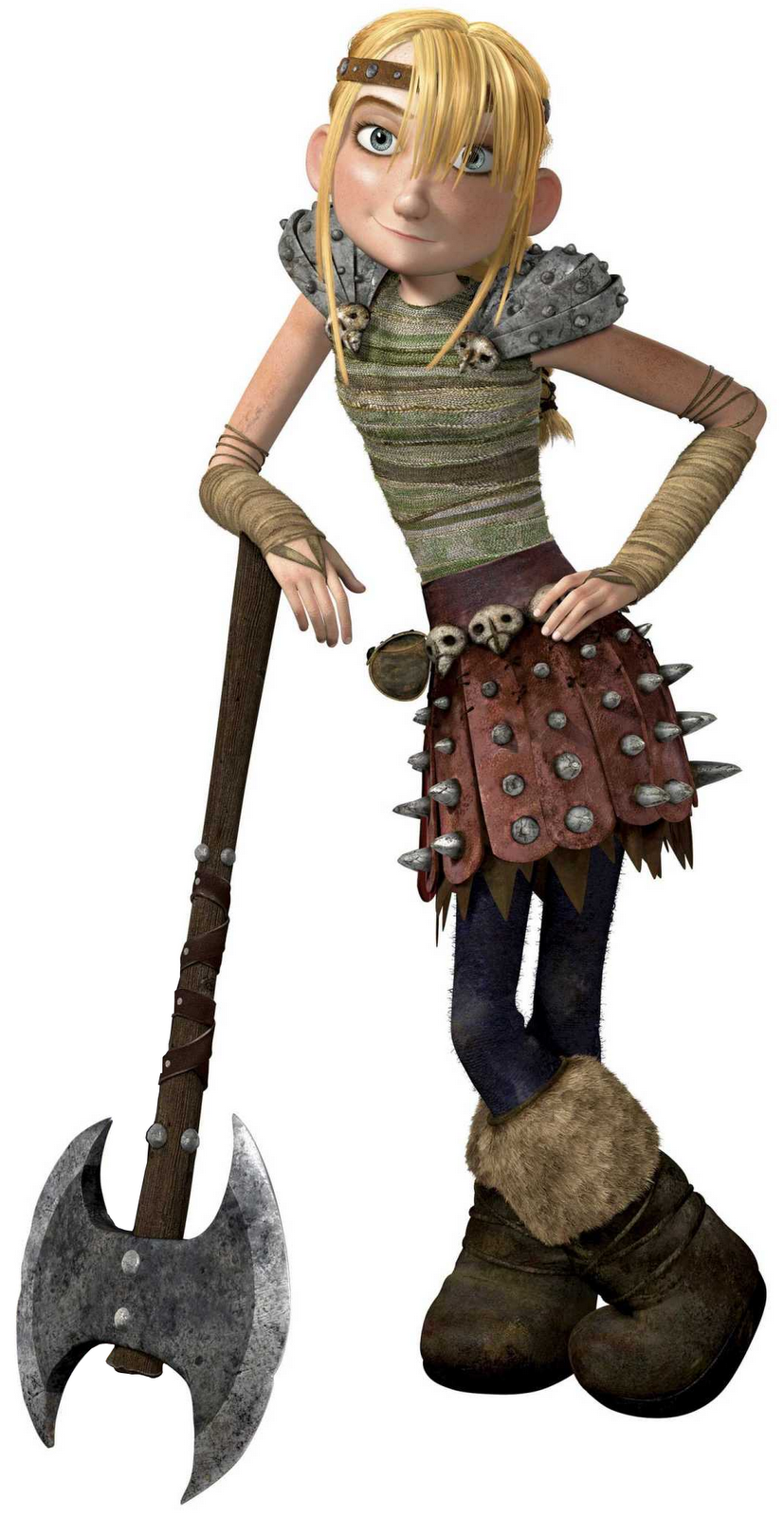
One final relationship I will mention is Hiccup’s relationship with Astrid (voiced by America Ferrera). Yes, Astrid does serve as the love interest, but she is also a character with her own personality. She is revealed to be determined and methodical. There are also several scenes demonstrating her capabilities as a warrior. This gives her personality so that, when she does fall in love with Hiccup, the audience can understand the reason why.

Astrid spends most of the movie with axe in hand.

How to Train Your Dragon is not the best animated film ever by a long shot, but it is a well-made film. There is much more here done right than wrong. The film never panders down to its child audience, never embraces the more flashy-dancey tendencies of other Dreamworks’ films, never does anything to sacrifice story or character. It is part of the proof that it matters more how a story is told, rather than what its content is.

PS – the sequel isn’t bad either.