Wasted Source Material: Abraham Lincoln, Vampire Hunter

Vampires, they’re everywhere in popular culture right now. Thankfully today’s post will deal with vampires more resembling the works of Stoker rather than Meyer. However, I’m not interested in discussing Stoker’s characters – Dracula, Mina Harker, Abraham Van Helsing – we’ll save them for another day. This article will discuss a different vampire hunter by the name of Abraham. Yep, old honest Abe, 16th president of the United States and, if you believe author Seth Grahame-Smith, one of history’s best vampire hunters. I just had the good fortune of reading Abraham Lincoln, Vampire Hunter and recommend it to anything out there looking to read something that manages to be both incredibly intelligent and hilariously stupid at the same time.

The cover captures the book's tone nicely.
The cover captures the book’s tone nicely.

I almost didn’t read this book. Not because I heard it was bad, quite the opposite. I heard nothing but glowing praise for Grahame-Smith’s novel. There was only one thing that made me want nothing more to do with President Lincoln’s secret crusade: the film. I saw Abraham Lincoln: Vampire Hunter before I read the book and let me just say this about the movie without going into too many details – it’s dumb. We’re not talking about about the fun kind of dumb either. This is not an entertaining movie to watch. It’s boring, cliched and does nothing to distinguish itself from any other sub-par action film (despite the fact Abraham Lincoln is it’s star).  How are two such wildly different reactions possible? It is hard to believe, especially given the fact that the book’s author, Seth Grahame-Smith, wrote the film adaptation’s screenplay.

Let’s address that issue first with a simple statement: being a talented author does not always translate into being a talented screenwriter. Anyone who doubts me need look no further than Stephen King. King is one of my favorite authors. Incredibly prolific, Stephen King has written some bad books to be sure but he has also written a wealth of novels that (I have no doubt) will one day be seen as literary classics of the 20th century. The same cannot be said for his movie career (watch Sleepwalkers some time). So authors don’t always write the best scripts. Furthermore, some authors don’t know what is best for the film adaptations of their work. To return to the Stephen King example: King famously hates Stanley Kubrick’s version of The Shining (he wrote his own adaptation in 1997 in the form of a mini-series, give that a watch too).

So Seth Grahame-Smith’s involvement did not guarantee success. If anything, it proved to be the film’s ultimate downfall. The script in Abraham Lincoln: Vampire Hunter is more than stupid. It’s stunted, sudden and leaves a very anti-climactic finale. So how did this happen? What did Grahame-Smith do to squander such great source material (that he created) in the film adaptation of Abraham Lincoln, Vampire Hunter? Let’s look into it.

The character of Jack Barts is very minor in the book but enjoys much greater screen time in the film.

In order to specify the film’s failures, the book’s greatest triumph must be highlighted. Seth Grahame-Smith must have done a lot of research before writing his fictional biography and it shows constantly in the reading. This book isn’t simply an exercise in “hey, wouldn’t it be cool if Abe Lincoln fought vampires”. It is the mythology of vampires and their folklore being painstakingly woven into the actual history of Abraham Lincoln’s life. There is so much in Abraham Lincoln, Vampire Hunter that reads like an actual diary. This effect greatly enhances the believability of Lincoln stalking vampires at night with his hunting axe and leading a Civil War with the main (but secret purpose) of banishing vampires from North America. Every ridiculous moment in the book is given credibility by its historical background.

There is nothing this fictional in the book. Unfortunately there is nothing else remotely this stupidly cool in the movie either.

The movie takes quite a few more liberties with history other than the inclusion of vampires. The result: it doesn’t feel like Abraham Lincoln anymore. Why use such a famous historical figure and then change things to the point where his life is almost unrecognizable? Funny enough, there was a movie that came out in 2012 that was a lot closer to the book’s level of intelligence:

Just add vampires and you have the book.

There is a semi-spoken belief that action movies must be stupid in order to appeal to the masses. I’d like to think films like Christopher Nolan’s The Dark Knight and Inception disprove this notion. After watching Abraham Lincoln: Vampire Hunter, I can’t help but wonder if Seth Grahame-Smith believes this to be true and that is the reason why he threw out his research for the film. Why else would he create the character of William Johnson (there was a real person by this name in Lincoln’s life but so completely different that he cannot even be said to be “inspiration”) other than to hammer in the fact that Lincoln hated slavery. I guess making slave owners into evil vampires that were butchering millions of people wasn’t enough to drive home the message that slavery was evil.

There is another character created specifically for the movie called Adam. Adam is the purely fictitious big bad vampire who is leading the order of vampires in the south. In the book it was Jefferson Davis (president of the Confederacy) who served as the final antagonist (Davis is not a vampire but had sold out, effectively selling all of mankind into slavery… pretty clever right?). This change wouldn’t bother me if Adam was interesting but he’s not. The wooden stake that kills him has more personality.

That’s really the biggest flaw in all of the changes. They do simplify, which is needed when there are only 105 minutes to work with, but they do not simplify well. I am very convinced that there was a better way to present this movie and the proof lies in Lincoln, a vastly superior movie released on nearly the same source material as the Abraham Lincoln, Vampire Hunter. They are both fictionalized historical biographies, one is simply far more fictionalized than the other.

Mary Todd Lincoln was nowhere near this physically attractive. Another change "necessary" for a successful summer action flick.
Mary Todd Lincoln was nowhere near this physically attractive. Another change “necessary” for a successful summer action flick.

I’m all for stupid movies as long as they’re fun. They definitely have their place in the summer. My disappointment in Abraham Lincoln: Vampire Hunter does not come from the fact that it took an intelligent book and dumbed it down. It lies in the poor adaptation skills of the author, Seth Grahame-Smith. Apparently for Grahame-Smith, smart writing is a lot easier than stupid writing. I only wish I could say that as a compliment. So if you’re interested in mixing Abraham Lincoln and vampires, do yourself a favor and read the book. Sure it will take you a few more hours but you’ll actually enjoy those hours. Six-eight happy hours vs. one hour and forty-five minutes of wishing you were doing something else with your time: your call.

Kudos to marketing for developing a cool, moody poster. Too bad the final product doesn't have near the same effect.
Kudos to marketing for developing a cool, moody poster. Too bad the final product doesn’t have near the same effect.

Thoughts? Comments? Am I full of it or onto something? Let me know now in the feedback section of this article.

We're Supposed to Like Him but Why? Grandpa Joe (Willy Wonka and the Chocolate Factory)

So today being a Monday, I decided to start the week with a not-so-serious article and talk about one of my favorite movies growing up. There are few films that convey “pure imagination” like Willy Wonka and the Chocolate Factory (I know… I had to use it). The songs, the sets, the characters, the candy: I love this movie. In my opinion there are few cinematic portrayals that rival Gene Wilder’s enchanting yet haunting Willy Wonka. It’s a performance that is right up there with Anthony Hopkins’ Hannibal Lecter, Johnny Depp’s Jack Sparrow and Heath Ledger’s Joker. But I’m not writing here today to talk about Wilder or the Oompa Loompas or anything so magical. Let’s instead talk about Grandpa Joe.

For any who haven’t seen this movie in a while, Grandpa Joe is one of four elderly invalids living with protagonist Charlie and his mother. It is established right away that this is not a financially secure household. The place is very tiny with all four grandparents having to share one bed. Their poverty is further established by the fact that Charlie, despite his young age, works a job while the other kids play and sing songs with candy vendors. In addition, when Charlie gets his pay raise and spends it on a loaf of bread, his mother refers to the food as “a banquet”. Yeah, he get the idea that the belts are tightened with his family.

This is good character development for Charlie as it establishes him as both responsible and selfless, despite his young age. He didn’t spend any of his hard earned money on candy, no matter how catchy the opening song. No instead he goes home and buys food for his family. In addition, he nobly volunteers to support his Grandpa Joe’s tobacco cost. Nice kid… let’s talk about Grandpa Joe.

Grandpa Joe lives a boring existence. Every day he lies in a bed, chatting with its three other occupants and watching television. He will also talk to Charlie and his mother if they are available (you know, not working to feed him and let him smoke). Let’s talk about some of the conversation he has with Charlie’s mother, in particular his commentary here: “One of these days I’m going to get out of this bed and help him.” Grandpa Joe is of course referring to Charlie, sympathizing with the protagonist. That’s all well and good but as Charlie’s mother responds: “Dad, in all the years you’ve talked about getting out of that bed, I have yet to see you set foot on the ground.” Guess what the response here is: “Well maybe if the floor wasn’t so cold.”

Yep, it’s that damn floor. Ruins so many plans doesn’t it? Here is tiny Charlie, a kid matured passed his age into supporting his family and why? Because that accursed floor holds Grandpa Joe prisoner, preventing him from, you know, being a responsible adult and supporting his family… or at least supporting his own tobacco habits. I never liked the character of Grandpa Joe and I didn’t get why the movie wanted to present him as a good guy. Certainly Charlie loves him but Charlie is a young and naive kid. We’re taught to think all the other kids that go with Charlie to the chocolate factory are horrible, wicked people that get what they deserve but what about Grandpa Joe? Seriously? Those kids may have been jerks but they were like eight. What’s his excuse?

Other reasons why Grandpa Joe cannot leave the bed: the liberal media, violent video games, Barack Obama's socialist policies.
Other reasons why Grandpa Joe cannot leave the bed: the liberal media, violent video games, Barack Obama’s socialist policies.

So Grandpa Joe, despite loving Charlie and sympathizing deeply with his plight, cannot be moved to help. He’s old damn it! Now maybe I’m being harsh. The film appears to establish Grandpa Joe as unable to leave the bed. Sure he has a fighting spirit, but that cannot overcome old age and a potentially debilitating condition. Maybe Grandpa Joe really would like nothing more than to spring out of that bed and help Charlie to support his family, he simply no longer possesses the strength. Yeah, I might be being too harsh.

NOPE.
NOPE.

As soon as Charlie wins the last coveted golden ticket, Grandpa Joe is suddenly more limber than Usain Bolt. Where was this energy when his family needed it? Where was that drive when his grandson was delivering papers or his daughter was up late at night washing laundry?

tumblr_mg2tpaTL941r4g1p5o1_500

Grandpa Joe doesn’t get better either. Any who have read the book know that the film differs in more than just its name. There is a whole added sequence involving fizzy lifting drinks which is not present in Roald Dahl’s novel. The scene occurs shortly after Violet Beauregarde as transformed into a giant blueberry and wheeled off to whatever fate awaits her. Point is: this scene occurs after children have failed and been kicked out (or worse killed). So Charlie and Grandpa Joe have reason to be on their toes. Now Charlie is a young kid, young kids are eager, impetuous – stupid. Point is, I don’t fault Charlie for wanting to try the fizzy lifting drinks. It shows that he’s human. Without this error, he would look like a young Christ figure (just watch Tim Burton’s Charlie and the Chocolate Factory to see what I’m talking about).

Now Grandpa Joe is the adult in this situation and the bulk of the responsibility falls to him. AND IT’S HIS IDEA! “Let’s take a drink, Charlie. No one’s watching.” Really? Really Grandpa Joe? This is the man who, not ten minutes prior, called Violet Beauregarde “a nitwit” for not listening to Mr. Wonka. So what does that make him? Did Mr. Wonka say the drinks were okay? No, no he did not. In fact he said the opposite.

I just nearly got my grandson and I killed for fizzy lifting drinks.

And yet, despite this, when Willy Wonka informs Charlie and Grandpa Joe of their failure to keep to the contract (one that Charlie signed without reading at request of Grandpa Joe), it isn’t Charlie who flips his shit. I know that Charlie is supposed to be the protagonist and he’s an awesome one but this movie can be read with a very cynical undertone. Willy Wonka and the Chocolate Factory: a story about how an old man uses his grandson to promote his living status. Think about it.

At the beginning of the film, Grandpa Joe is lying in bed and a small rundown home. At the end of the movie, he is essentially co-owner of Willy Wonka’s chocolate factory. Did he do anything to deserve this rise in fortunes: nope. Well he cultivated a good relationship with his grandson… although why Charlie listens to him is beyond me. Why he’s not portrayed far more negatively in the movie is beyond me as well; really looking at everything, he is an antagonistic figure.

I feel Grandpa Joe is one of the people that republicans must imagine when they fear unemployment benefits and welfare. Obviously his guy is taking advantage of not just his grandson but the system too. I can only imagine what happened after Charlie took over the chocolate factory and gave Grandpa Joe a job. What if he put him in charge of something important like keeping track of company income? I can only imagine the ordeal ending with: “Sorry Charlie, I know the factory closed but – the floor, it was just too cold to keep a cost efficient budget.”

Well played Grandpa Joe, well played.

Getting real tired of your shit, Grandpa Joe.

Thoughts? Comments? Am I full of shit or onto something? Let me know now in the feedback section of this article.

In Defense of Russell Crowe's Javert

Just going to give a head’s up that this article will be a very complete character examination of this man below (this includes full plot breakdown and ending spoilers):      les-miserables-poster-russell-crowe

Oh my god, we’re talking about Russell Crowe. More specifically I’m going to defend his performance of Javert in the recent musical hit, Les Misérables. Many people saw this and many people liked it. The film was nominated for eight Oscars; winning three of them (Anne Hathaway’s well-deserved win as Best Supporting Actress among them). So in short, Les Misérables was a critical success. There was only one performance that a lot of people took issue with. Yeah – our boy, Russell.  Many critics found Crowe’s singing to be… less than stellar. Well, when The Onion devotes a video to you, less than stellar may not be adequately summing it up:  http://www.theonion.com/video/russell-crowe-praised-for-stunning-portrayal-of-ma,30839/. Youtube even had Hitler weigh in on Russell Crowe, both as an actor and as a singer (warning, Hitler uses naughty German language): http://www.youtube.com/watch?v=Xt-m9dT_jwc.

Okay maybe that last video was overkill but point is: people, in large part, hated Russell Crowe in Les Misérables. He was labeled as the one awful performance amidst a sea of gems (Hathaway, Jackman, etc.). Now I have no comment on Russell Crowe as a human being (never met the guy) but I feel like he has been treated too harshly in regards to Les Misérables. Crowe’s performance in the film isn’t only one of the strongest, it would probably rank as author Victor Hugo’s personal favorite as I believe it is the truest performance to the character that has been portrayed thus far. 

And that's the way they all became the Javert Bunch!
And that’s the way they all became the Javert Bunch!

Before I get into Javert, a quick summary of the Les Misérables plot for those who may be unfamiliar: Wolverine steals a loaf of bread and Gladiator sends him to prison. After prison Wolverine goes on the run and adopts Catwoman’s daughter from Borat and Bellatrix Lestrange. Gladiator continues to pursue Wolverine but everyone runs into a 99% rally and a lot of people are killed. It may be comical but it is strangely accurate. Anyway, couldn’t resist having this in here. Back to Crowe’s Javert.

As said in the above poster, he is the law. That’s putting it pretty simply. In describing the character, many people have labeled Javert as a legalist. I’m going to use Wikipedia’s current definition of legalism, as I feel it is very adequate: “usually pejorative term referring to an over-emphasis on discipline of conduct, or legal ideas, usually implying an allegation of misguided rigour, pride, superficiality, the neglect of mercy, and ignorance of the grace of God or emphasizing the letter of law over the spirit. Legalism is alleged against any view that obedience to law, not faith in God’s grace, is the pre-eminent principle of redemption.” Woah, that does sum up Javert pretty well.

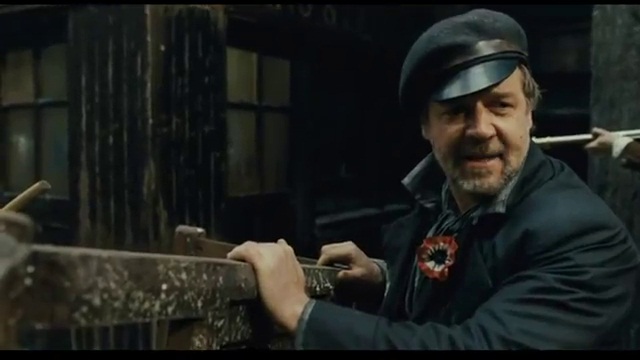
One of the few times in the film that Javert shows life is in his pursuit of the law.

Okay so that’s great about Javert but people had problems with Crowe’s performance. In particular he was called wooden and his singing style was described as awkward and not as emotionally free as the other characters. I would agree with the latter part of this criticism but I would not agree that it is criticism. Another way to put that: I believe that Russell Crowe’s singing style is completely intentional (just not comically bad as The Onion suggests).

It all starts if you accept Javert as a strict legalist, which I do as it makes full sense with his character. Now while Javert may be strict in his philosophical beliefs (as he is with everything else) there becomes present a very clear and dividing doubt within the character. Javert sees the world’s morality in terms of black and white: Jean Valjean stole so he is a bad man, the revolutionaries are rebelling against order so they must be bad people – that sort of thing. Problem for him is that Les Misérables is full of gray area. Yes, Valjean stole but he is also a noble man. Yes the revolutionaries resist the law but theirs is a noble cause. Javert is not stupid, he sees all this an it baffles him. Essentially Les Misérables can be watched as the slow breaking of Javert’s mind.

Javert is comfortable when secluded with the law. In his palace of police, there is no outside world presence.

You see this in Crowe’s performance. People have described it as a detractor. The fact that Crowe’s Javert has an almost constant expression on his face (the one pictured in the poster). He never looks certain as many people feel that Javert should. This is true, he does not look certain. He appears in conflict. While Javert is the face of the law, sworn to uphold it – Crowe’s Javert very clearly does not agree with the word of the law, despite his insistence otherwise. It is a psychological condition of denial that gives the otherwise villainous character of Javert a real human depth.

The only time Javert expresses happiness in the film is in the subversion of the law.

There is a sadness that Crowe imbues the character with that makes the audience feels for him. Look at that picture above. I’m not lying, that’s the only time in a nearly three hour film that Javert cracks a smile. In everything else: grim uncertainty. Yet if the fact that Javert is not happy in his work does not do enough to instill a sense of sympathy. I invite a contrast, look at how comfortable he looks above. Okay, now look below:

One of the most powerful character moments for Javert: among the dead revolutionaries.

Russell Crowe portrays Javert as more than out-of-place in this scene. There is genuine horror and dawning realization upon his features. It is only at this point in the film that Javert’s last illusions of black and white crumble away. That medal, which has been displayed so proudly on his chest in previous scenes, guess what is the first thing Javert does with that medal afterward:

Yep.
Yep.

Javert pins his medal on the dead body of the boy who identified him as a police inspector. For that crime, Javert was supposed to hang. The only reason he did not was through the actions of Jean Valjean.

Okay, you’re saying, right now I’m saying there’s a lot of strength in the character of Javert but I’m not doing much to showcase the strength of Russell Crowe’s performance. Audiences are fine with Javert, it’s Crowe that they have the problem with. True enough but while I have been focusing on Javert’s character, I have been doing that to highlight the pains and constraints by which he is acted. Javert is not a character who will give a tearful rendition of his thoughts and emotions. Well, he does do that once – right before he kills himself. Yeah, there is emotional repression. You know how that looks? Watch the subtleties of Crowe’s acting. Heck, just look at the way he carries himself on the pivotal balcony scenes:

Like a hanged man dangling without the rope.

Les Misérables is not a subtle movie. Really Javert is the only character in it who is not comfortable in self-expression. When you consider that, his character must then have a completely unique style of portrayal. Yes his performance should stand out, but it is not wooden. The Onion was right. Russel Crowe should be commended on his performance. It is the perfect portrayal of a man who walks the line between law and chaos, right and wrong, and what happens when he finally stumbles and falls.

Russell Crowe’s own defense of his performance: http://www.youtube.com/watch?v=vnAhVVPUdGU

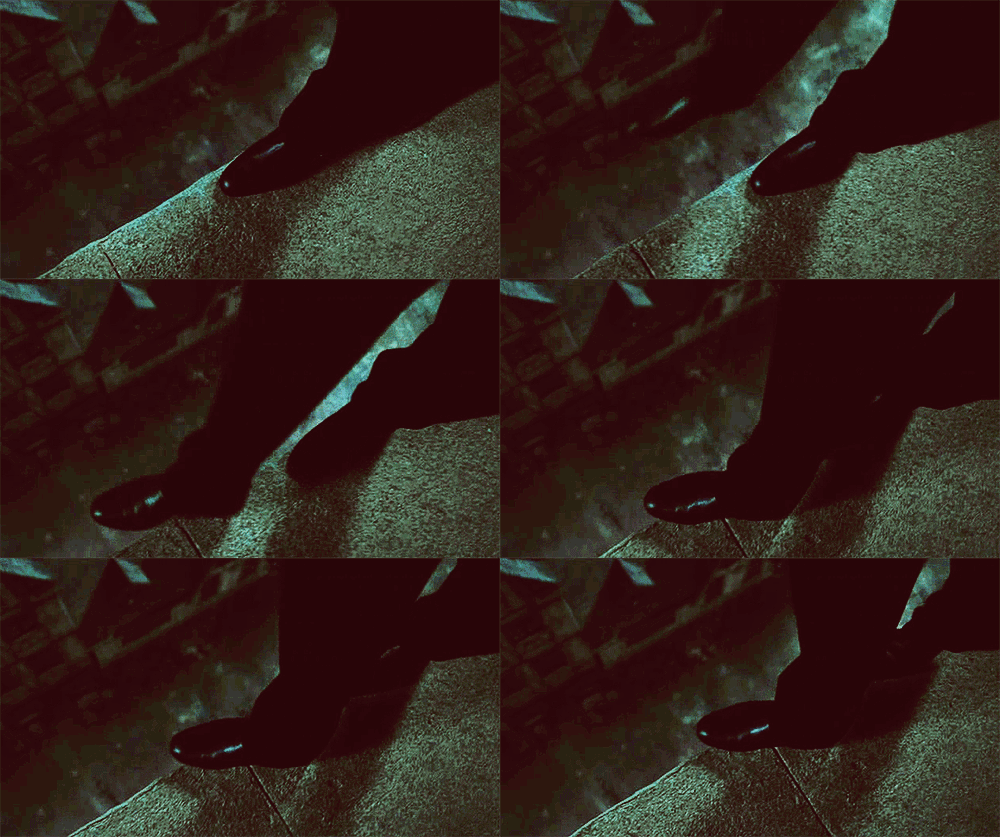
Walking the line. One side is visually simple while the other is complex. A whole character reflected in a sequence.

Thoughts? Comments? Am I full of shit or onto something? Let me know now in the feedback section of this article.