Blog

Comedy Resurrection: Family Guy

When I was in high school (back when dinosaurs ruled the Earth), I remember one show achieving an incredible cult status. Family Guy was a short-lived comedy series which had aired a couple years before and been subsequently cancelled. This was before the days of the Netflix instant queue so whoever had the DVD sets of the three seasons (Family Guy‘s initial run) was Johnny Cool. There were fifty-one episodes of exceptional quality. The show was like a newer version of The Simpsons in terms of a family-oriented comedy but with a splash of (at the time) refreshing randomness in the humor. It had characters you could care about, stories that were interesting and jokes that made you laugh. In short, everything needed to be a great comedy. And there were 51 episodes so it hardly pulled a Firefly (only 13) before being cancelled.

The holy grail of television comedy between 1999-2004.

Still, what if it came back? That was the hope on everyone’s mind. The first three seasons had been so good, imagine if there was more? Thanks to tremendous DVD sales (very similar to Austin Powers) Fox granted our request and, in 2005, Family Guy returned to television. Since then one hundred and fifty new episodes have appeared and Family Guy is still going strong, ready to begin its twelfth season this fall. But is it any good?

Short answer: no. Blunt answer: it really sucks. Commercial success is no guarantee of quality, simply look at The Simpsons‘ current twenty-four season run to validate that statement. So the question then becomes: what (in my opinion) went wrong? I was a big fan of Family Guy‘s original run, why do I hate the new episodes so much? Happy to elaborate.

In general, this sums up a good portion of my criticism.

Let’s start with the characters. As highlighted above, they did not return to television as they left it. Stewie in particular underwent a drastic change in the style of his humor. Gone were all his inventions, all his over-the-top, nowhere-near-remotely-plausible plans to take over the world. Instead of those jokes, we got gay jokes… which was great since there was no other source of homosexual humor present in Family Guy (besides Jasper, Bruce, Rupert, Herbert, Mr. Weed, etc). Point being, a unique source of jokes was substituted for cruder humor. None of these characters really portray any sophistication either, pretty much every one of them revolves around the concept of “ha ha ha, he likes guys – and he is a guy! That’s so gay and funny!”  So why did Seth MacFarlane (Family Guy‘s creator) decide that we needed yet another character dedicated to that style of humor, who knows? Maybe he was too busy with things like American Dad!, The Cleveland Show, and Ted to care.

This persona inspired nearly all the quotes that made Stewie Griffin a famous persona among teenagers. Still it was quickly changed when Family Guy returned.

But more about MacFarlane’s role (or lack thereof) in a moment. Remember those side characters I named. Just a list of five names, did you know all of them? I believe side characters to be an essential tool to increase longevity, especially in the case of comedies. When solid side characters (with depth and personality) are developed, it allows for a few episodes to shift their focus away from the main family, thus helping to prolong the freshness of the main cast. Let me use shows like the Simpsons and South Park for examples. Both developed their town ensembles ridiculously well. In this way, say South Park can devote an entire episode to Mr. Garrison while giving the boys only a cameo appearance. The episode is still funny since Mr. Garrison is more than a cut-out character.

This episode from The Simpsons made fun of the idea of spin-offs while at the same time devoting an entire episode to some of their stronger side characters.
This episode from The Simpsons, entitled “The Simpsons Spin-Off Showcase”, made fun of the idea of spin-offs while at the same time devoting an entire episode to some of their stronger side characters.

In my opinion, Family Guy never had the wealth of side comedy enjoyed by the other two shows. Aside from Peter’s immediate neighbors and in-laws, there isn’t much personality to be found in the town of Quahog. And when there is enough personality to salvage maybe an episode or two away from the Griffins, MacFarlane and company decided to take this route instead:

The Cleveland Show (2009-2013) was a poor decision on the part of Fox to further divide MacFarlane's jokes and comical talent. These characters should migrate back into Family Guy.
The Cleveland Show (2009-2013) was a poor decision on the part of Fox to further divide MacFarlane’s jokes and comical talent. These characters should migrate back into Family Guy.

When side character strength is a problem, don’t move the stronger ones out of town. This ties into another point: MacFarlane is a funny guy. Love him or hate him, it’s hard to argue with the amount of success he’s had… or didn’t have then suddenly had. Thanks to Family Guy‘s cult success in the DVD market, Seth MacFarlane went from obscurity to household name in a very short time. However I don’t think this success has been properly employed. Rather than simply putting Family Guy back on the air, Fox decided to do that in addition to giving another previously failed MacFarlane pilot the green light: American Dad!. Let the record show that, of the current MacFarlane comedy creations, American Dad! is my favorite. However, it’s creation would further the decay of Family Guy by removing writing talent from its staff. Watch American Dad! and Family Guy close together while remembering that formula I talked about back at the beginning of this article. Characters + story + random jokes = good Family Guy. American Dad! now has the stronger characters and story, leaving Family Guy to survive solely from its bouts of randomness.

Matt Weitzman and Mike Barker were two of Family Guy's more prominant creative staff who left to work on American Dad!. Their absence was quickly felt.
Matt Weitzman and Mike Barker were two of Family Guy‘s more prominent creative staff who left to work on American Dad!. Their absence was quickly felt.

But here is the real question: given how lucky Seth MacFarlane’s success was, did he really deserve so many venues for his comedy? Family Guy was not successful the first time it aired, the only reason the series survived to rebirth was because of the DVD sales. That isn’t roaring success by a long shot. Yet Fox was willing to give him multiple shows. Sure, you could argue and say that Fox did the same thing with Matt Groening (The Simpsons‘ creator) by giving him Futurama (we’ll talk more about this show later) but Futurama aired in 1999, the same year as season 11 of The Simpsons: the point where many people feel that The Simpsons began to drop dramatically in quality. Coincidence, I think not.

Imagine a show that combined all these characters and all these stories into one setting. That would be a dynamite comedy on the level of the original Family Guy.

With Seth MacFarlane’s success now branching off into movies (I personally wasn’t a huge fan of Ted – thought it was okay), it is a real question as to how involved he still is with the show that made him famous. Sure, he may voice half the cast but that isn’t the same level of commitment as writing or helping to create characters. I don’t think his heart is in it anymore. But hey, don’t take my words for it – here’s his: “Part of me thinks that Family Guy should have already ended. I think seven seasons is about the right lifespan for a TV series. I talk to the fans and in a way I’m kind of secretly hoping for them to say we’re done with it. There are plenty of people who say the show is kind of over the hill … but still the vast majority go pale in the face when I mention the possibility.”

So there you have it, Family Guy was a short-lived gem that was resurrected into a bloated brand name used to sell evenings on Fox. I don’t think the show has many years left. It will always be remembered as the show that made Seth MacFarlane famous and (for me personally) a highlight during high school in the early 2000s. Yet this was clearly one case where everyone should have left well enough alone and Family Guy should have simply been allowed to rest in peace. Oh well, at least American Dad! is still okay.

Thoughts? Comments? Am I full of it or onto something? Let me know now in the feedback section of this article.

Repetition vs. Atmosphere: Luigi's Mansion: Dark Moon

In 2001, Nintendo released Luigi’s Mansion for the Gamecube and it was good. The definition of a short and sweet video game, Luigi’s Mansion didn’t didn’t take longer than four hours to beat but was enjoyable enough to warrant multiple play-throughs (I think I beat it like seven times over the past twelve years). People liked Luigi’s Mansion, it was something new from Nintendo, and it would take twelve years before it would see a sequel.  Yet the wait is over as Luigi’s Mansion: Dark Moon was released for the Nintendo 3DS this past March. The verdict: it’s pretty good. If you were a fan of the first game, I highly recommend you check it out. That being said, today’s article aims to explore a decision in the design and the positives and negatives that came with it. I’m going to talk about one of the greatest changes that separates Luigi’s Mansion: Dark Moon from its predecessor: the level design.

As I said before, Luigi’s Mansion was a pretty short game. Luigi’s Mansion: Dark Moon is a good deal longer. I believe my initial play-through of the story mode took me roughly fifteen hours (nearly four times longer than the first game). So anyone out there who thought Luigi’s Mansion was too short, this is the game for you. Yet there is no giant mansion to explore this time. Probably a good thing as I am unsure if anything smaller than say, the mansion from Resident Evil, would be large enough to keep players entertained for fifteen hours. No, instead Luigi’s Mansion: Dark Moon opts for five mansions. None of them feel as large as the one from the first game but between the five: this is a bigger game.

There is no one mansion in Dark Moon that holds a candle to the original.

Yet Luigi’s Mansion: Dark Moon is designed for a portable system, not a console. This platform decision necessitated a different type of level design. Anyone who played Luigi’s Mansion remembers wandering the halls of the original mansion, unlocking rooms, backtracking and only being pulled out to save at the end of every act (there were also Toads scattered throughout the grounds who served as save points). Basically, there was a degree of immersive exploration to the gameplay. The original could get away with it too as it was a console game: meaning a game the player had to sit down to play.

Portable games today are designed to be played on the go, for those fifteen minutes of free time between stops. Look at Super Mario 3D Land (also for the 3DS), no level in that game takes longer than five minutes to complete. In the case of mobile games like Angry Birds, levels can take only seconds to clear. It’s smart design for portable systems. Frequent save points insure that progress can be made in relatively short time, allowing the player to progress without investing hours in a single sitting. Makes sense but what does that mean for Luigi’s Mansion: Dark Moon? It means you can expect to get pulled out of the mansions – a lot.

Expect to see Professor E. Gadd every twenty minutes or so.

Again this makes sense given recent portable game design but I don’t feel it was the right way to go for a Luigi’s Mansion game. The result is that the exploration feels a lot more like a mechanic than an organic part of gameplay. Remember when you completed an act in the first Luigi’s Mansion and certain things would reset (who could hunt for treasure in places you hunted for treasure before)? That happens every time you are pulled out by E. Gadd. This results in a lot of backtracking, backtracking that frankly feels nothing but tiresome after fifteen hours. I know I did not find everything in Luigi’s Mansion: Dark Moon but that’s because I didn’t want to. Vacuuming a vase or a table just looses its appeal after you’ve done it five times.

The levels are smartly designed but expect to revisit them multiple times in search of elusive collectables.

More than that, Luigi’s Mansion: Dark Moon has been slightly simplified since the first game. Remember the elemental spirits Luigi could suction up in order to shoot fire, ice, or water from his vacuum (it’s Nintendo logic, just go with it)? Well they’re not present in Dark Moon. So every puzzle can be solved by either sucking, blowing, or shining one of two light choices. The puzzles are still fun to solve, don’t get me wrong (even if there are one too many of them) but this is the long awaited Luigi’s Mansion sequel, I was expecting everything to be bigger and better. So yeah, you’re doing less but you’re doing that less more often.

The rainbow-spectrum dark light is the new attraction. Works like your normal like but with more rainbows (and it reveals hidden objects).

Don’t get me wrong, I really do like Luigi’s Mansion: Dark Moon. It oozes so much charm that it dares the player not to like it, and the controls work very well. The exploration mechanic was simply one of my favorite parts of the first game and I think this new one really loses atmosphere by making the levels must shorter and more objective based. In Luigi’s Mansion it felt like the player was being encouraged to wander, in Dark Moon there is more a feeling of being lead around. Does it make more sense given portable game design: yes. But why not just stick with what the first game did? A toad on every floor was fine for the quick save (a few more could have been added to insure there was always one around). I liked exploring, it made Luigi’s Mansion a great treasure hunting game in addition to the best Ghostbusters game ever made.

Another personal nitpick: while I like the ghost designs in Dark Moon, I really miss the painting-style ghosts from the first game.

Oh yeah, treasure hunting, that brings me to my final point. Remember in Luigi’s Mansion how there was a point to it? The player collected gold and gems and then at the end of the game was rewarded with a house (maybe a mansion, maybe a tree house) based on how much treasure was collected. That is gone from Dark Moon. Instead, the money is used to unlock upgrades for the Poltergust 5000. This would be great if there were enough to keep the player unlocking. There are very few upgrades and you will have them all by the halfway point of the game. After that, there really is no point to the money. It strikes me as a very strange decision. On one hand: money gathering is more focused on thanks to the repeat gameplay. On the other: it matters a lot less and has no bearing on the game after a certain point. That is a decision that baffles me. If I’m going to be encouraged to do something over and over, I would like to be rewarded for doing it over and over.

Nitpicks aside though, this is still the Luigi’s Mansion sequel and it is a great game. Personally I like the first one better (for the reasons just highlighted) but that’s just me. If you’ve been craving more Luigi for the past twelve years, you’ll be happy to know that the folks over at Nintendo (the publishers) and Next Level Games (the developers) did him justice. Now if we can just get one for the Wii U without waiting another twelve years… that would be great.

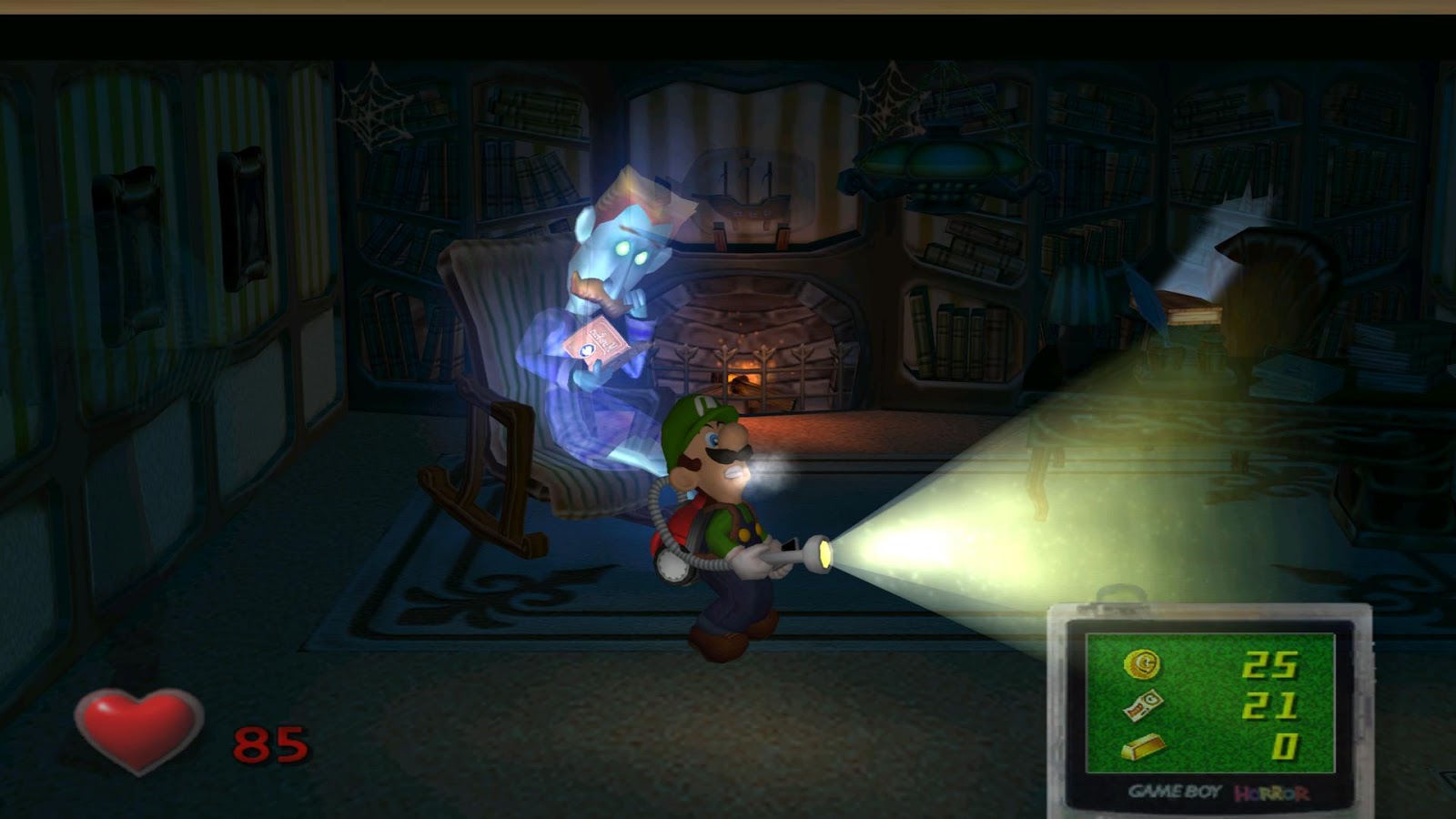
Pictures like this really make me want to see a fully HD Luigi's Mansion 2 for the Nintendo Wii U.
Pictures like this really make me want to see a fully HD Luigi’s Mansion 2 for the Nintendo Wii U.

Thoughts? Comments? Am I full of it or onto something? Let me know now in the feedback section of this article.

Wasted Source Material: Abraham Lincoln, Vampire Hunter

Vampires, they’re everywhere in popular culture right now. Thankfully today’s post will deal with vampires more resembling the works of Stoker rather than Meyer. However, I’m not interested in discussing Stoker’s characters – Dracula, Mina Harker, Abraham Van Helsing – we’ll save them for another day. This article will discuss a different vampire hunter by the name of Abraham. Yep, old honest Abe, 16th president of the United States and, if you believe author Seth Grahame-Smith, one of history’s best vampire hunters. I just had the good fortune of reading Abraham Lincoln, Vampire Hunter and recommend it to anything out there looking to read something that manages to be both incredibly intelligent and hilariously stupid at the same time.

The cover captures the book's tone nicely.
The cover captures the book’s tone nicely.

I almost didn’t read this book. Not because I heard it was bad, quite the opposite. I heard nothing but glowing praise for Grahame-Smith’s novel. There was only one thing that made me want nothing more to do with President Lincoln’s secret crusade: the film. I saw Abraham Lincoln: Vampire Hunter before I read the book and let me just say this about the movie without going into too many details – it’s dumb. We’re not talking about about the fun kind of dumb either. This is not an entertaining movie to watch. It’s boring, cliched and does nothing to distinguish itself from any other sub-par action film (despite the fact Abraham Lincoln is it’s star).  How are two such wildly different reactions possible? It is hard to believe, especially given the fact that the book’s author, Seth Grahame-Smith, wrote the film adaptation’s screenplay.

Let’s address that issue first with a simple statement: being a talented author does not always translate into being a talented screenwriter. Anyone who doubts me need look no further than Stephen King. King is one of my favorite authors. Incredibly prolific, Stephen King has written some bad books to be sure but he has also written a wealth of novels that (I have no doubt) will one day be seen as literary classics of the 20th century. The same cannot be said for his movie career (watch Sleepwalkers some time). So authors don’t always write the best scripts. Furthermore, some authors don’t know what is best for the film adaptations of their work. To return to the Stephen King example: King famously hates Stanley Kubrick’s version of The Shining (he wrote his own adaptation in 1997 in the form of a mini-series, give that a watch too).

So Seth Grahame-Smith’s involvement did not guarantee success. If anything, it proved to be the film’s ultimate downfall. The script in Abraham Lincoln: Vampire Hunter is more than stupid. It’s stunted, sudden and leaves a very anti-climactic finale. So how did this happen? What did Grahame-Smith do to squander such great source material (that he created) in the film adaptation of Abraham Lincoln, Vampire Hunter? Let’s look into it.

The character of Jack Barts is very minor in the book but enjoys much greater screen time in the film.

In order to specify the film’s failures, the book’s greatest triumph must be highlighted. Seth Grahame-Smith must have done a lot of research before writing his fictional biography and it shows constantly in the reading. This book isn’t simply an exercise in “hey, wouldn’t it be cool if Abe Lincoln fought vampires”. It is the mythology of vampires and their folklore being painstakingly woven into the actual history of Abraham Lincoln’s life. There is so much in Abraham Lincoln, Vampire Hunter that reads like an actual diary. This effect greatly enhances the believability of Lincoln stalking vampires at night with his hunting axe and leading a Civil War with the main (but secret purpose) of banishing vampires from North America. Every ridiculous moment in the book is given credibility by its historical background.

There is nothing this fictional in the book. Unfortunately there is nothing else remotely this stupidly cool in the movie either.

The movie takes quite a few more liberties with history other than the inclusion of vampires. The result: it doesn’t feel like Abraham Lincoln anymore. Why use such a famous historical figure and then change things to the point where his life is almost unrecognizable? Funny enough, there was a movie that came out in 2012 that was a lot closer to the book’s level of intelligence:

Just add vampires and you have the book.

There is a semi-spoken belief that action movies must be stupid in order to appeal to the masses. I’d like to think films like Christopher Nolan’s The Dark Knight and Inception disprove this notion. After watching Abraham Lincoln: Vampire Hunter, I can’t help but wonder if Seth Grahame-Smith believes this to be true and that is the reason why he threw out his research for the film. Why else would he create the character of William Johnson (there was a real person by this name in Lincoln’s life but so completely different that he cannot even be said to be “inspiration”) other than to hammer in the fact that Lincoln hated slavery. I guess making slave owners into evil vampires that were butchering millions of people wasn’t enough to drive home the message that slavery was evil.

There is another character created specifically for the movie called Adam. Adam is the purely fictitious big bad vampire who is leading the order of vampires in the south. In the book it was Jefferson Davis (president of the Confederacy) who served as the final antagonist (Davis is not a vampire but had sold out, effectively selling all of mankind into slavery… pretty clever right?). This change wouldn’t bother me if Adam was interesting but he’s not. The wooden stake that kills him has more personality.

That’s really the biggest flaw in all of the changes. They do simplify, which is needed when there are only 105 minutes to work with, but they do not simplify well. I am very convinced that there was a better way to present this movie and the proof lies in Lincoln, a vastly superior movie released on nearly the same source material as the Abraham Lincoln, Vampire Hunter. They are both fictionalized historical biographies, one is simply far more fictionalized than the other.

Mary Todd Lincoln was nowhere near this physically attractive. Another change "necessary" for a successful summer action flick.
Mary Todd Lincoln was nowhere near this physically attractive. Another change “necessary” for a successful summer action flick.

I’m all for stupid movies as long as they’re fun. They definitely have their place in the summer. My disappointment in Abraham Lincoln: Vampire Hunter does not come from the fact that it took an intelligent book and dumbed it down. It lies in the poor adaptation skills of the author, Seth Grahame-Smith. Apparently for Grahame-Smith, smart writing is a lot easier than stupid writing. I only wish I could say that as a compliment. So if you’re interested in mixing Abraham Lincoln and vampires, do yourself a favor and read the book. Sure it will take you a few more hours but you’ll actually enjoy those hours. Six-eight happy hours vs. one hour and forty-five minutes of wishing you were doing something else with your time: your call.

Kudos to marketing for developing a cool, moody poster. Too bad the final product doesn't have near the same effect.
Kudos to marketing for developing a cool, moody poster. Too bad the final product doesn’t have near the same effect.

Thoughts? Comments? Am I full of it or onto something? Let me know now in the feedback section of this article.