Blog

No Love Lost for Valentine's Day

Let me make one quick comment at the beginning of this post: I do not hate Valentine’s Day. I don’t love it either – it’s a day. Valentine’s Day, as a date of measured time, has never done anything to personally advance or hinder me so I bear it no feeling. For those out there hating Valentine’s Day, here you go. So why am I talking about it then? This is a blog dedicated to media’s (marketing/advertising/pop culture) impact on the world. I can’t entirely ignore it.

In many ways, Valentine’s Day is like every other major holiday. It has a history, it has a focus group. Many out there will claim that Valentine’s Day was invented simply to make money. Well, they’re right. In the same way that Santa Claus was invented for Christmas and costumes purposed for Halloween: there is a definite money-making angle associated with Valentine’s Day. Yet Valentine’s Day, for the record, is not a Hallmark celebration.

According to internet history a.k.a. Wikipedia, Valentine’s Day is a feast celebrating the life of St. Valentine. Which St. Valentine you may ask: good question, there may have been at least three so… all of them? The particular one people celebrate lived during the time when Christians and Romans were anything but bros. In fact helping Christians was a crime back then… yeah, Roman Emperor Claudius II had no time for these new crazy Jesus folk. In fact, St. Valentine was arrested for marrying Christian couples – Christian marriage back then being entirely illegal. Boy, if only there was a modern day equivalent for that:

Maybe all those people out there calling Valentine's Day "gay" are just being historically insightful.
Maybe all those people out there calling Valentine’s Day “gay” are just being historically insightful.

So anyway, St. Valentine got arrested. He was ultimately put to death for trying to convert the emperor (Claudius II had taken a liking to his prisoner just not in the way: “I like (will switch my faith) like you”). There it is: the official reason for Valentine’s Day. Celebrating a man who was jailed for helping others find love. That’s an excellent cause for celebration but probably not what most people take offense to.

Nothing says long-lasting love like an endangered species doomed to extinction.

Merchandising. Corporations are making a nice profit today, specifically florists, card makers, chocolate makers, and restaurant owners. For them, their valentine is small and green and smells like money. But here is the thing: nearly every holiday out there has been marketed to death (thank God for Thanksgiving) so Valentine’s Day isn’t unique. This isn’t even an invented tradition, people have been giving “valentines” to each other for hundreds of years.

This is a 13th century painting of the Valentine's Day hipster: giving hearts before it was cool.
This is a 13th century painting of the Valentine’s Day hipster: giving hearts before it was cool.

For those out there protesting corporate intrusion into something as personal as love: that I can support. Good thing there’s an easy remedy: don’t buy sh*t. Seriously, if anyone out there in a relationship can’t think of anything more personal than chocolates and flowers for their significant other… how well do they know each other?

Roses aren't even the only red flower in existence. At least be a little creative.
Roses aren’t even the only red flower in existence. At least be a little creative.

Yet I think there is more to the Valentine’s Day resentment than just the commercialization. This is day celebrating the joy of sharing love. Many out there don’t have another human being they feel that way about so naturally: there are feelings of exclusion. Again, I blame this on marketing. They’ve been better with other holidays:

Christmas: the Christian holiday for everyone.

Unfortunately here is the principle of marketing: making you, the individual, want something. Valentine’s Day is the double-dose of this principle. Since the day itself is purported to be  about celebrating love with a significant other – there is already a need for someone else. Now Valentine’s Day advertising says that someone else isn’t enough, the consumer must buy things to please that other. And if buying things make the other happy than not buying things might make them sad and so on… it’s a rabbit hole: don’t go down it.

You know the most precious thing about love: it cannot be commodified. Every love is unique. Asking a corporation or really anyone else to make a gift for your significant other is like asking a stranger to decorate your house or name your child. They have no way of knowing. It doesn’t make them soulless or evil, just outmatched. If you are in a relationship: you are the only person capable of getting your significant other what they truly want. Don’t ask Hallmark – they don’t know.

Hey, it's the best a stranger can do.
Hey, it’s the best a stranger can do.

And for those out there without a significant other: your love is still special, so you’re part of the celebration. Doesn’t really matter if you love another person or your job or something else in this wonderful world of ours – Valentine’s Day is about celebrating that healthy love. I say healthy because there are those out there just in relationships because they don’t know how to be alone… that is one romantic love that should be anything but celebrated.

Yes, marketing can make single people feel bad about themselves today. Marketing can (and does) make people feel bad about themselves every day: that’s their job (really sick when you think about it). Don’t blame Valentine’s Day, it’s just a day. And really: could be worse. Take Korea for instance, not only do they have two days for couples, they also have a day where single people are required to eat black food in mourning of their lack of relationship. Yikes.

The Beginning of the End for Assassin's Creed?

In the last generation of video game consoles, certain series dominated the sales charts. Halo, Call of Duty, Uncharted, Grand Theft Auto: all of these were powerhouse series that continue to push out installments at least every few years. For video game company, Ubisoft; the last generation represented a changing of the guard. Prince of Persia, a video game series once wildly popular, was dying down. Sales had diminished greatly in the last couple of games and even rebooting the series did not prolong its lifespan. For Ubisoft that meant one thing: move on. The outcome was Assassin’s Creed. If you owned an Xbox 360 or a PlayStation 3, odds are you tried out at least one of the Assassin’s Creed games. They were fun an addictive, with interesting story campaigns and competitive multiplayer experiences. Like any cash-cow: Ubisoft made a lot of them. In total (including the portables), sixteen games have been made in the series. However, as a new generation begins: the changing of the guard may be upon Ubisoft again.

Ubisoft's original wall-climbing, death-defying protagonist.
Ubisoft’s original wall-climbing, death-defying protagonist.

Let’s start with Assassin’s Creed III. Many fans of the series regard this game to be a miss-step in the series. Indeed, reviews were not overly wild when the game was released. This was also the first in the series to be released on a next-gen platform (the Wii U). However, despite the lukewarm critical reception, Assassin’s Creed III did very well for itself. It sold fast and became Ubisoft’s biggest game to date. Financially speaking: nothing to worry about. At least until Assassin’s Creed IV: Black Flag was released.

Assassin's Creed III marked a notable departure in both time period and setting. Ambition was not lacking in this game.
Assassin’s Creed III marked a notable departure in both time period and setting. Ambition was not lacking in this game.

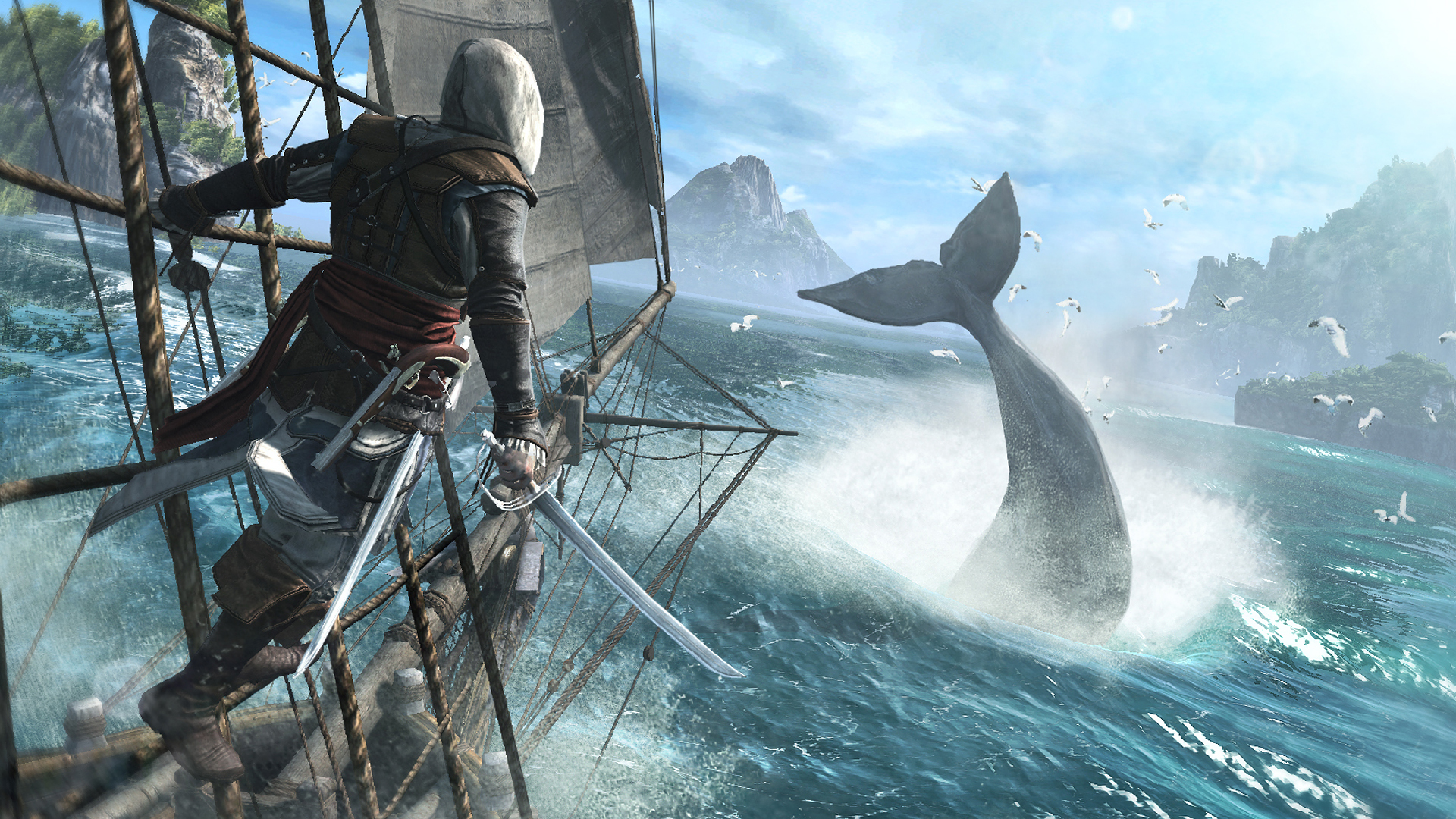
Where Assassin’s Creed III was determined a step back, Black Flag triumphed; being mentioned on multiple lists for “Best Game of the Year“. It was released on two more platforms than its predecessor as the Xbox One and PlayStation 4 were released in time to receive ports. Critical reception went up, platform count went up: sales went way down. 60% down according to initial estimates. Assassin’s Creed IV: Black Flag did not have the quick start that Assassin’s Creed III enjoyed. The game has not flopped: selling 10 millions units since its release. That is impressive but down 2 million from what Assassin’s Creed III sold in the same time frame.

Assassin's Creed IV: Black Flag continues to mess with the formula. However, gameplay remains largely unchanged.
Assassin’s Creed IV: Black Flag continues to mess with the formula. However, gameplay remains largely unchanged.

What does this mean for the franchise? Nothing… yet. Ubisoft blamed poor sales on the incoming consoles. Ubisoft’s CEO, Yves Guillemot, felt that the initial slow start was caused by people waiting to purchase the game on new consoles. Consoles that, in many homes, likely weren’t entering the picture until Christmas. True, Black Flag was not the only major game to hit this slump. Call of Duty: Ghosts and Battlefield 4 were also affected. However, Call of Duty: Ghosts received less than overwhelming reviews and Battlefield 4 had significant technical issues. This was not the case with Assassin’s Creed IV: Black Flag.

New consoles: bad for business in the short term, but essential for innovation.

Ubisoft may be facing another problem: fans might just not care as much as they once did. Assassin’s Creed III enjoyed quick sales… but those sales came mostly from pre-orders (people feeling confident spending $60 on a game before hearing any critical feedback… you know, morons). How many of those games were sold back in less than a week or only played for a few minutes before being banished to the shelf? Ubisoft doesn’t care about those numbers because they don’t reflect the bottom line. They made their money: the product was profitable.

Sixteen games is a lot for any series. Granted, ten of those are not associated with the major releases so let’s just say six. There have been six major releases for Assassin’s Creed in the past six years: that’s a lot. That is Madden like levels of production. Eventually fans will say: is a new one worth $60? They may have already started. How many unique, worthwhile, assassin adventures are out there? If Ubisoft is producing a title every year (not leaving much time for experimentation) are these games really so different from one another?

Every series can only survive for so long.

Ubisoft has spoken of ending the series, before backtracking on their statements. It is unclear just what higher plans, if any, they have. That must lead one to think that there is only one bottom line: money. For as long as Assassin’s Creed is profitable, there will be new games. That time might just be running out.

Assassin's Creed will expand to the cinema next year.
Assassin’s Creed will expand to the cinema next year.

The Good, the Bad, and the Ugly in Brother Bear

Everyone is in love with Disney Animation right now. Frozen has melted the hearts of everyone who has seen it. Building off of a revival that began with Princess and the Frog back in 2009, Walt Disney has returned to relevance. They are no longer simply the studio that produces Pixar movies. However, things were not always so wonderful in the House of Mouse. Turn back time ten years and you get what many consider to be the darkest period for Walt Disney Animation. The studio was dying: the ill-fated Home on the Range was about to be released and the name Disney meant “cheap sequel” to everyone who knew them and “another word for Pixar” to those that didn’t. In short: not great. The studio just wasn’t producing hits anymore. Even the surprising Lilo & Stitch wasn’t enough to turn things around. When Brother Bear was released in 2003, it was to mediocre reviews. The film was seen and forgotten. Today when people list the Disney Classics, Brother Bear is not a film on anyone’s lips.

And that’s a shame. Not because I think the film was a classic (NOPE) but because it was close to being something really special.

Let’s start with the good: the story. The dramatic conflict in this film had incredible potential. Kenai (voiced by Joaquin Phoenix) is unique among Disney protagonists. Remember in The Lion King, when Simba thought he was responsible for his father’s death (spoilers)? Well Kenai actually is responsible for the deaths of his loved ones. How is that for a flawed protagonist? The tragic event that claims his older brother’s life in the beginning of the film results directly from Kenai’s childish nature and then inability to accept responsibility for his actions.

The relationship between the three brothers is believable and part of the film's strong emotional core.
The relationship between the three brothers is believable and part of the film’s strong emotional core.

Later on, when Kenai has been bear-ified, he meets a cub named Koda (Jeremy Suarez). Koda is lost, having been separated from his mother. Kenai is lost: having just killed a bear, only to be turned into one by his now-spirit brother. By the way if you think it’s a horrible coincidence that Koda lost his mother at roughly the same time Kenai killed a bear… yeah: flawed protagonist, remember?

Kenai's transformation as a man is what drives the film. The visual change is a nice touch.
Kenai’s transformation as a man is what drives the film. The visual change is a nice touch.

But this is the triumph of the movie: I didn’t hate Kenai. Functionally he serves as the villain. He is the reason for the setbacks in the movie, for himself, for Koda – pretty much for everyone. Yet these conflicts are not the result of malice but the consequences of a child’s immature actions. Kenai is young and needs to grow up. Brother Bear faces the fact that every protagonist is capable of doing the wrong thing. What makes Kenai the hero is how he responds to his actions. I would love to be able to tell you exactly how he responded but… we’ll get to that in the “ugly”.

For now: the bad. This movie suffers from “Genie” syndrome. Genie syndrome, for those out there who aren’t familiar, applies to animated movies which feel the need to include a loud, in-your-face, pop-culture  side character; regardless if it contributes to the story in any meaningful way. Everyone wanted to recreate the Genie after Aladdin: that was lightning that never struck twice. So in Brother Bear we have:

Rutt and Tuke. No I can't tell you which is which. No, it doesn't matter.
Rutt and Tuke. No I can’t tell you which is which. No, it doesn’t matter.

They’re not as horrible as some of the others but they do not serve any real function other than to let the audience know that the plot will be stopping for a few minutes to have some horrible, Canadian-stereotype humor. I enjoy making fun of Canadians as much as the next guy but please: they give us better material than this. Okay, here comes the ugly:

55nowayoutcdde

F*cking Phil Collins. For the record, I don’t usually hate Phil Collins as much as other people. I really enjoyed his songs in Tarzan. But in this: the use of his music single-handedly makes the film noticeably worse.

I praised the emotional conflict that fuels this movie. Kenai’s acceptance of responsibility could have been one of the most powerful scenes in Disney Animation. This is the studio that turned “The Snow Queen” into a moving drama. Yet here is how the climax is handled in Brother Bear:

Aside from those written lyrics (which draw attention to the horrendous, ACTUAL lyrics): that is the exact sequence from the movie. There is no consequence, no resolution, just a crappy music number to gloss over every important action in the film. It is impossible to only blame Phil Collins. Someone approved of this. The directors approved of this. There is no dramatic punch in this film, just Phil Collins trying (and failing) to get another Academy Award. I wish I could say that this was the only bad song in the movie but the music is lackluster throughout. Again: shocking for a Disney movie.

Could have been so much more satisfying.

Yet despite all this: I didn’t hate Brother Bear. It’s fate is, in some ways, far worse than being hated. Hated films earn a place in memory. Brother Bear instead is banished to the nether of average. Eleven years later and it is nearly forgotten. There is nothing really to say about it in the end other than it could have been better, could have been worse. Ouch.

Don't worry, it got a completely unneeded sequel. As I said: these were the times for Disney.
Don’t worry, it got a completely unneeded sequel. As I said: these were the times for Disney.