Marketing Method: Godzilla (2014)

Trailers can reveal a lot about a movie. They can showcase the plot, the tone, and the characters. Often times, a film audience can tell the quality of a film, based on its previews. This May, the second American Godzilla remake will release across the world. This 2014 makes another attempt at adapting the Japanese creation for American audiences. The first attempt in 1998… did not go well. Just to recollect, here is the teaser for the 1998 remake:

I still remember seeing that in front of Men in Black. At the time I thought it looked fun and badass. Godzilla was taking out a T-Rex – take that, Jurassic Park! Oh, what foreshadowing that was. Godzilla 1998 never did get past that image of the T-Rex and those movies that came out right before it. But, enough about this movie, maybe I’ll talk about it another time.

I would like to show you the first teaser to the 2014 film, but sadly it was never legally released. All I can say is that it exists online and is worth checking out. This time, there were no mentions made of T-Rex. Instead the teaser was solemn, filled with images of destruction and the following quote:

"We knew the world would not be the same. A few people cried; most people were silent. I remembered the line from the Hindu scripture, the Bhagavad Gita; Vishnu takes on his multi-armed form and says, 'Now I am become Death, the destroyer of worlds.'"
“We knew the world would not be the same. A few people cried; most people were silent. I remembered the line from the Hindu scripture, the Bhagavad Gita; Vishnu takes on his multi-armed form and says, ‘Now I am become Death, the destroyer of worlds.'”

The teaser concluded with that image of Godzilla roaring at the sky. It gave goosebumps and sent a message: this remake was trying to capture the tone of the 1954 original. The first Godzilla was not a fun action movie, I have already spoken about it at length. After the debacle in 1998, director Gareth Edwards wanted to send a message to Godzilla fans that his film would be different. Message received. Here is the first, publicly-shown teaser:

Leaves a different impression from the 1998 version, right? While both teasers are light on the actual plot and characters (as teasers often are), they mainly exist to showcase a tone. The 1998 teaser was light and fun, while the 2014 teaser provided shots of death and destruction. Godzilla himself was also featured much more heavily in the 2014 teaser: showcasing the monster as the main presence of the film.

In the trailers since then, this image has been reinforced. The audience has gotten snippets of plot (Bryan Cranston appears to be a scientist, Aaron Johnson is his son, the soldier) and how Godzilla is being presented. He is shown as a force of nature. An unstoppable juggernaut that even nuclear bombs cannot slow down. The shots are dark, often set at night or filled with shadow. There is very little normalcy shown, the audience instead being treated to soldiers, scientists, and other figures who are playing central roles in the action (there is only one shot of a “happy couple” dynamic in any of the trailers).

This looked like a disaster movie, when mankind trying to survive Godzilla instead of a volcano or meteor. Then came the first real trailer, and another factor was added to the mix. Godzilla is not the only monster in this movie.

While it is hard to say exactly what MUTO is (other than a bug), this monster is definitely not Godzilla.

Dubbed M.U.T.O., there isn’t much known about this adversary, other than it is an original creation (there is no Japanese film where Godzilla fought Muto in the past). With the appearance of this new plot element, questions arise about the films tone. Can it still echo the somber nature of the 1954 film (Gareth Edwards spoken intention) while featuring something as blockbuster as a monster fight? The trailers seemed to back this up. That is, until the most recent one:

Of all the Godzilla marketing, this preview is the most apart, in terms of content and tone. While other previews spoke about Godzilla in very realistic terms (almost as if the events were actually happening), this one adds some definite movie lines. “No, a god”… really? A god…zilla, you mean? Yeah, it’s kinda cheesy. “Let them fight” also is marked departure. If destruction (and the horrors of) is a central theme, then why are the humans encouraging the giant monsters to battle each other?

The destruction is still highlighted, but this time it is also an effects shot.

It creates issues. The tone of the original Godzilla is what helped it to be such a powerful movie. If that tone is battling with say, another monster, it looks as though it is going to break down. Again, however, the trailers could be trying to simply appeal to a wider audience. Note back to that 1998 teaser: how prevalent were the children? Pretty easy to spot that film’s target audience. This new Godzilla has looked far more scary by contrast, and the marketing department may simply want to show that there are other elements of the film beyond Godzilla destroying things.

It remains to be seen just how well-made a movie this new Godzilla is. That said, the marketing has certainly done its job creating excitement for the movie. Whether the tones conflict or not: destruction, ominous lines, and dark shots of the monster seem to be all that is necessary to make an effective monster-movie trailer.

Oh yeah: and budget for believable special effects! Always forget that one.
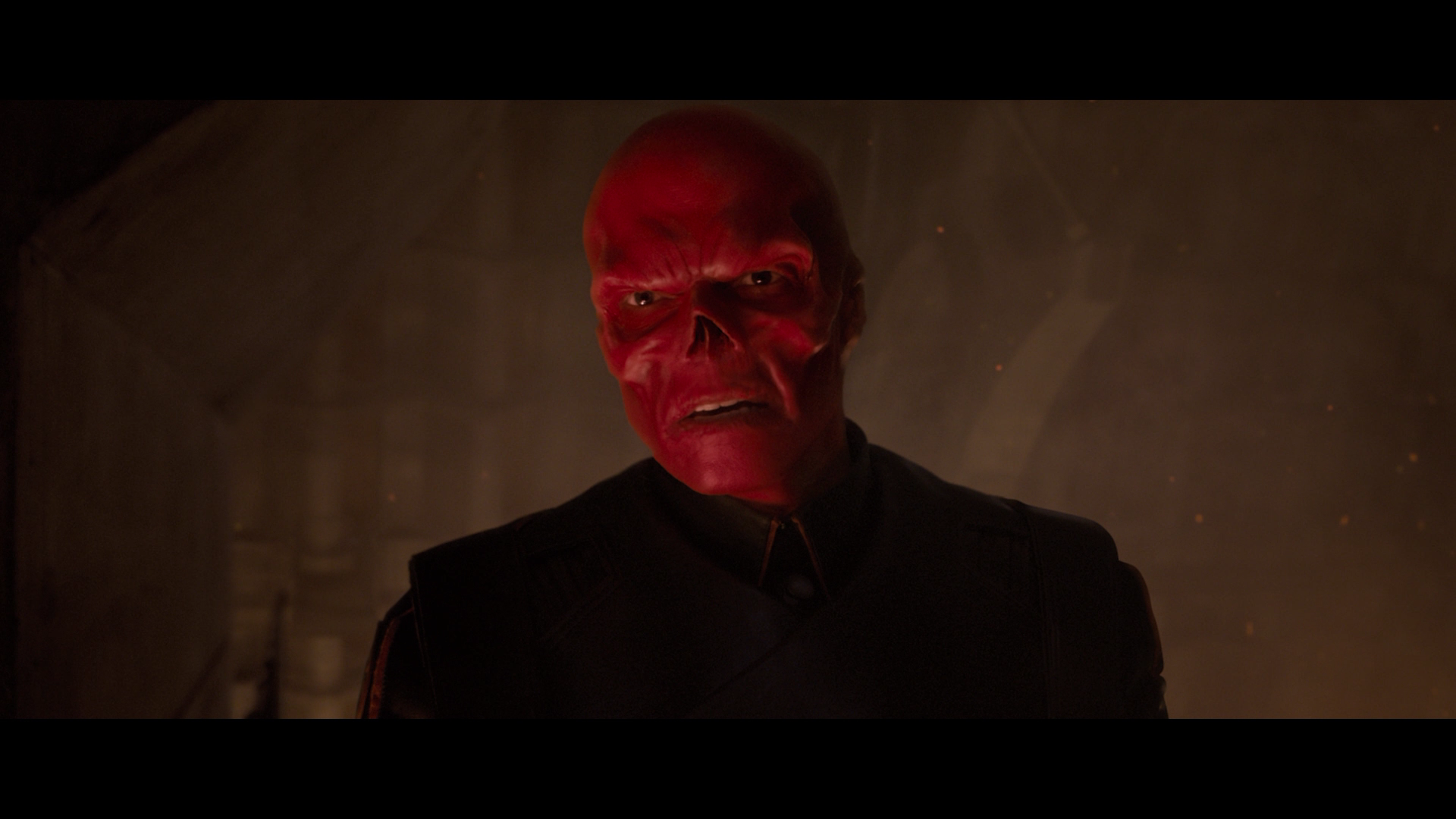
Everday I'm Moustache-Twirling: the Red Skull in Captain America: the First Avenger

Moustache-Twirling: Verb – When villains stand around talking about how they’re villains.

A good villain can make a movie or show (Darth Vader, The Joker, King Joffrey). Likewise, a bad villain can drag one down. The Marvel cinematic universe has been, for the most part, fortunate with their villain cast. Obviously the highlight is Tom Hiddleston’s Loki, while the low point would probably be whoever Christopher Eccleston was supposed to be playing in Thor: the Dark World (did anyone care about that character?). Then there is the Red Skull, the villain in Captain America: the First Avenger. On the one hand, he is played by Hugo Weaving (of the Matrix trilogy bad guy fame), who does an excellent job. On the other hand… he is a reaaaaallly boring character. Like reeeeeeaaaaaaaaaallllllly boring.

Hugo Weaving is a good actor and puts in a solid effort. The problems come from the script.

Why? People love Nazis as bad guys. Historically there is no better villain. Granted, the Red Skull leaves the Nazi party for Hydra but still – tom-A-to, tom-a-to. He doesn’t look dorky either, that makeup job is actually quite impressive. It would hard to imagine a more believable looking Red Skull in a live action movie. Certainly, there have been less realistic representations of the character:

No, the reason that the Red Skull isn’t interesting is because, in the vast majority of his scenes, he does nothing but stand around and talk about how evil he is. There are a couple of exceptions. One: his opening scene, arguably his best scene in the movie (and the scene that feels the most like part of an Indiana Jones film). In this sequence, the Red Skull starts the plot of the movie. He acquires the threat (the Tesseract) and kick-starts the plot. Now Captain America has a problem that needs solving. It is a good scene and important to the story.

One of the few scenes where the character isn't drawing huge amounts of attention to the fact that his face looks like a jack-o-lantern.
One of the few scenes where the character isn’t drawing huge amounts of attention to the fact that his face looks like a jack-o-lantern.

When we see him next, I believe it is the painting scene (I haven’t seen the film in a while so if something is out of order, I apologize). In this scene it is established that… he has a red face (SPOILER). Yeah, pretty much he talks to Dr. Zola (who’s not purely evilness makes him more interesting) and tells him that they are going to try and kill Dr. Stanley Tucci. Yes, I guess that information is technically relevant to the plot but it could have been conveyed to the audience in a much more interesting way. Everyone already knows (or can guess) what the Red Skull’s face looks like – hint: read his name! Not a great scene and ultimately it just feels like a distraction from the much-more-interesting sequences involving skinny Steve Rodgers at military training.
The next scene with the Red Skull is Hydra’s departure from the Nazi Party. Now this scene is really useless. For all intents and purposes, it changes nothing. There is never a follow-scene of Hydra fighting the Nazis or the Nazis temporarily allying with Captain America to take out the Red Skull. He was a bad guy at the start of the sequence, he is still a bad guy at the end. He simply goes a little more obscure (“yeah, I’m leading Hydra now. We’re an underground giant terrorist organization, you’ve probably never heard of us.”). If anything, it makes him more likeable because he kills Nazis. In cinema, killing Nazis rarely makes a character less likeable.

Fun fact: the Red Skull kills more Nazis than Captain America in this movie.

Fast-forward to the first meeting between Captain America and the Red Skull. Where the Red Skull takes off his fake face and reveals that… he is the Red Skull. WHO SAW THAT COMING?! They also fight for a bit but it’s nothing spectacular. Doesn’t take the Red Skull long to beat a hasty retreat in order to let the movie focus on its other, more interesting characters.
We then really don’t see the Red Skull much into the finale. There are a few short scenes with him, the largest being when he shoots one of his own men (this guy just keeps killing bad guys!), but these are all reactionary scenes to the actions of Captain America.
His last big sequence is, of course, the movie’s finale where he engages Captain America in battle. The fight is less than drilling, both in dialogue and execution. It… well it looks like something out of Inception in all honesty, a film that was released a year prior to this one. As for the dialogue… everything is general good vs. evil, black-and-white jargon. While it works for the film, this does not breed in-depth characters. Then, the Red Skull “dies” and the movie is over. Whew!

I went onto IMDB.com to try and find quotes to illustrate my point. I believe I did: look up all of the Red Skull’s selected quotes, they all have to do with Captain America. He really simply exists to give the movie a villain. This is in contrast to Loki, a character with his own arch that keeps him in near-constant conflict with our protagonists. One of these ways is a much better way to write a villain. They cannot exist only to receive the good guy’s punches.

On the same level as the majority of the Red Skull's dialogue.
On the same level as the majority of the Red Skull’s dialogue.