South Park: the Stick of Truth vs Saints Row IV

Warning: Video links are NSFW (South Park ridiculousness)

Last year saw the end of one of the larger video game publishers, THQ. The company was responsible for such hits as the Saints Row series, the Darksiders series, and the Red Faction series. Further proof that producing successful games does not guarantee longevity in what can only be described as a cutthroat industry. When THQ went under, two enormous titles, South Park: the Stick of Truth and Saints Row IV, were still in development. The public was excited for both of these titles and, luckily, each found a home with a new publisher. South Park: the Stick of Truth was released courtesy of Ubisoft, while Saints Row IV found new life with Deep Silver. THQ’s last great games would be live to be played be the public. What makes these two titles very interesting, however, is the fact that they deal with similar subject matter. Both are games designed to parody other games. Well, as it happens with any two like products, the question becomes: which one is better?

Spoiler alert: I pick this one.

To begin, let’s examine the core games that each title is parodying. South Park: the Stick of Truth was molded to make fun of the traditional RPG (roleplaying game), where a silent protagonist teams up with a team of other, computer-controlled adventurers to complete an epic quest. Think old school Final Fantasy for this one. Heck, just look at how Canada looks in the game:

I love how Quebec is transformed into "the Caverns of Quebec."
I love how Quebec is transformed into “the Caverns of Quebec.”

The game also draws attention to the illusion of choice. There is one sequence in particular where the player character is ambushed by elves (kids dressed as elves). The elves offer a choice: fight or come quietly. Immediately after, one of the elves mentions that the fight is pointless and that the player will be forced to come along no matter what. There are several other instances throughout the game where the player is offered “choice,” and each one unfolds in a similar manner.

There is a point in the game where the player is asked to choose between Kyle and Cartman. This choice is also meaningless as both characters remain in your party.

I have already written and article talking about the Saints Row series but, just to reiterate: this is, at its heart, a spoof of the Grand Theft Auto series. Saints Row IV marks a large departure as series such as Prototype and Infamous become the primary draw for gameplay. While the core game focuses on spoofing those two series, Saints Row IV draws from several other key sources. The Mass Effect trilogy is evoked in two ways. First, Keith David is in the game as… Keith David. The character serves as a comedic stand in for his Mass Effect character, David Anderson.

2494030-keith+david+model

In addition, Saints Row IV pokes fun at Bioware’s relationship system. The idea that your player character is irresistible to everyone else and can have sex just by talking to another person. Where Mass Effect restricted it to one or two partners per playthrough, Saints Row IV allows the player to have sex with everyone in their party (minus Keith David), including one machine. This pokes fun at the idea that the only reason any player ever completed a relationship in a Mass Effect game was for the sex scene “reward” (there will be another, more serious article on this) at the end.

While both games are intelligent parodies, it is Saints Row IV that pulls ahead with simply better gameplay. It is the more fun game to play. While South Park: the Stick of Truth is hilarious, it is only meant to be played a certain way. The player is encouraged to directly complete quest after quest. Wandering (an element central to most RPGs) is discouraged. This is a short game with only a set amount in it. The repetition of things to do becomes apparent to any player who chooses to explore and (uselessly) grind against enemies. While this isn’t a huge knock against South Park, it is a limitation that Saints Row IV does not have (at least not as glaringly).

I feel that this difference is best showcased by comparing game maps, have a look:

The South Park map is exactly what you would expect. There are never more than half a dozen quest markers on screen at a time.
Most of the map for Saints Row IV. There is a much greater variety in mission type. There is also a mode just to see collectables.

Another area where Saints Row IV excels is the intelligence of some of its make-fun segments. For example, there is the moment where Saints Row IV switches to a 2D beat ’em up making fun of Streets of Rage (the segment is called Saints of Rage I believe). It is short and fun and, most importantly, easy. The joke does not overstay its welcome.

South Park: the Stick of Truth is not so smart. Any gamer out there can tell you about the frustrations of button mashing sequences. They are as the name suggestions: hit a button as fast as you can and hope it is fast enough to work. Not big on the skill but high on the tedium. On one level, the South Park game makes excellent fun of this. There is a completely voluntary sequence where the player character can use the bathroom and the player must button mash to complete the task. Fun, easy, and short – all three things. There are also several sequences where the player must button mash to complete boss battles or advance the story. These are not always fun or easy and come dangerously close to exactly copying the games that they are trying to make fun of.

One last point that I will harp on: glitches can ruin games and there are far more game ending glitches in South Park: the Stick of Truth. I encountered one such glitch and the game was nearly ruined for me. I will not dive into this further as I am planning to do a full article on the game production patterns over at Obsidian (the developers of South Park: the Stick of Truth). Suffice it to say, this is not the first Obsidian game to be held back by technical slip-ups.

For players seeking a humorous game experience, neither title will leave you disappointed. However, there are simply more funny jokes in Saints Row IV that are done better. Trey Parker and Matt Stone are geniuses in the world of cartoons, but the good folks over Volition, Inc. have the edge when it comes to properly enabling comedy through video games. There are advantages to being more familiar with your craft.

Special Address: #YesAllWomen

Recently, I heard on the news that there had been another shooting. I tuned it out, I honestly could not deal with hearing about another senseless act of gun violence. The atrocity that I was numbing myself to was, of course, the Isla Vista tragedy. It was not until later that the matter was brought to my attention again. This time I heard more about what had happened: a hate crime – a man (his name really does not matter) shot and killed six people because he was an out-of-control misogynist. Was this the action of a mentally disturbed individual: he probably was. That said, to call this crime “insane” is to put it in a far away box and not examine the issue. This act was not random, it was fully planned out. The savage history of it exists on the internet and can be viewed right now.

There is a perception of this crime as an isolated incident that I feel is incorrect. I am not the only one who feels this way – the #YesAllWomen movement on Twitter, as well as really every feminist and humanist rally out there, acknowledges that this hatred is sadly not isolated. What happened in Isla Vista was an extreme version of an all too common incident. While there is no rationalization to be learned from the killer (NOTHING will ever make what he did forgivable – in any circumstance), there is an alarming window into society. The killer was not evil, he was a human being. He grew up in the United States, he had an education – he was probably a very intelligent individual. That is what makes it frightening. We’re not dealing with a boogeyman, we’re dealing with a person. That is why I am writing this article.

Let me show you a video from Joss Whedon that I saw last year:

Whether you agree with all the points he made or not, there is one line that simply sums up the issue at hand: “You either believe women are people or you don’t. It’s that simple.”

Unfortunately, I believe that it has been (and to a lesser extent, still is) part of the American culture to view women as less than men… as less than people. Now, that is a loaded statement. For the record, I do not believe that American culture directly creates misogyny (hatred towards women), I believe that is only one reaction. Our culture is far more guilty of creating the attitude that, while women are special, they are not people like us men. It goes back to the image of the hero. I have posted this quote on this website before:

eagleLook at that, there’s even a bald eagle next to it. This, to me, is still a beautiful quote. However, the term “hero” is problematic. What is a hero? Well, if you look at culture – you have Hercules, Superman, Han Solo, Indiana Jones, Batman… there are hundreds of examples (many of them are women, I am just focusing on the males to make my point). All of these characters are heroes and they all share similar qualities. They never give up, they keep fighting, they are true to themselves, etc. This pays off in victory. The hero saves the day, beats the bad guy, grabs the girl, and rides off into the sunset. Wait, slow down – grabs the girl? Yes, in many hero narratives, the good guy gets the girl – simply by being a good guy. This makes for wonderful literature but HAS (not could – HAS) contributed to a lesser view of women in society: simply that they are a treasure to be won. A reward for being good.

You may respond with: “That’s fantasy, I know the difference between that and real life.” If so, good for you but not everyone does. Also, this is a behavior that can happen subconsciously as well. Few men probably look at a women and directly wish to “own” her (at least I hope so). Yet there is a belief that good behavior brings rewards. This is not a bad belief to have. We should, as a species, be encouraged to do the right thing… but not for a reward. Fellow internet voice Arthur Chu wrote an article that wonderfully articulates the point I am trying to make (find it here). There does still exist the attitude that women owe men for our generosity, our kindness, our attentiveness… specifically: that women owe us for treating them like men.

Got bad news for all the "nice guys" complaining about being put in the fabled friendzone: if you were expecting sex, you're not being a nice guy.
Got bad news for all the “nice guys” complaining about being put in the fabled friendzone: if you were expecting sex, you’re not being a nice guy.

Have you ever heard a guy talk about how he listens to all his girlfriend’s problems and doesn’t really care but whatever, the sex afterwards made it worth it. I have, and I have not said anything. That’s just guy talk, right? Sure, some of us talk like that when only men are around but… but it’s because we think that’s okay. It’s guy talk – no harm comes from it. Except when it does. I was re-watching a show from childhood recently, X-Men Evolution, and I noticed something I had never even noticed before: Jean Grey was dating a total asshole before she dated Scott Summers.

What does that say about Jean Grey? I know it may look like I’m getting off topic here by talking about a stupid cartoon when people have just died but it is relevant. This is a show that (primarily) young boys, such as myself, watched. It helped to show how Scott Summers, by being the good guy, ultimately got Jean Grey… but seriously, what does it say about her that she is dating such a pig? Relationships say a lot about the individual and, in all other areas, Jean Grey was a strongly developed character. She was cool-headed, mature (even motherly to a point), and very confident… dating the loudmouth, cocky jock athlete. The show never shows their relationship in a positive light so the audience never likes her old boyfriend – you just wait and cheer for Scott to win her over, which he eventually does (to be fair, Jean decides to break up with her old boyfriend and date him but still). It was just such a throw away, another challenge for Cyclops to overcome in becoming the hero. For the record, the show also had some very positive episodes:

Okay, that diversion is done, back to the serious conversation: American culture needs to change. We are far too comfortable in our dismissive views of women as part of life’s achievements rather than as fellow travelers. Some out there may still think that I’m being extreme… it’s the 21st century after all. Very true, when’s the last time you heard someone ask a guy: “are you really going out dressed like that?”

When’s the last time you heard it said to a woman?

Is she being very assertive, yes. To the point of maybe being annoying: sure. Does any of that prevent her from being right and making a point: not the last time I checked.

As a guy, I have walked home late at night many times. Was I ever scared that I was going to be robbed: not really. Was I ever afraid that I would be raped for wearing clothing that just turned some rational, civilized human being into a sex-crazed monster: can’t say I’ve had that worry either. The existing rape culture results from this skewed view of women. Who could ever rape another human being? Furthermore, who could defend the perpetrator should that tragedy happen? We do. We do it every day: what were the other factors? Tell me about the girl?

THERE IS NO OTHER CRIME WHERE WE ASK QUESTIONS LIKE THAT.

“Oh, you got robbed? Did you leave that new big screen by a window… shit, man… sounds like you were asking for it.”

Insane right?

“Oh you were drinking, well murdering six people isn’t so bad then. You couldn’t control yourself.”

Seriously, it's not a hard lesson to learn.
Seriously, it’s not a hard lesson to learn.

Women should not be labeled as extremists for asking for the same rights and protection that men enjoy. I am not saying: women, welcome to the crime-free awesome existence that men have, I am simply saying that it is time to stop saying that things are fair and actually MAKE them fair. Should parents teach their sons to be nice to the girl that he likes: absolutely. That said, the next lesson should be “she has no obligation to be nice back.” That’s life.

This is, for us men, a turning point. We have a lot of the power here. There is another video I would like to show you, this one is from Patrick Stewart (yes, as my sources indicate, I am this much of a geek):

Will there still be violence against women if the cultural view is changed. Yes. It isn’t like men are nothing but roses to each other. For the record, men are also not the only ones who can inflict abuse. The reason that I have focused this article on directing men to change is that we are the largest source of abuse. More men abuse women than women abuse men. Sorry guys, them’s the facts for right now.

But stories like this.

And anger like this.

We can all help to put this dark chapter behind us. To use Joss Whedon’s word: genderism is still alive and well in the United States. It always will be… but we can make it weaker. We can make it as backward and as persecuted as it should be. America believes in life, liberty, and the pursuit of happiness. It is time that we spread that to everyone. So, nice guys, the next time you’re trying to win over a woman, just remember: she is another human being. There is nothing you can do to ultimately change the mind of another human being. Be nice, be the best you can be – just remember that you’re dealing with another you, even if he’s/she’s a different gender.

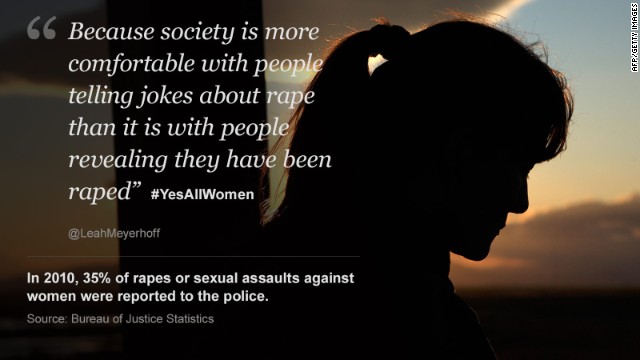
140527134957-yesallwomen1-horizontal-gallery

Three-Pronged Protagonists: Garion from Pawn of Prophecy

There is a writing podcast out there, on the interwebs, called Writing Excuses. For anyone passionate in the world of literature, I recommend checking it out. One of the first episodes that I listened to had to deal with an issue called “three pronged character development.” I will let their words do the summarizing, as I feel that they provide a simple explanation:

“We talk about characters a lot, which is fitting since character are what make things go in most of our favorite books. [There is] a new model for examining characters in which three primary attributes – Competence, Proactivity, and Sympathy – are contrasted. We treat each one as if controlled by a fader or slider, like on a mixing console, and we look at what the relative positions of those sliders do to a character.”

So there it is: a system of attribute management used to determine the strength of a created character. Personally, I love the idea of this model and have used it in my own writing ever since. That said, if the model is a genuine tool then it must be applicable when it comes to characters created in the past. For this post, I have chosen Garion, the protagonist from David Eddings‘ fantasy series, The Belgariad (anyone out there looking for fantasy but not simply wanting to reread the Lord of the Rings should check this out). As there are five books in the series, let this be an examination of Garion in Pawn of Prophecy (the first book in the series).

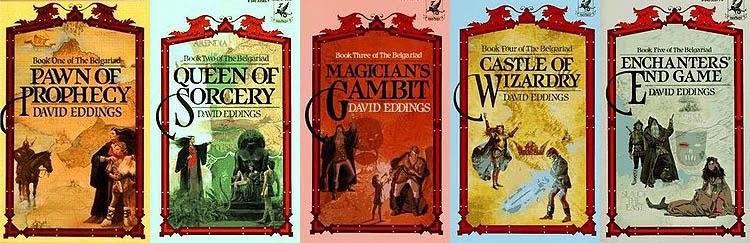
The five books in the main series. Apparently, Eddings was like Tolkien and wrote other material set within the universe that he had created.

Garion is your standard unknowing chosen one. He is the titular pawn of prophecy. In the book, Garion is a young teenager (there are also several early chapters where he is younger). Introducing his age brings us to the first point that I have chosen to cover: competence. Garion is a young boy who has been raised on a farm. He does not know how to read and spent a large portion of his childhood cleaning kitchens. So far this is not sounding like an especially competent character (unless the villain is defeated by poor kitchen hygiene). Nevertheless, Eddings takes great care to show the reader that Garion is merely ignorant, not stupid.

Ignorance fits with his character background, but Garion does not stay that way for long. While the plot moves forward without Garion being aware of its significance (despite his best efforts), the protagonist learns a great deal on his journey. From a hidden sign language to beginning his tutelage with a sword, Garion keeps active. He is not the best at his skills (it is only the first book) but he applies himself and does not shirk responsibility. Where Garion’s competence truly shines, however, is his ability to sneak. No one teaches Garion how to move without being noticed, he is simply naturally talented. This gives Garion a certain believability as most people out there have natural strengths and weaknesses (Garion does possess all the arrogance and self-centered attitude that one might expect a young person to have). Overall, I believe that, if we were to examine the model of Garion’s attributes, competence would be set close to the middle – with a slight inclination towards “high competence.”

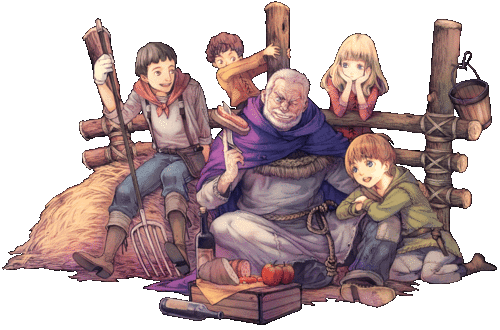
Garion may not know much at the beginning of the Belgariad, but he is not simply a farmboy either.
Garion may not know much at the beginning of the Belgariad, but he is not simply a farm boy either.

Next we come to sympathy – this would undoubtedly be Garion’s highest attribute setting. Garion is an orphan. His parents were killed (violently as he learns) when he was just a baby, and he was sent to live with his aunt. While Aunt Pol is not a wicked relative by any stretch, she is very strict. It is obvious to everyone in the story (Garion included) and to the reader that Pol is keeping her nephew on a very tight leash. While she does praise him occasionally, Aunt Pol is far more likely to point out everything in the situation that he did wrong.

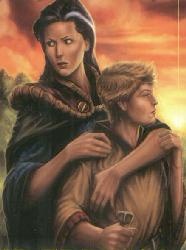
Aunt Pol does love Garion, no question. That said, she can easily be described as "over protective."
Aunt Pol does love Garion, no question. That said, she can easily be described as “over protective.”

Add to this the fact that Garion is a pawn. His life is out of his hands entirely. While he is not overly sad to leave his farm and begin his quest, Garion has little choice in the matter. Think back to the beginning of Harry Potter and the Sorcerer’s Stone: Harry has little influence on his life in the beginning. He did not choose to be a wizard or to begin his learning at Hogwarts (not that he wasn’t very eager to do so). Garion is like Harry… only Garion never gets to choose his classes… or whether to play Quidditch, or how to stop Professor Quirrell. Garion is held, throughout the book, as an observer to his fate, and not the active participant. This generates sympathy as the reader experiences a protagonist whose life is outside his control.

The last attribute is Garion’s proactivity. This is the lowest factor of his personality. As said before: Garion is a pawn. Yes, there are moments in the story where he is active and contributes to the plot (even foiling an attempted coup at the end of the novel). That said, even when Garion is alone, he is not acting solely on his influence. He is semi-controlled by a “dry voice” in his mind, separate from his own consciousness. This “dry voice” is the closest that the novel comes to deus ex machina. It exists for little more than to explain why Garion does not do certain obvious actions at certain times. Is there a fantastical explanation for this voice: of course.

The idea of prophecy is nothing new in fantasy series.
The idea of children bound to prophecy is nothing new in fantasy series.

For the record, I cannot say for certain that Garion’s attributes change throughout the course of the series (I have only completed the first book), however, it is beyond likely that they do so. This attribute scale provides not only a great way to measure the start of a character, but also a tool to chart their growth. Characters with low sympathy may very well gain exceptional amounts of humanity as the story unfolds (think Quenton from the Magicians series). While I do not know for certain, I am willing to bet that Garion develops into a much more proactive protagonist by the end of the Belgariad. He is, after all, the chosen one.

I don't know who this character is but something tells me that I'm going to like her!
I don’t know who this character is but something tells me that I’m going to like her!