Sequels We Didn't Need: Cloudy with a Chance of Meatballs 2

In 2009, Phil Lord and Christopher Miller brought Cloudy with a Chance of Meatballs to the screen. The film told the charming story of Flint Lockwood and how his weather-to-food invention changed his life and the lives of those around him. Using visual, vaudeville-style humor and endearing character development, Lord and Miller were able to bring a soul to Cloudy with a Chance of Meatballs that elevated it beyond a mediocre 3D effects fest. It is a great little movie and worth a watch to anyone out there who hasn’t seen it (and still has enough of a child’s wonder left to appreciate food falling from the sky). Fast-forward to 2013 when Cloudy with a Chance of Meatballs returned to the screen. The aptly named Cloudy with a Chance of Meatballs 2. It is a sad realization to understand that Hollywood’s response to anything successful is this: make more until it isn’t. Sequels are just an inevitability these days. As audiences, we can only hope that they’re good. Cloudy with a Chance of Meatballs 2… is not such a sequel.

Wait, what went wrong? It is such a dynamite concept! I mean, food falling from the sky – that’s at least eight films right there…

3 could be about the evolution of food people and 4 could be about them leaving Earth to find their own planet! And then you have a trilogy of fighting food aliens! Brilliant.

Yeah, for anyone who hasn’t seen the first film, I will just say that it ends without the feeling that there is something more to tell. Certain movies, like Back to the Future and the Incredibles, close with a tease: the promise of more exciting adventures to come. Flint Lockwood’s story was done at the end of Cloudy with a Chance of Meatballs. He had grown up, realized that he didn’t need to prove himself to everyone when the people who mattered already supported him. The weather-to-food machine (yes, I’m aware it has a more creative name) is destroyed and life returns to normal. There and back again: adventure complete.

Things literally ended with sunshine and rainbows.

That is not to say that all sequels to complete stories are bad. Look at the Toy Story trilogy: each one of those is a complete adventure on its own. Yes, they use the same characters but there is no overarching plot. It is just three separate toy stories that work really well together. So Cloudy with a Chance of Meatballs 2 was not dead in the water. It even gained a fun life in its new idea: a Jules Verne-style island of living food. Sort of a next mutation phase to Flint’s invention.

Where Cloudy with a Chance of Meatballs 2 falls off is its continuing character development. Here in lies one of the greatest pitfalls for sequels. You can always tell if a sequel is driven by writing or by marketing. For instance, in a sequel driven by writing (Toy Story 2), not every character returns from the first movie. There is no desire to create a “hey, do you remember how cool this was last time?” moment, since the story has enough to tell on its own. In a sequel driven by marketing, everyone comes back regardless if they have anything to contribute to the current story. Case in point:
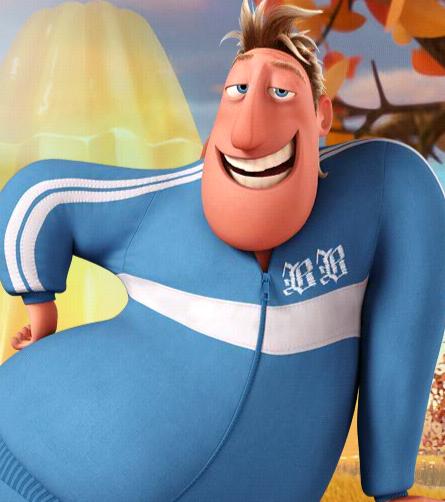
This guy.
This guy.

Brent was a character who had a purpose in the first movie: he was the guy Flint Lockwood wanted to be. He was popular and people liked him. The first film was also clever enough to showcase the failings of Brent’s type of “popularity” (no one really cares about him as a person, just about one thing he did) and use it to teach Flint what true acceptance was. In the sequel… he’s just there. Really, there isn’t anything that he does that is vital to the plot. I love Andy Samberg but… yeah could have done without him.

The real failing though is with Flint Lockwood. Like I said, his journey in the first film was one of acceptance. He felt like he had to prove himself and didn’t realize that he was already cared for. There was an evil mentor figure (the Mayor, voiced by Bruce Campbell) who led Flint along: pushed him to do more than he was comfortable with, to betray his own instincts just to satisfy others. Luckily by the end of the movie, Flint knows better. He is not looking for acceptance from the wrong places anymore and knows that there is more to life than pleasing everyone. Well, good thing that’s over and done with… right?
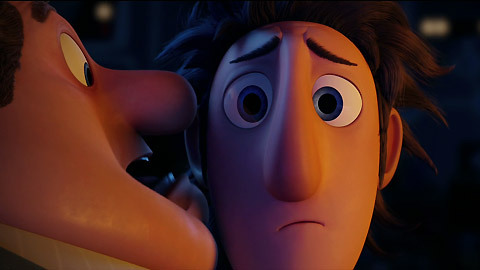
Certainly this will never happen again.

Wrong. The sequel re-does that same character growth. The new villain, Chester V (voiced by Will Forte) is essentially the Mayor from the first movie. Wait, no: he’s Flint Lockwood’s childhood inspiration… wait, I thought that was his mom? No matter, rather than evolve Flint – the film regresses him back to a place of insecurity that is well, boring. We already saw that movie.

And it happened again.

This writing decision prevents any of the other characters from growing as well and basically keeps the movie in an unnatural holding pattern that exists solely to move the plot along. There was potential here as Chester V comes off in the vein of Steve Jobs. A more clever film would have examined the idea of selling scientific advancement for profit vs. knowledge for the good of all mankind. Sadly, this is what we got.

So if you haven’t seen the first Cloudy with a Chance of Meatballs, do yourself a favor and give it a watch. If you have, liked it, and want to see more: watch the original again. The sequel is just the same story… that, like a joke, isn’t as great the second time that you hear it.

Also Sam is a non-character in the sequel. I mean, to be fair she's already been a love interest so what more is there... right? Sigh...
Also Sam is a non-character in the sequel. I mean, to be fair she’s already been a love interest so what more is there… right? Sigh…

Scene Dissections: The Picnic Love Scene in Star Wars Episode II: Attack of the Clones

All right, here we go: it’s St. Patrick’s and time for an appropriately themed post. That’s right, let’s talk about Star Wars! Oh, you’re saying: not Irish enough? Very well, we’ll focus on Episode II: Attack of the Clones. You have to be stereotypically Irish to enjoy the scenes in that movie. Maybe not every scene, some of the action and effects shots are really well done. It’s just the other stuff… the stuff with the people doing something… it isn’t lightsaber fighting, it’s something else… TALKING! Yes, the scenes with the people talking are frankly, well they’re awful in that movie. And never does the quality sink lower than when Anakin Skywalker (Hayden Christensen) and Padme Amidala (Natalie Portman) are on screen together. I could talk about any of their scenes at length but, let’s just pick at random and go with this one:

https://www.youtube.com/watch?v=Z0Ti9NXc7CM

Did you watch it? Are you so turned on by love that you can’t sit still anymore? If you’ve never seen the movie: there are all like that. EVERY. SINGLE. LOVE SCENE.

But anyway, bashing Episode II is nothing new. By doing this I simply join the dark side of internet geeks trashing a movie they, for some reason, can’t stop talking about. The above scene is a failure, no question, but let’s talk about why. I’m going to break it down by story, acting/direction, and scenery/effects/music. I’m not going to do this in context with the rest of the movie (I might a bit but I’ll try to avoid it). I just want to talk about that sequence, as it is. What went wrong.

STORY: Two people are talking at a picnic. The dialogue isn’t horrible. It’s not riveting either. They’re talking about her crush… from when she was twelve (before the wonders of Star Wars puberty) and Anakin makes it clear that he doesn’t like politics. To be fair, he does this like a typical 19 year old, in the sense that he sounds incredibly naive and dismissive (like 50% of most democratic populations). Here is the first failure: Padme is not put off by this exchange. She is a senator. Someone who has devoted their whole life to the government.

Let’s try an experiment: next time you’re with a politician (or even a political science major) just say: “yeah democracy is a load of crap, people just bicker and stuff. We should totally just have someone in charge who just does right.”  That is para-phrased dialogue from Episode II. Say that to your political friend and see how often they laugh and come onto you (granted there has to be ZERO flirting beforehand… you have to be as cold as they were in that scene… so looking bored in grass).

ACTING/DIRECTION: God do they look bored. There isn’t one second of natural warmth between them. Padme laughs a little and Anakin laughs a little but what are they laughing at? Anakin’s jokes aren’t clever, not to a senator (or anyone) in their early twenties anyway. They act like teenagers at the prom: too scared to make a move and too awkward to look comfortable. Problem: He is 19 and she is 24. It’s okay for him to be awkward because he has spent the last ten years as a sexless monk-knight, but she grew up with luxury: no way she would find it that charming.

Natalie Portman has won an oscar. Hayden Christensen has disappeared. I never saw him in anything else so I don’t know that he’s horrible, but given how unnatural Academy Award-winning, Natalie Portman is acting: this is not a scene to blame on the actors. George Lucas clearly had a vision here: the mono-myth picture of ideal, innocent love. Two children in a field, just enjoying each other’s company. That’s the scene, that is an accurate description of the scene. He directed it like two children, problem is he wrote it for two young adults. Second problem: this isn’t just writing. One of the beauties of film is that it breathes with living performance when done well. When it’s done poorly… it looks like the above scene.

SCENERY/EFFECTS/MUSIC: This goes back to George Lucas’ vision. It is the idyllic field in a land of (at this point) scientifically explained magic and whimsey. Star Wars is no stranger to fantastical backgrounds but both Empire Strikes Back and Return of the Jedi brought a sense of realism to their worlds. The people acted like people. thus drawing attention away from the scenery. No such luck here. The visuals may look impressive (at least until Anakin tries riding one of those… alien cow pigs) but they carry too much of the scene. It’s not good.

One thing truly works here and that is “Across the Stars“. “Across the Stars” is the love theme, composed by the great John Williams. Yes, it is over-the-top but this is Star Wars. The music has never been subtle. In my opinion, this piece is beautiful and captures a brief image of the idealized love that Lucas was going for. Does it sound grounded: nope, but it is the one thing that absolutely doesn’t have to be.

So there you have it: fantasy gone wrong. I guess that sums up the prequels in a nutshell. At least we got some funny Robot Chicken sketches out of it. Like this one:

https://www.youtube.com/watch?v=5DFOE0td1Yw

And this one:

https://www.youtube.com/watch?v=rmTaZd2hIZE

Good times. Anyway, for those out there wondering why I didn’t write an article on St. Patrick’s Day (and the wonderful “political correctness” of Irish stereotypes), I was in the mood to rant so I did something stupid to rant on. The Irish article is coming so… we’ll enjoy that at a later date.

What Went Wrong With the World War Z Movie

In 2006, Max Brooks published his novel, World War Z: An Oral History of the Zombie War. Granted, there isn’t a high standard out there for zombie literature. When people think of books involving zombies, it’s either World War Z, The Zombie Survival Guide or The Walking Dead (which is a graphic novel series). My point is: standards may be low when it comes to zombie-related reading material. That is not to diminish the writing talents of Max Brooks. Author of both World War Z and the Zombie Survival Guide, Brooks is certainly an accomplished author. While the quantity of notable zombie literature is low; the quality is high. World War Z: An Oral History of the Zombie War is an incredible narrative woven together using short stories to tell a surprisingly believable “what if” scenario. The Zombie genre may be over-bloated with material but trust me: this book is worth checking out, it’s fame is well-deserved.

If you haven't read it yet: check it out.
If you haven’t read it yet: check it out.

World War Z: An Oral History of the Zombie War was so successful that there was actually a bidding war for the film rights. Two companies, Appian Way (owned by Leonardo DiCaprio) and Plan B Entertainment (owned by Brad Pitt) vied for the film rights. At this point: it’s pretty easy to tell who won. For Pitt, it was a personal project that he wanted to do for his children, who were enormous fans of the zombie genre and of the book… so what happened?

Those out there who have read the novel and seen the adaptation already know: the movie is not the book… not even a little bit. They both have zombies in them and involve Israel, I’m being honest when I say that the comparison ends there. To give World War Z an equivalent as an adaptation, I would look to the 1998 version of Godzilla. Both adaptations make sparse use of their source material, opting instead to go with something more generic and easily marketable. In my opinion: this adaptation technique didn’t work (in either case) and crippled what could have been powerful film-making.

I had yet to read the book when I saw the trailer but even then I knew that changes had been made. The zombies weren't supposed to be running.
I had yet to read the book when I saw the trailer but even then I knew that changes had been made. The zombies weren’t supposed to be running.

But I digress, I do not wish to review World War Z. Plenty of critics have already done that. Simply saying I did not care for the film is enough. Let’s instead discuss how a passion product for Brad Pitt became a film that could have easily gone by any other, zombie-related, title.

After Plan B secured the rights to film adaptation, Babylon 5 creator J. Michael Straczynski was hired to write the screenplay. He did, two drafts of it apparently. For any out there very curious, here is the second draft of that script. This screenplay was close to the book but deviated in a few areas. Certain locations (like the battle of Yonkers) were altered and the focus shifted slightly for the triumphant spirit of humanity to who was to blame for the zombie outbreak (hint: George W. Bush).

Max Brooks never had any say in the film version of his novel but expressed approval at Straczynski’s work. However, Studios weren’t convinced and the film hit problems. Matthew Michael Carnahan was brought in to make script rewrites and Paramount (the studio who had initially agreed to distribute the film) looked for a partner to share in the costs.

Certain actors increase profits. Brad Pitt increases profits. Brad Pitt with beautiful hair: millions.

No second studio ever entered the picture but with Brad Pitt confirmed to star, Paramount funded the product anyway. Filming began in July 2011 and ended by 2012… only to start again. The reason: the ending. The original ending of World War Z has never been seen but has been revealed. Considerably darker and more open-ended (the War is far from over in the original draft), Studios feared that the original ending would not be well received.

The "camouflage" ending was an invention of cinema. As Brooks wrote many times in his novel: there was no easy way out.
The “camouflage” ending was an invention of cinema. As Brooks wrote many times in his novel: there was no easy way out.

Damon Lindelof and Drew Goddard (both of Lost fame) were brought in to completely rewrite the film’s third act. The result was that production had to resume and nearly forty minutes of new material was shot. The ending was re-envisioned to be more hopeful and action-oriented, better appealing to the summer blockbuster crowd. Various political subtexts were also toned down to make the film more approachable.

In regards to art, there is a belief that I hold: art for everyone is art for no one. What I mean by this is that when you try to alter something to make it please the masses, you inevitably lose what was unique about that piece in the first place. There is no piece of work created by any human being that has ever fully appealed to everyone.

More accessible meant more merchandising. Because everyone likes toys.

That being said, I cannot claim World War Z a complete failure: the studio succeeded in their goal. Despite going over budget (125 million became 190 million), World War Z went to gross over $540 million worldwide. Enough success to warrant a sequel and be a surprise financial hit in 2013.

So mission accomplished… I just don’t agree with the mission. World War Z: An Oral History of the Zombie War is not a novel for everyone. It is dark and brutal and realistic while still being fantastical (it reads like a war history… against an undead opponent who eats people). While action occurs, it isn’t the focus. So those out there wanting mindless entertainment would be disappointed in it because the novel is simply too smart. It forces the reader to think and question aspects of humanity. It is depressing and uplifting and many emotions in between. The film was a product, a predictable outcome after so many complications. The novel was art. There’s the difference. There’s where they went wrong.