What do Star Wars Episode VIIand the NFL Professional Football Draft have in common? For starters, let me clarify immediately that, for the purposes of this article, Star Wars Episode VII does not refer to the movie itself, but rather to all the fan speculation surrounding it. Hopefully the movie, Star Wars Episode VII, will be nothing like the NFL Draft. Hopefully.
Two weekends ago was Star Wars Day, an unofficial holiday celebrating the creation of George Lucas’ beloved (and despised) Star Wars series. Of course, things have been slightly different recently. This marks the second Star Wars Day since Disney acquired Lucasfilm, a business move that also announced the impending release of Star Wars Episode VII. That happened in October of 2012, so there was not much information by the following May. Now, all that has changed (kinda). We have a director, we have a cast, we have theories! Interesting to note that Star Wars fans were not the only ones geeking out this month.
The NFL draft began on May 8th of this year, several weeks later than usual. Why: ratings. There is some bullsh*t “other” reason out there but really, the NFL Commissioner wanted more viewers. For those out there who do not know, the Draft is when the professional NFL teams select the promising players emerging from the college systems. In the weeks (or months) leading up to the Draft, experts sit around discussing possibilities. Which team will take which player? Which players will work out? Which players will bust? It is essentially pure speculation, backed by only the most basic logic (this logic is not an essential piece). Sound familiar?
Looks like the Star Wars geeks and the NFL jocks have something in common. They both like to speculate. These are not the only two subjects on there were speculation drives the fanbase. Any product where the information flow is not constant requires dedicated fans to fuel its interest and generate hype. Look at E3, where video game developers show trailers and fans instantly proclaim “console victory.” Remember Lost, the show that started the online craze of tracking fan theories and open speculation? Just how did Sherlock survive the fall?
If anything, the NFL Draft has a value lesson to teach these other arenas. There is money, a lot of it, to be made in speculation. Heck, pretty much all of Professional Sports commentary is just that: people sitting around discussing the odds that something might happen. Not like for just fifteen minutes either, these people make 9-5 jobs out of it.
For those out there who felt that three hours was excessive… please watch the NFL Network sometime.
With Professional Sports, there is one difference that I feel I should mention: the answer is not out there. Sure, the future will reveal everything, from who will win the next World Series to who will win the Bruins-Habs series that is happening in the NHL right now. Time is the only certainty that will remove the need for analysis and discussion. With Star Wars Episode VII: it is purely a marketing scheme. The script it out there, it exists. If J.J. Abrams felt like it, he could upload that cast reading that happened a couple of weeks ago and everyone would immediately know what would happen. But where is the fun in that?
I didn’t bother to source that last one… he just better not be.
Son of a bitch.
I could do the same thing for the NFL Draft but it would be redundant. People enjoy talking about shared interests. People enjoy the excitement of what could be. People enjoy making money. This is how hype has become a business. The future will end the hype for both the 2014 NFL Draft selections and Star Wars Episode VII. Good thing we will have the 2015 Draft and Star Wars Episode VIII when that happens.
Right off the bat: I’m talking about the TV series (2008-2014), not the movie. The series is worth at least one post. The movie… we might get to that another time.
Star Wars: the Clone Wars is a fascinating and unique series. For one, it is the second animated Star Wars television series to chronicle the Clone Wars (the first can be found here, in all its glory). Arguably, this second series is far worse than the original, in terms of vision and storytelling ability. Yet it is that storytelling ability that I feel makes the Clone Wars into an interesting show. Is this the best series I’ve ever watched? Not by a long shot. That said, it is enjoyable and worth watching if you’re bored or one of those few Star Wars fans out there still brave enough to care.
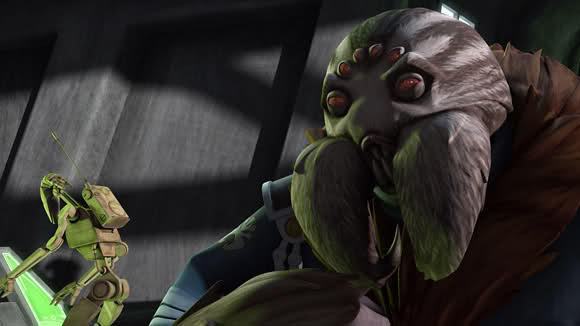
What makes Star Wars: the Clone Wars interesting is its scripts. Some are pretty great (Rookies), some are terrible (Bombad Jedi) and others are a mixed bag (Cat and Mouse). Let’s talk about “Cat and Mouse” a bit more. This episode is at a level that many are in the series. Parts of it are well written. The episode introduces compelling characters, an interesting plot, and a cool action set piece. One of the best parts: Admiral Trench, this fetching fellow below.
The Separatist Army: where even spiders can become generals.
Yes, his look in a little too evocative of a certain local life form for my taste. Nevertheless, Admiral Trench is charismatic and provides and entertaining shift from General Grievous and Count Dooku (two villains who the audience know must survive the series). Yet just as the writing does something right (although credit must also be given to Dee Bradley Baker, who provided the voice) in creating Trench, it falls short in describing him. There is a scene with Republic General Wullf Yularen and Anakin Skywalker where the two discuss the evil admiral. This scene is designed to inform the audience just how dangerous Trench is. Unfortunately the dialogue isn’t great. I don’t remember the exact lines but, if you have time to watch the episode, General Yularen essentially informs Anakin that Trench beat him in the past by… beating him in the past. Trench is supposed to be a tactical genius but his tactics are never revealed. This could be due to a lack of time in the episode, or it could be that the writers didn’t feel familiar enough with military tactics to write about them, and assumed that what they had was good enough.
Equivalent: clone troopers are great soldiers. They are so skilled because they are the best soldiers in the galaxy. How did that explanation work for ya?
When writing: research is everything. To draw an example, I highly doubt that Timothy Zahn is a military genuis but he was able to write Grand Admiral Thrawn as one (seriously, if you haven’t read those books – do yourself a favor, the are the second best thing to come from Star Wars). In addition, the episode also creates arbitrary drama between Anakin and Obi-Wan (they’re arguing about… something, I guess it’s to spice up the plot) and undoes its greatest accomplishment in its finale.
Yeah, Trench dies… or does he?!
No, no he does not.
There are a lot of episodes like this in Star Wars: the Clone Wars. As a writer, I find it fun to watch them. Many series out there reflect either superb or non-existent writing, it is interesting to find one in the middle. This allows the audience to learn: both from what is done right and what could be improved. I’m not saying to go out and write Star Wars fan-fiction in an attempt to improve the show. Just keep in mind what works and what doesn’t. This is a great show for writers, especially writers who happen to be Star Wars fans.
Call me a sucker for bizarre romances, but this one is special. Irene Adler is a character who has seen many incarnations, only three of which I am really familiar with. The first is the Irene Adler from the stories by Sir Arthur Conan Doyle. She is barely in them (only appears in A Scandal in Bohemia). If one reads that story looking for a steamy romance between Holmes and ‘the Woman’, prepare for disappointment. The romance was an invention that came later. The second Irene Adler I encountered was portrayed by Rachel McAdams in the Sherlock Holmes movies starring Robert Downey Jr. She had the physical attractiveness of Irene Adler but none of the mental presence. To be fair to Ms. McAdams, that was more the script that turned her into a damsel-in-distress, rather than her acting. Okay, two Irenes out of the way, let’s talk about Lara Pulver‘s powerful performance from the BBC series, Sherlock (specifically the episode: A Scandal in Belgravia).
Rachel McAdams: Proof that beauty does not equal presence.
She is one of the best characters I have ever seen on screen, hands down. I will begin with a description of her character: character in this case being shaped by the script and Pulver’s acting. Irene is sexy and she knows it. I know that there is a modern view that power, in the female sense, comes from sex appeal (and knowing how to control it). I really do not agree with this statement and it does not apply at all to Irene Adler. She is sexy, true, and she knows it. This Irene Adler is intelligent, cunning, and unafraid to do what she needs to do to get what she wants. The fact that she has any attractiveness is simply another tool for her to use.
Pulver’s Adler always looks composed. More importantly, she is doing something in nearly every scene. She does not exist to simply stand there and look pretty.
The Irene Adler, in this incarnation, is a dominatrix (children, don’t ask your parents what this means) who is (spoiler alert) under the employ of James Moriarty. Moriarty is the arch-nemesis of Sherlock Holmes, in case anyone out there was wondering. Anyway, Moriarty hires Adler to seduce Holmes and get him to give her information. Anyone even remotely familiar with the character of Sherlock Holmes knows this is not an easy task. He is known as “the world’s greatest detective” a.k.a. “not a moron.” Nevertheless, Irene Adler matches wits against Holmes… and wins and loses.
She succeeds in manipulating Holmes. He is attracted to her (the two share a phenomenal chemistry) and is foolishly tricked into giving her the information that Moriarty wants. Irene Adler is set to walk free at the end of the episode, having manipulated Sherlock completely without getting involved… except she did get involved. Part of the great success of the BBC Sherlock series is that genius characters are still human characters.
In one of the many scenes to showcase their similarities, Adler and Holmes prepare for battle. Both understand that appearance is important… but they look at it as part of the power struggle rather than simply looking pretty for one another.
“Brainy is the new sexy.” Irene’s words to Sherlock near the beginning of their encounter. It is true, for both parties. Sherlock is attracted to Irene’s intelligence, Irene is attracted to Sherlock’s intelligence. The wonderfully tragic element emerges in who both of these characters are. Sherlock Holmes, in any portrayal, is always slightly ostracized from other human beings because of his intelligence. In the BBC edition, Sherlock is a high-functioning sociopath. He does not (outwardly) care about people or even acknowledge emotions. Irene is a dominatrix, someone so in control of herself that she is afraid of feeling helpless more than anything. Both are in constant struggle for power in their relationship, and the power comes from the appearance of not caring. He is how it climaxes:
For those out there who haven’t seen the episode and are curious as to the context: go watch it (seriously do, it’s wonderful). I will give brief background – the phone was Irene’s challenge to Holmes. She gave him time and opportunities to figure out the password and he almost bungled it until… well, you saw what happened.
“But wait,” you say, “that didn’t look like a romance. Sherlock didn’t care.” Really? That’s the power struggle. In that scene Irene has lost, her emotions are betrayed and Sherlock has the advantage. If he didn’t really care he could just walk away and that would be the end of it. Irene Adler would be killed and the world spins on. She is nearly killed… until this happens:
They both lose the game… and they are okay with it. Sherlock, in the most bizarre way possible, gives a very important lesson about love. When two people love each other, they are at their most vulnerable. Logic, intelligence: these things fall to impulse and emotion. I feel that this theme is the center of A Scandal in Belgravia, and is reflected even in the music. The love theme between Sherlock and Irene fluctuates in intensity, similar to the way emotion works. It embraces, then pulls back, only to ultimately embrace again. Feel free to disagree but please, listen to it in its entirety (“The Woman” and “Irene’s Theme” are also part of this):
This Irene Adler is the most compelling because she is the only one I have seen who manages to stay equal to Sherlock Holmes. Both characters have their moments of triumph and defeat. For brilliant people, they make a mess of love. Luckily they are smart enough to sort it out in the end. I remain cautiously optimistic for Adler’s return in the series. Irene Adler was only in one book, but maybe that was simply because that incarnation was less interesting.
There is one line from the episode that I quickly want to touch upon. It is a dialogue exchange between John Watson (Martin Freeman) and Mycroft Holmes (Mark Gatiss). I am simply paraphrasing here so apologies if I get a line wrong:
Mycroft: “Closed forever. I am about to go and inform my brother—or if you prefer, you are—that she somehow got herself into a witness protection scheme in America. New name, new identity. She will survive—and thrive. But he will never see her again.” Watson: “Why would he care? He despised her at the end. Won’t even mention her by name. Just ‘The Woman’.” Mycroft: “Is that loathing or a salute? One of a kind, the one woman who matters.” Watson: “He’s not like that. He doesn’t feel things that way. I don’t think.” Mycroft: “My brother has the brain of a scientist or a philosopher, yet he elects to be a detective. What might we deduce about his heart?” Watson: “I don’t know.” Mycroft: “Neither do I. But initially he wanted to be a pirate.”
This perfectly encapsulates the nonsensical nature of love. It really never can be explained. If it could, I doubt it would be as powerful (I know, I’m a romantic, humor me). Point is that, at the end this is a blog post, and if it can impart any wisdom it is: love is not always portrayed correctly in media, but when it is, it is powerful. That said, it will never be as powerful as – you know – the love you will experience in your actual life. So if there is a ‘the woman’, ‘the man’, or whomever out there, let them know. Whether traditional flowers or something as screwed up as Sherlock Holmes and Irene Adler, love is worth noting – even if it is just in a small way.
Anyway, sorry to get sidetracked at the end. A Scandal in Belgravia: see it if you want to see a version of Irene Adler who earns the title of ‘the Woman’ and not just some damsel-in-distress.
Probably says more about me than I would like that this is one of my favorite written romances.
Mycroft: Closed forever. I am about to go and inform my brother—or if you prefer, you are—that she somehow got herself into a witness protection scheme in America. New name, new identity. She will survive—and thrive. But he will never see her again. Watson: Why would he care? He despised her at the end. Won’t even mention her by name. Just The Woman. Mycroft: Is that loathing or a salute? One of a kind, the one woman who matters. Watson: He’s not like that. He doesn’t feel things that way. I don’t think.
Mycroft: My brother has the brain of a scientist or a philosopher, yet he elects to be a detective. What might we deduce about his heart? Watson: I don’t know. Mycroft: Neither do I. But initially he wanted to be a pirate.
Mycroft: Closed forever. I am about to go and inform my brother—or if you prefer, you are—that she somehow got herself into a witness protection scheme in America. New name, new identity. She will survive—and thrive. But he will never see her again. Watson: Why would he care? He despised her at the end. Won’t even mention her by name. Just The Woman. Mycroft: Is that loathing or a salute? One of a kind, the one woman who matters. Watson: He’s not like that. He doesn’t feel things that way. I don’t think.
Mycroft: My brother has the brain of a scientist or a philosopher, yet he elects to be a detective. What might we deduce about his heart? Watson: I don’t know. Mycroft: Neither do I. But initially he wanted to be a pirate.



 Colin McMahon
