Pixar, Feminism, and the New Brave Problem

In my commentary on The Incredibles, I made mention of a “Golden Age” of Pixar. The period I am referring to there is 1995-2010. During this time, nearly every Pixar movie made (minus Cars) ranged from above-average to artistic work of animated perfection (Wall-E is on my top ten films ever made list). Sadly with the release of films like Cars 2 (seriously Lasseter, please let this series die) and Brave, the “Golden Age” of Pixar is over. Whether it is merely taking a short break or gone forever is yet to be determined. But let’s talk about Brave for a moment. Brave is the first non-Cars Pixar film that I have not fully enjoyed.

As a huge fan of Celtic folklore, I was originally estatic to hear that Pixar was creating a film called The Bear and the Bow (Brave's working title).
As a huge fan of Celtic folklore, I was originally ecstatic to hear that Pixar was creating a film called The Bear and the Bow (Brave‘s working title).

If I had to name my largest problem with Brave, it would be its sloppy application of its feminist message. I am not against a feminist film, really we need more of them. I believe the film medium is a great platform to intelligently convey ideas and perspective. Brave is not intelligent. Brave teaches us that teenage daughters know more than their mothers about life and that hundreds of years of culture can be disregarded without serious consequence.

This could have been an image of profound empowerment where mother and daughter realized they both knew how to live in an unfair world. Instead it's another moment of Merida showing up her mother.
This could have been an image of profound empowerment where mother and daughter realize they both knew how to live in an unfair world. Instead it’s another moment of Merida showing up her mother.

So basic plot rundown for anyone unfamiliar with Brave. The film follows the story of Merida, a young girl being forced into marriage by her parents. Merida doesn’t want to get married and refuses, she flees her home and encounters a witch. Desperate to escape her fate, Merida buys a spell from a witch and uses it on her mother (cause it’s all her mother’s fault and not just the societal reality of the situation). This spell unexpectedly turns her mother into a bear and, for the rest of the movie, Merida proves how stupid everyone is and then doesn’t get married. I’m simplifying that last part but that really is pretty much it.

There’s a reaction scene in particular that irks me. When Merida first turns her mother into a bear. Merida scolds her, saying something along the lines of “well this is what you get for trying to force me to get married”. I have no problem with Merida saying this. She’s a teenager: selfish, proud… stupid. My problem is that the movie supports it. Not once is there ever an interjection on Merida’s immature approach to the situation. Marriage back in those days, particularly among royalty, was not done out of love. Marriage was a political move to make sure people didn’t kill each other. This was the reality for royal men and women.

"Merida, please listen. It's the Dar Ages, we will go to war if you don't do this. Haven't you seen Game of Thrones?
“Merida, please listen. It’s the Dar Ages, we will go to war if you don’t do this. Haven’t you seen Game of Thrones?

True, Brave does make a side-mention that Merida’s suitors aren’t really interested in getting married either but again, you don’t change culture with a lectures from teenagers, especially not during the Medieval period! The problem really lies with centering the conflict on mother-daughter. Queen Elinor (Merida’s mother) has no real power in the situation. Blaming her for a system that already existed is believable on a character level but foolish on a plot level. Really if she wanted to actually change the culture, Merida’s main conflict should have been with her father, King Fergus since, you know, he is the only one at the time with power.

But Colin, it’s just a family film, you should cut it a break.

This is a Pixar film. These are the people who brought us Finding Nemo, The Incredibles, Wall-E, Ratatouille, and Toy Story 3. They are capable of doing incredibly intelligent pieces of film making. I’m not against Brave‘s message, I just really wish it was done in a smarter and more believable story. Feminism is a rational belief, please make a rational movie out of it. But anyway, Brave came out last year so why am I talking about it? Because of this:

Walt Disney's unveiled plans to "redesign" Merida.
Walt Disney’s unveiled plans to “redesign” Merida.

This is why movies like Brave have a point. Walt Disney has long been known for their line of princesses (most of whom do not take an active role in feminist culture) and Merida is now going to be included. That should be a good thing. Regardless of my feelings on the movie, including the princess who didn’t get married is good. It gives girls a new role model and teaches them that there is more to pursue in life than a ring. So yay Brave for that reason.

However, this “redesign” is not good… at all. It takes hotheaded, imperfect Merida and transforms her into a skinnier, doe-eyed fairy princess. So much for an intelligent conversation on feminism. Neither side here is right. We have the movie with its immature approach and now the Walt Disney corporation has reacted with their own immaturity (they are refusing to change the new image, despite objections from both the filmmakers and some consumers). Why make Merida look like that? Why take the fire out of this princess? She has been subjugated in this new design and no amount of impassioned lectures (yes I see the irony of this post) is going to change that.

It is sad that, in the 21st century, in a so-called age of progress, we’re still having stupid arguments. Having a stupid argument about a stupid subject is one thing but feminism deserves better than this. It is intelligent so can we please be mature about it? No more movies that strip it down to bare, idiotic ideals. No more redesigns that show us how important those ideals are in the first place. We need a better princess for feminism, good thing one exists – Mulan.

Note: if anyone out there feels that because Mulan has a romantic interest she cannot be a good role model for feminism, please tell me so. We’ll have a fun conversation about it.

Merida could learn a thing or two about being strong.

Thoughts? Comments? Am I full of shit or onto something? Let me know now in the feedback section of this article.

Star Trek Into Darkness: Boldly Going in a Direction that may Piss off the Fanbase

I’m going to begin this review with a disclaimer and this does have a huge bearing on my perception: I am not a Star Trek fan. I don’t really care about any of the older movies. Some of them are fun, some of them are awful, some of them I haven’t seen. I grew up a Star Wars guy. I make no apologies – Star Wars is just a much better series for me, I relate to it a lot more than I do Star Trek. That being said, I was a huge fan of J.J. Abrams’ reboot of the series in 2009. To me, 2009’s Star Trek struck a great balance. It reinvigorated a series with new blood and broader appeal while still treading with respect to the original Star Trek canon. Right, with that in mind, let’s launch into Stark Trek Into Darkness. Don’t worry, this review is spoiler-free.

Star Trek Into Darkness is a great summer action movie. There are fights, glorious effects scenes and excellent use of the 3D (I saw this film in IMAX 3D and it was gorgeous). It is fast-paced from the get go and is designed to give few pauses for breath. It is a relentless, simple movie that anyone (regardless of his/her Star Trek knowledge) can walk in and enjoy. This is its great strength… and also its ultimate weakness. This is a Star Trek movie, but it is designed in such a way that may anger fans (or really anyone familiar) with the old show and movies.

The entirety of the cast returns from the 2009 film and continues their great performances in Star Trek Into Darkness.

There is a blurred line between reboot and remake. I’m actually not sure what the difference is. Dictionary.com declares a remake “to make again or anew” whereas to reboot means “to restart”. Boy, don’t those sound similar. Now, in the case of Abrams Star Trek, I believe what made that film a reboot was the fact that it did not disregard the old canon. Leonard Nimoy is in the film serving as a bridge between the two while the movie “restarts” the franchise from an earlier point in time. The first two-thirds of Star Trek Into Darkness feel like a continuation of this reboot, old and new at the same time. The final third, however, (which is the portion of the movie I have the most problems with) decidedly feels much more in the vein of a remake. I won’t say which Star Trek film is being remade but it will become painfully obvious to anyone with even a basic familiarity of the old films.   

This was not a smart move for two reasons: 1) it risks angering the fan base by spitting at them a key scene from before that frankly does not carry the same emotional weight and 2) it was a really boring direction to take the film. For the first two-thirds of the movie, I was completely on board with everything that was going on and eager to see what happened next. At the end I knew exactly what was going to happen and how so that all the drama vanished and I was left simply enjoying action eye-candy (not that it was bad, it’s called candy for a reason). The result greatly diminished my excitement leaving the theater. After all, one of the reasons I enjoyed Abrams’ Star Trek so much is that I felt it was new. Star Trek Into Darkness leaves me wishing for more “newness”. I don’t want to see the earlier films remade: I want to see new adventures with the proven characters.

Okay, that’s enough of the negativity. Is Star Trek Into Darkness flawed: yes. Don’t expect it to be on the level of Christopher Nolan’s The Dark Knight in terms of a sequel. That aside, there are some really great things in this movie. Let’s talk about the most obvious improvement over the original: the villain.

All right, I admit it, the real identity of Commander John Harrison is, in fact, revealed to be Space Sherlock.

While everyone in the film delivers a good performance, Benedict Cumberbatch soars past them onto a higher level. He is commanding, mysterious, cunning and brutal in his performance. In the sequence pictured above, he runs acting circles around Chris Pine (Kirk) and Zachary Quinto (Spock). This sequence is the strongest in the film and gives real depth to John Harrison’s character, taking him a notch above Eric Bana’s Nero of the first film. Tragically the depth shown here is never present in the third act but hey, I said I would highlight the positives here.

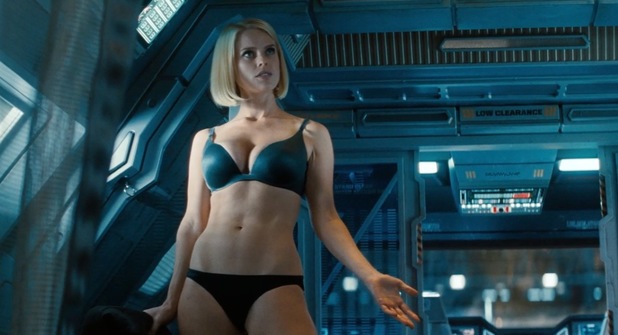
The other addition to the cast who will be more overlooked than she deserves is Alice Eve. She joins the film as Science Officer Carol Wallace and gives a much-needed additional female presence to the film. No offense intended to Zoe Saldana, I am not calling her performance lacking. It is simply nice to have another woman do something of importance aboard the enterprise. Eve portrays a funny, clever science officer and injects the “newness” that I want to see a lot more of in future Star Trek films.

Of course she is still a sex symbol and yeah... underwear. I think there will be an article in the future addressing what is becoming a serious problem with the portrayal of women in "mainstream" action films.
Of course she is still a sex symbol and yeah… underwear. I think there will be an article in the future addressing what is becoming a serious problem with the portrayal of women in “mainstream” action films.

The last and greatest triumph of Star Trek Into Darkness are the character journeys of Captain Kirk and Commander Spock. I was a little worried when the film started as both Kirk and Spock appeared to have regressed slightly from their maturity at the end of the first movie. That problem is quickly rectified, however, as the main focus of the film is to show the final leg in these two characters becoming the icons from the first movies. Kirk in particular really grows from reckless and hotheaded into a more responsible and selfless Captain. The handling of these two characters was the largest strength in the first movie and it remains the best thing about the second.

So yeah, if your Star Trek knowledge is as limited as mine and you want to see a fun, well made, summer movie – check out Star Trek Into Darkness, you’ll love it. But to fans of the original series and films, I must emphasize that I’m really unsure how you’ll take to this entry. If you thought 2009’s Star Trek was a little heavy on the action and light on the characters: prepare to roll your eyes at Abrams’ new film. This is not a science fiction film, this is an action film. The good news is that Star Trek Into Darkness is aware of its action tone, with several of the crew members remarking, at various points, that the main job of the U.S.S. Enterprise is exploration, not combat. I hold out hope that the third entry in the Star Trek reboot will at least produce the cohesion of old and new that the series has been striving for. But in the mean time Star Trek Into Darkness is a pretty fun ride.

Star Trek Into Darkness opens everywhere today. Do yourself a favor and see it soon as the spoilers are soon to become the internet's new favorite occupation.
Star Trek Into Darkness opens everywhere today. Do yourself a favor and see it soon as the spoilers are soon to become the internet’s new favorite occupation.

Marketing Method: J.J. Abrams

With the imminent arrival of Star Trek Into Darkness, I have decided to take a closer examination of one of Hollywood’s best marketers: J.J. Abrams. For the record I should point out that the public is unaware if said genius comes directly from Abrams or is simply from a mind at his studio, Bad Robot. Regardless, Abrams takes the credit – both in the public eye and as the subject of this blog post. From TV to the big screen, no one knows how to turn heads like Jeffrey Jacob Abrams.

One of the top players in Hollywood and arguably its best showman.

To understand how Abrams markets the films he’s attached to, one must first examine this principle: the monster behind the door is always the scariest. What does this mean? Simply put it means that our imagination is more powerful than anything realized. The monster behind the door is scariest because we can’t see it, therefore the mind dreams up all sorts of horrific possibilities as to what it might be. Once it is seen, it can be rationalized. There is nothing scarier than the unknown.

That’s lovely but why am I talking about monsters? Well it follows logic, if our mind is the strongest tool when it comes to fear then why not excitement as well? This is the principle Abrams and the people at Bad Robot operate under. They believe (rightly) that audiences will go crazy over a tease and that teasing itself can be the best way to create hype. Let me show you what I’m talking about. Watch this teaser: http://www.youtube.com/watch?v=IvNkGm8mxiM.

Remember that? That was the teaser for Cloverfield (not that you could tell because they don’t even give you the title). Here is the Abrams bump in its full glory. He did not direct that film, Matt Reeves did. This is a time when Abrams is working only as a producer and doing his job very well. I don’t know about any of you but I believe that is the most memorable teaser I have ever seen. I can remember the first time I saw that in theaters – I can’t remember what movie I was seeing that day – but I remember seeing the teaser and going nuts over it.

What is going on? What is attacking the city? What could do that to the Statue of Liberty? So began Cloverfield‘s marketing campaign. It is one of the most financially profitable films to ever be released in January (it made nearly 200 million on a budget of 25 million) and it’s not hard to see why after that teaser. Not that trailers are the only weapon in J.J. Abrams arsenal. He is the undisputed master of viral marketing.

This image from San Francisco was echoed across every major city in the United States.

Viral marketing is a wonderful new invention made largely possible by our friend the internet. Thanks to the world wide web, it is now possible to generate community buzz in a way that was before only dreamed of. The most wonderful thing about it is that actual movie footage is completely unneeded.

Where else but the internet would people study and manipulate posters to try and find images? This photo above shows an attempt to see the monster's silhouette by flipping two posters against each other.
Where else but the internet would people study and manipulate posters to try and find images? This photo above shows an attempt to see the monster’s silhouette by flipping two posters against each other.

In large part, the strategy used for films like Cloverfield, Super 8 and even Star Trek was perfected through Abrams’ efforts with television. While the producer/director has had hit series like Alias and Fringe: do you remember Lost, what show in television history has ever had more fan involvement than Lost? The fan theories, the DHARMA Initiative, Bad Twin, The Hanso Foundation – all part of the Lost Experience.

Yes, this was its own thing – look at the wikipedia page (http://en.wikipedia.org/wiki/Lost_Experience), there has never been, before or since, a show that has so successfully enraptured fans’ attention and curiosity like Lost. Abrams may not have been super involved via directing or writing, but he made that series into an art form. Want to watch six seasons exploration of the “what’s behind the door” theory, go take a look at Lost.

Did this have anything to do with the series: no. Did that fact matter: absolutely not. I have never had more fun with a show outside of Lost.

Now let’s fast-forward to today. What door is the Abrams marketing machine hyping us up to look behind this time? Oh yeah, this guy:

The identity of Benedict Cumberbatch's character in Star Trek Into Darkness has been at the center of it's marketing campaign.
The identity of Benedict Cumberbatch’s character in Star Trek Into Darkness has been at the center of its marketing campaign.

Who is Benedict Cumberbatch playing? Is he Khan? Is Stark Trek Into Darkness a remake of Wrath of Khan? Is he Sybok, a renegade vulcan after the source of all creation? Is he Gary Mitchell, a Star Fleet officer slowly transforming into a god? Is he a new character? Is he Space Sherlock? The list goes on…

The official name at the moment: Benedict Cumberbatch is playing a man named John Harrison. There are fewer people on the internet who believe in the moon landing than believe that this is anymore more than an alias. What does it matter, 90% of them will be crowding the theaters in the next few weeks to find out the truth. Incidentally: if you don’t want to be spoiled, stay off of Star Trek Into Darkness‘s wikipedia page… that is just not cool.

What it really comes down to is the incredible ability of draw. Abrams has figured out a way to pull people into the theaters. Most out there don’t like spoilers. How anti-climactic is it to read the truth on a page after months of speculation? It’s boring and ruins the game. Yeah, Abrams has made movies and television interactive by adding mystery and inviting the audience to solve it. A great and proven strategy that has been emulated by movies and TV shows alike. Remember how many shows out there tried (and are still trying) to be the next Lost? Remember that cool viral marketing campaign for The Dark Knight? All because of Abrams. He has ushered in a new age of marketing to the cinematic experience and the media is much more fun for it.

I can’t guarantee anything about Star Wars: Episode VII (Abrams next directing effort, I’m not lying) right now beyond this: Abrams + Star Wars is going to be the most hyped-up, most highly marketed thing that any of us are likely to see in our lives. I’m just getting ready to enjoy the ride.

Remember Slusho!? Did this have anything to do with anything? What was going through your head, J.J. Abrams?

Thoughts? Comments? Am I full of shit or onto something? Let me know now in the feedback section of this article.
Be sure to check back tomorrow to read my spoiler-free review of Star Trek Into Darkness!