Ghidorah, the Three-Headed Monster or How Godzilla Became the Good Guy

I had some debate this morning as to what post to write. Should I write the Godzilla-related post that I had planned or should I instead pen a piece about the Montreal Canadiens, and the glorious level of hypocrisy they set for the rest of the NHL? As writing about the Canadiens now could be seen as a “sore-loser” move (seriously, the Bruins would have lost to any quality team… doesn’t matter who you’re playing when you can’t pass and you can’t shoot), I will put it off for a later date, simply finishing with: go Rangers. Anyway, now that I got that out of the way, let’s get back to Godzilla.

The Montreal Canadien version of Godzilla: smaller, quicker, can't take a shot... but probably could still wreck Boston if none of the city's military was working.
The Montreal Canadien version of Godzilla: smaller, quicker, can’t take a hit… but probably could still wreck Boston if none of the city’s military was working.

As has been stated before in other posts, Godzilla began his creation as an antagonistic force. He terrorized Tokyo and ruined lives. An unstoppable metaphor for the nuclear holocaust that was visited upon Japan at the end of World War II, Godzilla was nothing less than terrifying in his first appearance and played the villain in the following three movies. Yet as most out there already know, Godzilla is famous for more than just being a nuclear metaphor. In many of his films (particularly in his first series of movies, the Showa Era 1954-1975), Godzilla is the hero. The brave monster fighting for humanity against other threats. It should be noted that it was not simply the arrival of these ‘other threats’ that turned Godzilla into the good guy. In his three films after the original, Godzilla faced off against Anguirus, Mohtra, and even King Kong. In all of those movies: Godzilla was the bad guy.

King Kong was seen as the underdog of the fight while Godzilla was depicted as a stupid bully.

It wasn’t until 1964, in Ghidorah, the Three-Headed Monster, that Godzilla turned protagonist. For the record, this is not one of the better Godzilla films. It is not horrible, but it is far from the most entertaining. Essentially, it feels like a prototype for the far superior Invasion of Astro-Monster that would be released in the next year. Nevertheless, Ghidorah, the Three-Headed Monster was the film that introduced Godzilla to traditional, 1960s science fiction themes: namely, aliens. Alongside this introduction to beings from outer space came the unveiling of Godzilla’s greatest nemesis, King Ghidorah (pronounced GE-door-ah or Gi-dora, depending on the movie).

With three, lightning-shooting heads and the ability to fly, Ghidorah was a powerful enemy.

King Ghidorah comes from an unspecified area of space to destroy the world. According to the plot of the film, Venus was once a nice place to live before Ghiodrah got a hold of it. At this point of the movie, Godzilla is still the bad guy. He and Rodan (Row-dan) have been fighting and destroying cities. Mothra shows up to convince the two to put aside their differences and save the Earth. Godzilla and Rodan refuse and it isn’t until they watch Mothra fight Ghidorah alone that the two monsters put aside their differences to stop the evil Ghidorah.

How is that communication-heavy scene of monster interaction accomplished? Quite well actually, thanks to the help of Mothra’s two fairy girls (don’t ask), the Shobijin (I have no idea how to pronounce it). Apparently, Mothra’s priestesses speak very good monster-ese. Regardless, the scene showcases and in-depth look into Godzilla’s psyche. He doesn’t hate people per say… he just doesn’t think much of humanity’s greatest achievements. By giving Godzilla a less pure evil personality, the film is able to transition him to a creature that can (and does) decide to fight for good. By creating Ghidorah as a nemesis, the series insures that there is usually a creature on screen that is far more evil than Godzilla.
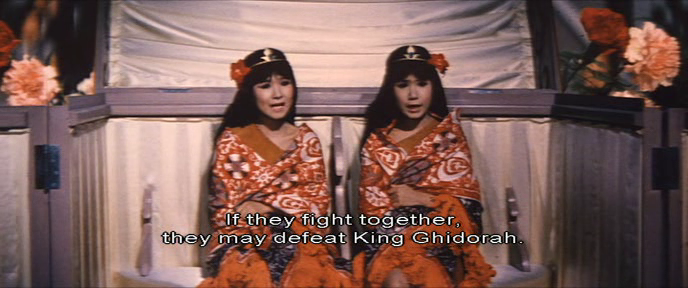
Does any of it make sense: no. Does it work: sure.

One of the most fascinating aspects of the Godzilla film series is its commentary on culture. I am not only referring to the original here, but to the entire series. Godzilla can be seen as an allegory to more than just the atomic bombings, he can also be seen as America. Godzilla’s relationship with Japan begins as one of oppression but transforms into a mutually beneficial arrangement. This reflects Japan and the United States changing relationship as the two grew economically closer.

For Ghidorah, the Three-Headed Monster in particular, Mothra can be seen as Japan: a smaller, weaker force that nevertheless strides for good. Godzilla and Rodan represent America, larger and more powerful but currently indifferent to the plight of the Japanese people. Ghidorah, well that’s easy. This movie was made in the sixties and deals with a threat from outer space. What space-racing nation was challenging the U.S. and its allies at that particular time?

Ghidorah would return many times, including to fight in Destroy All Monsters. Don't ask me for allegory on that one.
Ghidorah would return many times, including to fight in Destroy All Monsters. Don’t ask me for allegory on that one.

Is the analogy 100% proof, no but it does highlight that there was more to some (definitely not all) of these movies than just people in suits beating each other up. Transitioning Godzilla into a good guy reflected a changing attitude in Japan. It wouldn’t be until 1984, with a desire to return to the dark tone of the original, that Japan would abandon the benevolent image of Godzilla. He would return to good guy status in later films (notably Godzilla: Final Wars) and it is said that the Big G even sports several shades of hero in the upcoming Gareth Edwards movie.

The review for said film will be going live tonight at midnight, I hope you will check it out.

The Five Essential Godzilla Films (Original not Included)

Over the past couple weeks, I have had friends come up to me and go, “So that new Godzilla movie is looking pretty cool, are there any I should watch beforehand?” To which I always reply: “Watch the 1954 original.” That is my go-to answer and I am sticking to it. If anyone out there ever wants to understand why Godzilla became famous, why there are soon-to-be thirty movies starring the King of the Monsters, why this creation matters in culture: the original is the way to go. Problem is, most of my friends have now seen the original and are asking: “What others are worth watching?”

Thirty films is a tough list to narrow down. Really, the original is the best, and if you can only watch one Godzilla film before the release of Gareth EdwardsGodzilla, that should be it. That said, if you feel yourself craving a little bit more of the big G (yeah, that’s a fan nickname… just so cool right now), the following are my top five recommendations.


5. Godzilla vs. Destroyah (1995)

Godzilla vs. Destroyah is the last in the second series of Godzilla movies (known as the Heisei series 1984-1995). For the record, this is my least favorite series of Godzilla films. It is more serious in tone than the first (the Showa series 1954-1975) while loosing nearly everything that (in my opinion) made the series fun. None of the “serious” Heisei films come anywhere close to being as effective as the 1954 original, but they do try… kinda. Right, now that I have bashed the Heisei enough, let me say why Godzilla vs. Destroyah is a Godzilla film worth watching:

Godzilla can barely contain all of his power in this movie.

This is the movie (outside of the original) where Godzilla dies (spoiler alert). This was a huge deal back in 1995 and is still worth noting today. I remember hearing about this in the news – here in the United States. When else, outside of a Hollywood remake, has Godzilla made the American TV news? Remember, the internet wasn’t a thing back then so this is even bigger. It took me a couple years to track down a bootleg VHS copy, but it was worth the effort.

Destroyah is actually created as a result of the oxygen destroyer. This ties into the first film and reinforces the theme that devastating weapons create devastating monsters.

Godzilla vs. Destroyah features the excellent monster effects that highlight the Heisei series. Destroyah looks sinister, like Godzilla is fighting the giant monster version of the devil. The plot is also more interesting than most as the humans have to try and figure out how to survive Godzilla’s meltdown (he is dying from an overload of radioactive energy). There is one sequence in particular that sticks out in my mind: the humans fight a bunch of primitive-form Destroyahs in an industrial complex. They go in guns blazing but just get annihilated. If this sequence is sounding like something out of Aliens, that is because it is.

Many of the Godzilla movies feature elements that are… let’s say similar to other culturally significant films. The better Godzilla movies incorporate those elements and make them fun. Godzilla vs. Destroyah accomplishes this well and is definitely worth the watch.

4. Godzilla, Mothra and King Ghidorah: Giant Monsters All-Out Attack (2001)

Also known as GMK, this film has a very unique feel to it. Of all the Godzilla films to approach the allegory of the original, this one comes the closest. It is the third in the third series of Godzilla films (the Millennium Series 1999-2004). Take a look at the Godzilla costume for this movie:

gmk_ghost_godzilla_2001_by_mrjlm18-d65xctw

The all white pupils make it one of his most striking incarnations. As stated previously, this is a film about allegory… however it is not just nuclear allegory this time. Godzilla represents the angry souls of all of those lost in World War II (this is stated in the movie rather than implied). He has returned to wreak havoc on Japan and make sure that the people are reminded of the suffering that took place. Japan’s only hope, outside of the military, is three guardian monsters. Baragon, Mothra, and King Ghidorah must battle Godzilla and attempt to calm his fury before Japan is destroyed. Interesting note: this is the only time King Ghidorah is every portrayed as a good guy.

Godzilla's atomic breath leaves striking imagery in this film.
Godzilla’s atomic breath leaves striking imagery in this film.

If this movie is sounding weird, it is. It is also very well-filmed. The miniature and costume work are excellent, and there are several sequences that are very effectively directed. Godzilla is made terrifying again, and this is the only time since his creation that it works.

3. Godzilla: Final Wars (2004)

Holy crap this movie! Made to celebrate Godzilla’s fiftieth anniversary, this film is a spiritual remake of Destroy All Monsters (1968). This film features fourteen monsters (14!) and has Godzilla just wade through a stream of enemies as he fights aliens that are attacking the Earth. This might be the most zany Godzilla movie ever made. The plot is this: Godzilla was locked in ice years ago and humanity has moved on, building advanced weapons to fight the other monsters on the planet. The greatest of these weapons is the Gotengo, a flying submarine with a drill on it… yep. Also, mutants have appeared, they’re just like people but more Matrix-y.

This isn't even every monster in the movie.
This isn’t even every monster in the movie.

Anyway, aliens show up and put most of the Earth’s monsters and mutants under their control. Humanity’s last option: wake up Godzilla to fight EVERYTHING. What enfolds next is essentially a never-ending series of action sequences until the credits roll. Oh, Godzilla’s son is in this one too, he exists outside of the plot. I say plot but, don’t watch this movie expecting one. It’s not the point. If you let go of your sense of reason, this is one of the funnest movies out there. Godzilla even fights the first American Godzilla in this movie:

2. Mothra vs. Godzilla (1964)

Don’t let the title fool you, this is definitely a Godzilla movie. The fourth Showa movie is one of the best in terms of overall film quality. Director Ishiro Honda (the man who created Godzilla) crafts a very in-depth tale of Japan rebuilding in the wake of disaster. Capitalism is featured… and not overall favorably, as greed drives employers to value money over safety.

The movie opens with a violent storm destroying a large portion of coastline. As the people sift through the wreckage, an enormous egg is discovered. An opportunistic businessman immediately seizes control and starts thinking up ways to use the egg to make money. Only one problem: it’s Mothra’s egg (giant moths lay eggs apparently). Oh, Godzilla also washed up as well. He isn’t discovered right away as he was buried by other debris but, he makes himself known fairly quickly.

This Godzilla suit is regarded as one of the best in the series.

There is just something about this movie that really makes it work. The costume design is one of the best, the characters are interesting, the fights are cool… oh, and the plot, for the most part, makes sense. This is a rare combo in Godzilla movies. Interesting note: this is the last of the Showa series to feature Godzilla as an antagonist. Going forward, he would be transformed into the hero of Earth, fighting any threat to mankind… and speaking of threats to mankind –

1. Godzilla vs. Mechagodzilla (1974)

I may be biased here: this is the first Godzilla film that I ever saw. This was the fourteenth film in the Showa series and celebrated Godzilla’s twentieth birthday… by making him fight a giant, mechanized version of himself.

One of Mechagodzilla's many abilities.
One of Mechagodzilla’s many abilities.

Godzilla vs. Mechagodzilla is a movie featuring spies, ape-like aliens, explosions, gore, monsters, and an overly-long musical number. Godzilla is the good guy, joining forces with Anguirus (Aang-gear-us) and King Caesar to fight the evil Mechagodzilla. The ape-like aliens, they control Mechagodzilla. The spies, members of the human race trying to thwart the aliens. The explosions, Mechagodzilla shoots more projectiles than any other two monsters in the Godzilla series. The gore, Mechagodzilla makes Godzilla bleed. The monsters: I already mentioned them. The overly-long musical number exists to wake up King Caesar, here it is:

This movie is campy in the best way. I absolutely love it.

Amazing poster art, check.


So there you have it, five Godzilla movies that are worth checking out. If any out there manage to brave these selections and desire more, my runners up are as follows: Invasion of Astro Monster, Son of Godzilla, Destroy All Monsters, Godzilla vs. Megalon, and Godzilla vs. Biollante. If you feel like watching any more beyond those then do yourself a favor: take a month and watch a Godzilla movie a day. At least you’ll be able to cross that off the Bucket List once you’re done.

Star Wars Episode VII vs. the NFL Draft

What do Star Wars Episode VII and the NFL Professional Football Draft have in common? For starters, let me clarify immediately that, for the purposes of this article, Star Wars Episode VII does not refer to the movie itself, but rather to all the fan speculation surrounding it. Hopefully the movie, Star Wars Episode VII, will be nothing like the NFL Draft. Hopefully.

Two weekends ago was Star Wars Day, an unofficial holiday celebrating the creation of George Lucas’ beloved (and despised) Star Wars series. Of course, things have been slightly different recently. This marks the second Star Wars Day since Disney acquired Lucasfilm, a business move that also announced the impending release of Star Wars Episode VII. That happened in October of 2012, so there was not much information by the following May. Now, all that has changed (kinda). We have a director, we have a cast, we have theories! Interesting to note that Star Wars fans were not the only ones geeking out this month.

The NFL draft began on May 8th of this year, several weeks later than usual. Why: ratings. There is some bullsh*t “other” reason out there but really, the NFL Commissioner wanted more viewers. For those out there who do not know, the Draft is when the professional NFL teams select the promising players emerging from the college systems. In the weeks (or months) leading up to the Draft, experts sit around discussing possibilities. Which team will take which player? Which players will work out? Which players will bust? It is essentially pure speculation, backed by only the most basic logic (this logic is not an essential piece). Sound familiar?

Looks like the Star Wars geeks and the NFL jocks have something in common. They both like to speculate. These are not the only two subjects on there were speculation drives the fanbase. Any product where the information flow is not constant requires dedicated fans to fuel its interest and generate hype. Look at E3, where video game developers show trailers and fans instantly proclaim “console victory.” Remember Lost, the show that started the online craze of tracking fan theories and open speculation? Just how did Sherlock survive the fall?

If anything, the NFL Draft has a value lesson to teach these other arenas. There is money, a lot of it, to be made in speculation. Heck, pretty much all of Professional Sports commentary is just that: people sitting around discussing the odds that something might happen. Not like for just fifteen minutes either, these people make 9-5 jobs out of it.

For those out there who felt that three hours was excessive… please watch the NFL Network sometime.

With Professional Sports, there is one difference that I feel I should mention: the answer is not out there. Sure, the future will reveal everything, from who will win the next World Series to who will win the Bruins-Habs series that is happening in the NHL right now. Time is the only certainty that will remove the need for analysis and discussion. With Star Wars Episode VII: it is purely a marketing scheme. The script it out there, it exists. If J.J. Abrams felt like it, he could upload that cast reading that happened a couple of weeks ago and everyone would immediately know what would happen. But where is the fun in that?

Especially since we already know.

Star Wars Episode VII will suck. Star Wars Episode VII will resurrect the emperor. Benedict Cumberbatch will not be in Episode VII. Harrison Ford will have a co-leading role. Jar Jar Binks will not be in it.

I didn’t bother to source that last one… he just better not be.

Son of a bitch.
Son of a bitch.

I could do the same thing for the NFL Draft but it would be redundant. People enjoy talking about shared interests. People enjoy the excitement of what could be. People enjoy making money. This is how hype has become a business. The future will end the hype for both the 2014 NFL Draft selections and Star Wars Episode VII. Good thing we will have the 2015 Draft and Star Wars Episode VIII when that happens.