As audiences, we see these words a lot. Recently, I was at the cinema seeing The Imitation Game and these were the first words to greet me on the screen. It gave everything in the film a sense of gravity and added weight. I was not watching fanciful creations but someone’s actual life, dramatized because of its significance… or so I thought. Afterwards, I immediately inquired further into the validity of The Imitation Game‘s information. There were inconsistencies to say the least. This is not to say anything negative against the movie as a film, or to single it out as the only culprit when it comes to twisting reality. This happens a lot. Books, movies, even video games all love to use the tagline: based on a true story. Well cool – what’s it mean?
For those who do not know, Fatal Frame is a game where you take pictures of ghosts with a camera… yeah, cause that totally happens.
After some digging, I was able to find a legal definition in regards to the phrases “based on a true story” and “inspired by a true story.” Keep in mind, this is in regards to literature (although safe bet that similar stature exists for the other media types):
“A core of truth” does not go far to keep a story grounded in reality. Essentially, what that means is that one significant aspect of the story must be true. If one is making a film about a real life killer for instance – a killer will be in the movie. Does the movie killer have to be related to the actual killer? Look no further than Ed Gein vs. Leatherface for the answer to that one.
As the definition suggests, legal trouble can also arise from uses of the term. Families and living relatives often take issue with film portrayals of their ancestors (let’s use The Imitation Game again as an example). In the case of the atrocious film, The Fourth Kind, many newspapers and an entire city were angered over the film’s liberal use of “based on a true story.” Argo might hold some kind of record since it angered the majority of Canada by downplaying the country’s role in the “true” events depicted on-screen.
So, with all the trouble that can come of “based on a true story,” why do they use it?
Because we love it.
In many cases, this phrase appears associated with either drama or horror, leveraging that all important aspect of audience relatability. What could be scarier or more moving than something that actually happened? The chills of a “real-life” psychopath will get the adrenaline flowing better than any fictional boogeyman. Anyone experiencing either the rush or low of a relationship will take solace in knowing there are other people out there who went through similar situations.
The use of real life characters adds more weight to certain genres of storytelling.
Is it real… well does it need to be? “Based on a true story” is used to heighten emotional reaction. The upside is, this technique clearly works as more and more films adapt it into their hits. The (potential) downside: some people actually believe it while it further increases the cynicism of others.
The Internet: proof that some people will believe anything.
So who is responsible? While some blame Hollywood and publishers for their overzealous use of phrase, I believe that it is the audience’s responsibility to be informed. It is a lazy mind that takes everything it sees or reads at face value. That is not to say that they have the right to lie or slander individuals at will. Let’s keep those laws we have working for us.
If anything, “based on a true story” should be taken as an invitation to do some research. Heck, if you already thought the subject was interesting, why not look into it a little more?
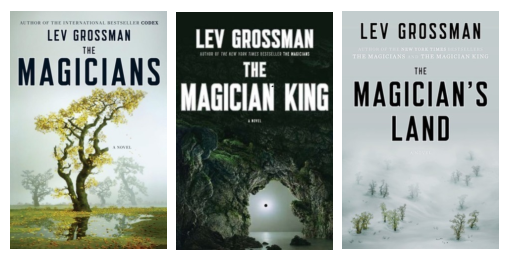
Back when I wrote my article on untapped potential series for HBO, there were many strong intellectual properties that I left out. One such I.P. was The Magicians trilogy, written by Lev Grossman. For those out there who are unfamiliar with this series, picture a far more adult/realistic interpretation of Harry Potter. A world where being wizards does not stop children from engaging in drug use, alcohol, sex, and all the other stupid crap kids tend to do as they grow older. Add to this an incredibly smart parody of the Chronicles of Narnia series and you have the essence of what The Magicians trilogy is about. This past summer saw the end of the trilogy with the final book, The Magician’s Land, being released in August. Like many fans of the series, I went through typical post-book depression once reaching the end before looking out to see what future, if any, the series might have. Grossman is, at the moment, insisting that this is the end for the series (I’m not so sure) so book-wise prospects were limited. There is a planned television show, however! Huzzah! Who is making it? Netflix? HBO? Hulu? Syfy? Really – Syfy… okay, not sure how to feel there.
A fantastic little trilogy of books for anyone looking for well-written fantasy.
Actually I do know how to feel: not confident. The network formally known as Sci-Fi has not been the recent name in terms of quality programming. To look back at it, the last Syfy show that anyone even talked about was Battlestar Galatica and that ended (rather poorly) in 2009. Since then Syfy has produced shows such as Haven, Defiance, and Z Nation. None of these shows have enjoyed terrific critical reception. It seems that since Battlestar Galatica, Syfy is still scrambling to find a show that garners a stronger reaction than: “Z Nation, that sounds a lot like the Walking Dead!”
In fact, there is only one recent series that Syfy is famous for: Sharknado. Yes, for those out there looking to gauge just how intelligent the usual Syfy programming is, look no further than Sharknado. For those poor souls out there who are unaware what Sharknado is… it is exactly what it sounds like. A movie about a tornado – made of sharks. Two movies actually, with a planned third on the way. Not to criticize Sharknado, on a personal level I love it for the wonderfully, intentionally stupid movie series that it is. That said, “From the network that brought you Sharknado comes the Magicians” just sounds wrong on so many levels.
Yeah, this is what to expect from Syfy these days.
The point I am trying to make is that the Magicians is smart, and it is that intelligence that made the series work. On the face of it, there have been numerous fantasy books that have tried to bring that ‘adult edge’ to the Harry Potter scenario – and most of them have failed miserably. These books did not rely on their sex or occasional brutal violence to tell a story, they relied on the charm and wit that Lev Grossman installed into their characters.
In particular there is a special challenge with the series protagonist, Quentin Coldwater (I love that name). Quention is nothing like Harry Potter. He is much more your typical hormone-filled adolescent. He makes mistakes, a lot of them, and he is not likeable through the first part of the trilogy. This character is realistic but hard to write. Grossman was able to give Quentin humanity and sympathy – which was very tough when his character was best described as a person who has everything: magic, a woman who loves him, a school to grow his talents, a portal to a magical world… and he manages to thoroughly f*ck everything up through his immaturity and inability to take responsibility. That may not be a tough protagonist to make relatable, but he is not the easiest guy to root for – not in the beginning anyway.
One of the main lessons that Quentin needs to learn throughout his journey.
Writers John McNamara and Sera Gamble have their hands full in handling the pilot of this adaptation. McNamara’s career is long but not filled with any real highlights (Lois & Clark is not something to be proud of). Gamble at least has Supernatural under her belt. It is not a guaranteed failure, but the odds appear stacked against the Magicians being a show on the same level as the book series it is based off of. I am only hoping to be proved wrong.
On a quick side note, how funny is it how much the dialogue has changed on shows?
Lord Voldemort: the Dark Lord, He-Who-Must-Not-Be-Named, You-Know-Who… That Guy. Everyone knows the story of Harry Potter (available in seven books or eight movies). Lord Voldemort is the evil villain and main antagonist of the books. He is a murderer, his most prominent victims being Harry’s parents. Many people have drawn comparisons between Voldemort and the likes of Hitler and Satan. At first glance it makes sense, I mean he did bring the wizarding world to its knees before being defeated by a conveniently resurrected teenage Messiah. Hold on one moment… teenage? Yes, J.K. Rowling may want Voldemort to come off as threatening but really – who is she kidding? Let’s take a good look at “the Dark Lord” of the Harry Potter universe as he is presented.
Sounds pretty cool, like an evil-summoning rally cry. How does it actually look?
Oh wow… a snake and a skull. That’s really bad-ass. Not the type of thing that would be included in EVERY SINGLE WASHABLE TATTOO SET FOR KIDS EVER.
I’m going to guess that Voldemort was either at a dollar store or a pharmacy when he came up with the design.
This does not look like an evil logo. This is trying too hard. It is the type of thing that someone named Devlin would get when he is sixteen to “express his dark and tortured soul.” Evil does need to try and be evil. It can look as simple as this:
Every villain needs followers and Voldemort is no exception. As a man obsessed with power and blood supremacy, it only makes sense that he would call his followers “death eaters”… except that it doesn’t. Where did that name come from? Were “Doom Bringers” and “Pain Makers” taken? Do they feed off the death they create – are they cannibals? I’m going to guess it just sounded better than “Evil Evildoers.”
At least they look cool right?
Someone’s ready for the Slayer concert.
The Name “Voldemort”
God, how smug is the Tom Riddle when he explains this to Harry:
Ladies and gentlemen: Lord Voldemort has some daddy issues. Seriously, first the tattoo and now a new name? How much of this is screaming “you’re not the boss of me!” to anyone who will listen.
Tom Riddle Sr: “Tom, pick up your clothes. Did you clean your room like I told you?”
Tom Riddle Jr: “My name is Voldemort, dad! Voldemort! I am a great wizard!”
Tom Riddle Sr: “Sounds like one ‘great wizard’ isn’t getting any pizza this evening.”
Tom Riddle Jr.: “I hate you so much!”
Seriously, it would be like if Adolf Hitler renamed himself Nazi Maximus.
The Snake Thing
Every edgy teenager who wants to be taken seriously needs an edgy pet. Dogs and cats: only conformists have the loyalty of those creatures. Voldemort got into snakes in a big way. He has a pet snake (not an innuendo), he can speak to snakes, he even received body modification to make himself look more like a snake. Voldemort’s kind of a big deal in the snake world.
We get it man, you like snakes. No one cares.
I get it, snakes are a symbol of evil in the Old Testament. J.K. Rowling was going biblical in her villains. It is just a little silly in this day and age. You know what else was evil in the Old Testament: women. Seriously, they were the source of a lot more problems than the snake. They were even closely involved in the whole snake debacle in the garden. So if Voldemort really wanted to be Old Testament evil, he should have lost his “snake” and gone for an operation.
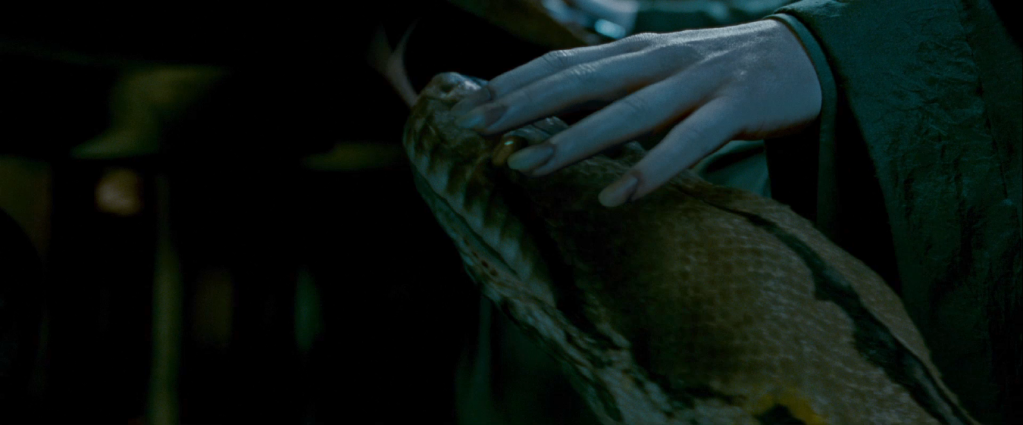
Voldemort playing with his pet snake… still no innuendo.
Yeah… people like that never gain a lot of power. In a world where people can be killed with a wand and a couple words (or a gun), fear is not enough to attain sublime power. Even if readers believe that Voldemort is the most powerful wizard who ever lived (and the next point speaks against that), he is still not immortal. Sure, he has the horcruxes so he will come back to life… eventually, but still – Voldemort is just one man. Every dictator in history has possessed the ability to manipulate. Voldemort is just too busy trying to be cool – I mean evil.
Harry Potter
Last but not least, a villain can be defined by the protagonist he is opposing. Voldemort, supposedly the greatest wizard who ever lived, has a teenager for an arch-enemy. Sure, Harry is supposed to be gifted… but seriously. There is still a gap between strong student and greatest ever. It would be like if Stephen Hawking battled a college student with a strong G.P.A. Harry is not even the most intelligent person among his friends and yet: he is still able to outwit the Dark Lord on a regular basis.
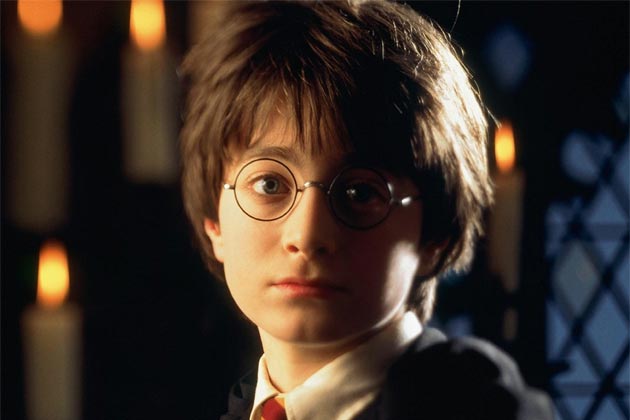
Yeah, Voldemort is really terrifying. Remember that time he lost to an eleven year old?
Does this look like the face of mercy to you?
Bottom line: J.K. Rowling tried too hard. Voldemort is a cartoon bad guy, complete with evil laugh and sidekick. It is simply not possible to take him seriously. Yes, he is a murderer, yes he hurts people… but seriously – he is kind of a dweeb. Maybe Voldemort will amount to something when he finally grows
“Ravleen: How much does the fact that voldemort was conceived under a love potion have to do with his nonability to understand love is it more symbolic
J.K. Rowling: It was a symbolic way of showing that he came from a loveless union – but of course, everything would have changed if Merope had survived and raised him herself and loved him. The enchantment under which Tom Riddle fathered Voldemort is important because it shows coercion, and there can’t be many more prejudicial ways to enter the world than as the result of such a union.”
Yes, it seems like sex matters to J.K. Rowling, and bad people only come from loveless unions… or single parents. I may be reading too much into this but I stand by that: every time J.K. Rowling opens her mouth, the magic of Harry Potter dies that much more.







 Colin McMahon