History vs. Storytelling: The Monuments Men

At last year’s Academy Awards ceremony, Ben Affleck’s Argo took home “Best Picture”. The film was widely entertaining but had historians and certain former members of government crying foul. I know: a major Hollywood movie not being completely factual – blows my mind too. Anyway, there is a point to keeping historically based movies somewhat similar to the actual events. However, when Affleck defended his film, Argo and the changes he made, one message was obvious: it was his first job to make the movie good. It won “Best Picture” so… Mission Accomplished!

Fast-forward to the present day and George Clooney‘s film, The Monuments Men. Like Argo, Monuments Men is inspired by actual historical events. This film centers on the end of World War II when the Allied Forces (namely the United States of America) sent in art experts to try and save historically famous pieces from the hands of the Nazis. Wow, there really is no better villain than the Nazis: not only were they a genocidal death force but even the paintings weren’t safe. Seriously, is there any area of life where these guys weren’t villainous?

I have never read the book but, from what I've heard, it has similar narrative problems.
I have never read the book but, from what I’ve heard, it has similar narrative problems.

So, in terms of storytelling; there is the fish-out-of-water protagonist(s) – Clooney and his men – entering World War II Europe (great setting) to recover priceless pieces of art in the name of safeguarding both history and culture. That is a great setup. The comedy, the moral questions, the championing of art as a vital piece of mankind to be saved. Problem is: The Monuments Men is not that story.

George Clooney has directed many quality films including Good Night and Good Luck.
George Clooney has directed many quality films including Good Night, and Good Luck.

There is great strength in documentary-style storytelling. Experts and eye-witnesses reconstruct events while adding important evidence and insights. This style provides an excellent vehicle to attain the general knowledge of a topic. The Monuments Men is not set up like a documentary. Instead the film plays like flashes-from-life. There is no flow, no constructed story structure of any kind. Scenes simply happen, some humorous, some inspiring, some very tragic. But they all just happen.

Neither Matt Damon or Cate Blanchett feel needed for this film. They spend the majority of the movie on their own, making no significant addition to the story.

The result is there is no way for the audience to easily connect. The film follows nine individuals (Clooney’s team, French Cate Blanchett and a US-German interpreter). That’s a big central cast. Don’t worry: they’re split up most of the film and they’re so interchangeable that it doesn’t really matter. Even George Clooney and Matt Damon disappear for significant stretches so the film never feels like it has any one character to follow. There is a reason why I’m not naming any of the actors in this movie by their character names: there really weren’t any characters.
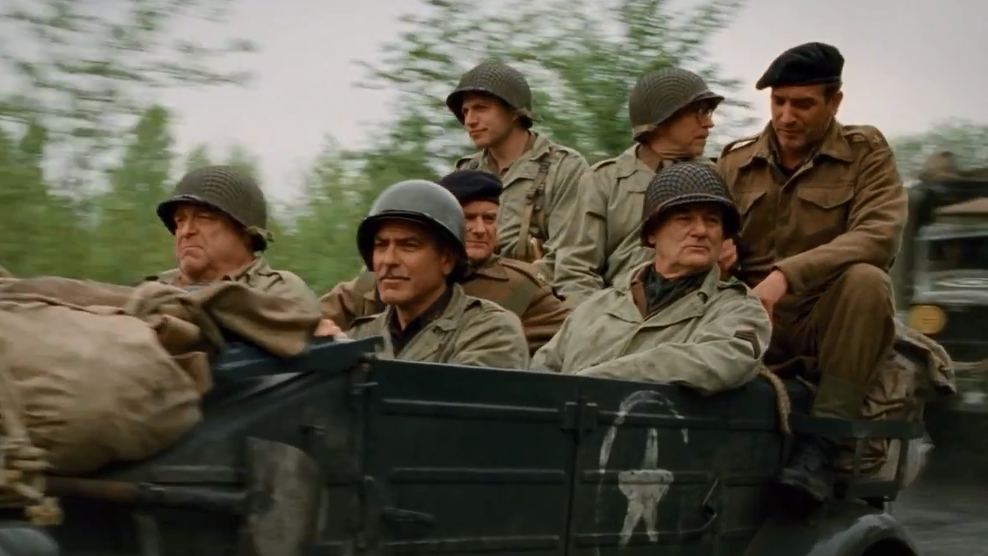
Never have so many great actors had so little to do.

What is on screen feels accurate to history (I have yet to extensively fact-check the movie so I cannot say for certain). Everything in this film is akin to a World War II highlight real. There’s the shots of the Nazis being evil, the shots of the Russians being antagonistic (but not so much so that they were not part of the Allied Forces), the shots of Europeans resisting Nazi rule, and the shots of men dying for a cause they believe to be greater than themselves.

Ben Affleck’s point now is made valid by this movie. As an audience member, I feel like I learned more about the world, history and human nature from Argo (fictitious attributes aside) than I did from The Monuments Men. Next time George Clooney directs a movie, he had better remember that he is a storyteller first and a historian second.

What Went Wrong With the World War Z Movie

In 2006, Max Brooks published his novel, World War Z: An Oral History of the Zombie War. Granted, there isn’t a high standard out there for zombie literature. When people think of books involving zombies, it’s either World War Z, The Zombie Survival Guide or The Walking Dead (which is a graphic novel series). My point is: standards may be low when it comes to zombie-related reading material. That is not to diminish the writing talents of Max Brooks. Author of both World War Z and the Zombie Survival Guide, Brooks is certainly an accomplished author. While the quantity of notable zombie literature is low; the quality is high. World War Z: An Oral History of the Zombie War is an incredible narrative woven together using short stories to tell a surprisingly believable “what if” scenario. The Zombie genre may be over-bloated with material but trust me: this book is worth checking out, it’s fame is well-deserved.

If you haven't read it yet: check it out.
If you haven’t read it yet: check it out.

World War Z: An Oral History of the Zombie War was so successful that there was actually a bidding war for the film rights. Two companies, Appian Way (owned by Leonardo DiCaprio) and Plan B Entertainment (owned by Brad Pitt) vied for the film rights. At this point: it’s pretty easy to tell who won. For Pitt, it was a personal project that he wanted to do for his children, who were enormous fans of the zombie genre and of the book… so what happened?

Those out there who have read the novel and seen the adaptation already know: the movie is not the book… not even a little bit. They both have zombies in them and involve Israel, I’m being honest when I say that the comparison ends there. To give World War Z an equivalent as an adaptation, I would look to the 1998 version of Godzilla. Both adaptations make sparse use of their source material, opting instead to go with something more generic and easily marketable. In my opinion: this adaptation technique didn’t work (in either case) and crippled what could have been powerful film-making.

I had yet to read the book when I saw the trailer but even then I knew that changes had been made. The zombies weren't supposed to be running.
I had yet to read the book when I saw the trailer but even then I knew that changes had been made. The zombies weren’t supposed to be running.

But I digress, I do not wish to review World War Z. Plenty of critics have already done that. Simply saying I did not care for the film is enough. Let’s instead discuss how a passion product for Brad Pitt became a film that could have easily gone by any other, zombie-related, title.

After Plan B secured the rights to film adaptation, Babylon 5 creator J. Michael Straczynski was hired to write the screenplay. He did, two drafts of it apparently. For any out there very curious, here is the second draft of that script. This screenplay was close to the book but deviated in a few areas. Certain locations (like the battle of Yonkers) were altered and the focus shifted slightly for the triumphant spirit of humanity to who was to blame for the zombie outbreak (hint: George W. Bush).

Max Brooks never had any say in the film version of his novel but expressed approval at Straczynski’s work. However, Studios weren’t convinced and the film hit problems. Matthew Michael Carnahan was brought in to make script rewrites and Paramount (the studio who had initially agreed to distribute the film) looked for a partner to share in the costs.

Certain actors increase profits. Brad Pitt increases profits. Brad Pitt with beautiful hair: millions.

No second studio ever entered the picture but with Brad Pitt confirmed to star, Paramount funded the product anyway. Filming began in July 2011 and ended by 2012… only to start again. The reason: the ending. The original ending of World War Z has never been seen but has been revealed. Considerably darker and more open-ended (the War is far from over in the original draft), Studios feared that the original ending would not be well received.

The "camouflage" ending was an invention of cinema. As Brooks wrote many times in his novel: there was no easy way out.
The “camouflage” ending was an invention of cinema. As Brooks wrote many times in his novel: there was no easy way out.

Damon Lindelof and Drew Goddard (both of Lost fame) were brought in to completely rewrite the film’s third act. The result was that production had to resume and nearly forty minutes of new material was shot. The ending was re-envisioned to be more hopeful and action-oriented, better appealing to the summer blockbuster crowd. Various political subtexts were also toned down to make the film more approachable.

In regards to art, there is a belief that I hold: art for everyone is art for no one. What I mean by this is that when you try to alter something to make it please the masses, you inevitably lose what was unique about that piece in the first place. There is no piece of work created by any human being that has ever fully appealed to everyone.

More accessible meant more merchandising. Because everyone likes toys.

That being said, I cannot claim World War Z a complete failure: the studio succeeded in their goal. Despite going over budget (125 million became 190 million), World War Z went to gross over $540 million worldwide. Enough success to warrant a sequel and be a surprise financial hit in 2013.

So mission accomplished… I just don’t agree with the mission. World War Z: An Oral History of the Zombie War is not a novel for everyone. It is dark and brutal and realistic while still being fantastical (it reads like a war history… against an undead opponent who eats people). While action occurs, it isn’t the focus. So those out there wanting mindless entertainment would be disappointed in it because the novel is simply too smart. It forces the reader to think and question aspects of humanity. It is depressing and uplifting and many emotions in between. The film was a product, a predictable outcome after so many complications. The novel was art. There’s the difference. There’s where they went wrong. 

Where are Catching Fire's Academy Nominations?

Adaptations are now the norm of major Hollywood production. Very few truly original films are released to the public and that is true of this year. From Iron Man 3 to 12 Years a Slave to (of course) the Hobbit: the Desolation of Smaug: adaptations dominate the box office. Many of them, including the three I just mentioned, were positively received and earned Academy recognition for their efforts. Yet there is one missing from the list that many, including myself, feel has been overlooked. The Hunger Games: Catching Fire took in major dollars this year and earned its share of nominations, yet received no Oscar notice.

At first glance this appears improbable. One needs look no further than the casting to find an area worthy of Academy recognition. Jennifer Lawrence has already won an Oscar and received a nomination, this year, for her work in American Hustle. Granted, her performance in that movie is powerful, but in Catching Fire she is the soul of the movie. Suzanne Collins wrote her Hunger Games trilogy from the perspective of Katniss Everdeen. In the book, the reader was treated to a multitude of nuances and perceptions from Everdeen’s thoughts: everyone knew what she was thinking. Lawrence didn’t have that in the film. She made up for it in raw acting talent. The audience is able to feel all of Katniss’ emotional (as well as physical) struggles, thanks to the talents of Jennifer Lawrence.

There is no scene in this movie where Lawrence does not cement her talent as a lead actress.

Her work isn’t the only in the film to stand out. Unlike its predecessor, The Hunger GamesCatching Fire makes excellent use of its supporting cast. Woody Harrelson, Donald Sutherland, Stanley Tucci and Philip Seymour Hoffman all shine in their respective parts and easily could have merited Academy consideration. Best Supporting Actor is a tough category this year, filled with many (including Michael Fassbender and Bradley Cooper) strong performances competing. Catching Fire‘s omission from this category is understandable but still regrettable.

The real snub is the script. Audiences have already seen what a mediocre treatment of Collins’ writing looks like. They were treated to it in 2012 with the release of the Hunger Games. The result was a semi-entertaining film (thanks only to Jennifer Lawrence) that failed to deliver on any of the emotions or characters from the book. The Hunger Games: Catching Fire is flawless by contrast. As someone who read the book, there was little I noticed that was missing from the adaptation. Whenever a book is adapted into the movie, scenes must be smartly written to avoid losing their substance and Catching Fire is a prime example of adaptation done right. There is no wasted scene in the movie: there isn’t time for one. The film’s only weakness, its cliffhanger ending, is still reflective of its source material.

This film does not rely on acting alone to generate emotions. There are many powerful moments thanks to the script.

A last category to look at for nomination would have been the visual department, specifically “Costume Design” and “Makeup and Hairstyling”. Catching Fire does not have any enormous computer-generated creations to gawk at yet the movie still delivers many images that are visually striking. Again, it is startling because the audience has seen it done wrong in the previous film. Katniss Everdeen really does look like the “girl on fire” this time around and all the districts are given more personality through their wardrobe choice. With some suspect films taking nominations in these categories this year, it is sad to see Catching Fire left out in the cold.

the-hunger-games-catching-fire-wallpaper-cast

At the end of the day, the Academy Awards are just that: awards. They are only more glorified by the amount of press coverage they receive. In the past, the Academy has omitted many great films from its “prestigious” recognition, including recent works like Wall-E and the Dark Knight. Films do not need Oscar wins to be memorable and there is little doubt that Catching Fire will be remembered as anything less than what it is: a fantastic adaptation of a thrilling novel. It is just a shame that the film Academy forget to notice it.

But seriously, how did this movie earn an Oscar nod before Catching Fire?

Find this and more great articles at Culective.