"I AM KING UNDER THE MOUNTAIN!" – 'The Hobbit: The Desolation of Smaug' Review

Eleven years ago, New Line Cinema released The Lord of the Rings: The Two Towers. The second chapter in Peter Jackson’s Lord of the Rings trilogy found incredible critical acclaim and took home two Oscars. However, departures from the source material, including the delay of Shelob, the character change of Faramir and the presence of elves at the battle of Helms Deep, angered some of the more diehard Tolkien fans. To those people I have one thing to say: STAY AWAY FROM THIS MOVIE. Of course, if you sleep with The Hobbit on your nightstand and hold the word of Tolkien as law, then you probably already walked away from this new trilogy in disgust last December. Peter Jackson’s The Hobbit: The Desolation of Smaug is a bold departure from the source material and… a pretty good movie… I think? I’ll get into it.

(MINOR SPOILERS TO FOLLOW)

The Desolation of Smaug essentially picks up right where the first film left off. As you may remember, Bilbo Baggins (Martin Freeman) and company are on the edge of Mirkwood. The orcs are still right behind them and the eagles have left to return to the realm of Deus ex Machina. Yet there is also flashback scene to ease us into our fifth return to Middle-Earth. Returning to the famous “Prancing Pony” Inn from Fellowship of the Ring, we witness the initial meeting between Gandalf (Ian McKellen) and Thorin (Richard Armitage). This scene, as well as many of additions/changes to the source material, exists for one purpose: there are bigger things going on in Middle-Earth than Smaug.
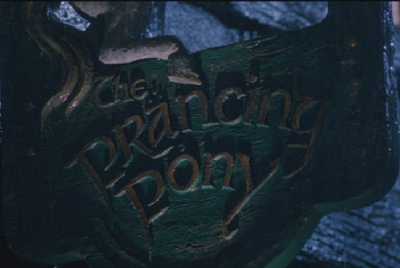
Get ready, there is a lot of Lord of the Rings in this movie.

This is grand departure. While Jackson’s Hobbit trilogy employees Bilbo Baggins as its chief protagonist, its identity is not that of the simple children’s adventure story. These movies represent the beginning of the war of the ring.

Did you hear that? Every diehard Hobbit book fan just groaned.

Yes, it is true, that little band of gold is as much of a star in this movie as Martin Freeman or Ian McKellen. Really, it is arguably a larger star than Freeman, who sadly takes a backseat in this second installment. Personally I felt that one of the strongest plus factors going in An Unexpected Journey was the strong characterization of Bilbo Baggins. Evidently Jackson and co. felt entitled to a pass this time around.

Bilbo Baggins is as much a part of the scenery in this movie as those blue butterflies.

So, amidst the gathering doom of greater forces, the little dwarf quest continues – and is a lot more fun this time around. The film only really falters at the beginning with the interjection of Beorn (a were-bear who will no doubt come back into play in the third installment) before hitting its stride in Mirkwood. We get spiders and elves and a barrel chase and it is all great fun. The addition of Evangeline Lilly as Turiel, an elf guardsman, is welcome and breathes life into the movie. Really her performance and subsequent subplot with the dwarf, Kili do a lot to improve the pacing and give the audience a breather from the one-track Thorin (this dwarf needs his mountain something fierce) and the somber beginnings of Sauron (one of two villains this movie voiced by Benedict Cumberbatch).

It's Evangeline Lilly as an elf. Damn.
It’s Evangeline Lilly as an elf. Damn.

The result is a pace that feels at a thrilling rush and gets us to Lake-town feeling jazzed to see what comes next. What comes next: the audience is introduced to Luke Evans (good performance) and Stephen Fry (Republican performance) before it’s off to see the dragon!

Now, about that dragon… here come my spoilers. Those out there wishing to see Smaug die, you’re not getting your Christmas present this year. Peter Jackson, possibly trying to emulate the Hunger Games: Catching Fire, has gone the root of the abrupt cliffhanger leaving all resolution for the Hobbit: There and Back Again. The result is a jarring ending preced by a greatly expanded upon confrontation between Bilbo and Smaug (voiced by dragon-Sherlock aka Benedict Cumberbatch).

Pretty accurate.
Pretty accurate.

I said at the beginning of this review that I wasn’t sure how to feel about the movie and that’s why. This doesn’t feel like a complete story. Unlike the chapters in the Lord of the Rings trilogy, not much is resolved at the end of the Desolation of Smaug. There is no victory at Helms Deep, no breaking of the fellowship: the movie just ends. Yes, one can argue that the climactic expulsion of Smaug (yes, he gets forced from the mountain in this movie) is enough but that dragon is still alive and in good, fire-breathing shape.

Ironically this tale feels more like part one-of-two than part two-of-three. As a piece of a film, it is entertaining and fun… but it only a piece of a film. The final word on Peter Jackson’s trilogy will come next December. Until then, The Hobbit: the Desolation of Smaug is a solid blockbuster rich in Tolkien lore. I just hope that all of this buildup has a payoff… other than the Battle of Five Armies.

Verdict: Worth seeing at full price.

PS – For those curious about my thoughts on the first movie, click here!

Why Aren't We Getting David Fincher's 20,000 Leagues Under the Sea?

The year: 1954, the movies: awesome. Seriously, so many of my favorite films came out in that year, it’s not even funny. While Disney’s 20,000 Leagues Under the Sea may not make my top ten list, it was still one of my favorite movies to watch as a kid. Before I was old enough to appreciate the characters or the themes, I had the giant squid scene – and boy did I have fun with that.

I used to fast forward my VHS copy to just watch this scene. I think I saw the giant squid sequence at least 50 times before I ever watched the full movie.

Anyway, as time passed, I began to appreciate the more mature values of Richard Fleischer’s film. The bitter determination of Captain Nemo stuck out to me and I found a fascination with the character that encouraged me to read Verne’s novels (20,000 Leagues Under the Sea and its quasi-sequel, Mysterious Island). Captain Nemo is still one of my favorite literary figures of all time. However, when I read the novel, one thing became clear to me: there are big differences between the page and the film treatment. Verne’s novel reads more like a fantastical scientific journal while the Walt Disney production is an action-adventure epic with anti nuclear war undertones. It makes sense, as with any good adaptation the film version was adapted to fit its time (things change between 1870 and 1954).

Still, that version was 70 years ago and I for one am ready to see Disney try again… too bad it doesn’t look like that is going to happen.

The original is a classic in its own right but time has taken it out of the public perception.

Well, scratch that. We’ll probably get one soon but I don’t know what kind of quality we can expect. After months of trying, an update came today that none other than David Fincher (Se7en, The Curious Case of Benjamin Button, The Girl with the Dragon Tattoo, Fight Club, Alien  3 (can’t resist putting that one in there)) has left the project. As a movie fan, that sucks to hear.

Fincher is a filmmaker known for creating dark, moving atmosphere with smart scripts and talented actors... pretty good fit for 20,000 Leagues Under the Sea.
Fincher is a filmmaker known for creating dark, moving atmosphere with smart scripts and talented actors… pretty good fit for 20,000 Leagues Under the Sea.

While I can’t say I’m the biggest fan of Fincher’s work – I personally would rate Se7en as one of the most overrated films I’ve ever seen – I cannot deny his ability. He’s just a good fit for the project, anyone familiar with the original source material would attest to that. There’s certain combinations that just sound like a good fit. Remember when Gore Verbinski (The Ring, Pirates of the Caribbean) was going to do a Bioshock movie? Well, that was also a good fit that didn’t happen.

Anyway, the question then becomes: why? David Fincher is a critically successful director who produces commercial success. Even a big budget (and apparently he planned a big budget) shouldn’t frighten Disney away from the idea of a remake. It didn’t, it was a casting problem.

I know what you’re thinking: Nemo. Of course, the iconic character. One of the greatest creations ever given birth by the pen. Yes, who would play Nemo? Clearly Disney and Fincher must have had some debate over which way to go with the most important piece of the puzzle. Well, fact is they never got to Nemo. Couldn’t get past replacing this guy:

Kirk Douglas as Ned Land.

Ned Land marked the biggest change between the book and the original Disney movie. In the novel, he’s a fairly minor character who doesn’t make much of an splash (I’ll stop) on the plot. In the movie… well, he was Kirk Douglas. The fact that the casting of Ned Land was the first priority is telling. Clearly this remake intended to follow closer to the film original than to the book. This was not necessarily a bad thing.

Here’s what happened: initially David Fincher intended Brad Pitt to play the role. Again this fits as Pitt has a similar acting style to Douglas. However, Pitt wasn’t interested (for some reason or other) and the role went to both Daniel Craig and Matt Damon for consideration. While both were interested in the part, neither wanted to abandon their families for a 140 day shoot in Australia (the proposed location for the film). Good news about approaching veteran actors – they’re mostly good. Bad news – they mostly have families they don’t want to leave for long periods of time. So three great ideas for a replacement Ned Land, come and gone. Fincher decided to change tactics and proposed the much longer Channing Tatum for the role. Disney was… not on board with this.

Remember that big budget I mentioned? Well, David Fincher may be a good director name but Disney felt it needed a dynamite actor name to guarantee big box office money. They were fine with Pitt, Craig or Damon, but Tatum? In his (much shorter) career, he has not had the commercial success of the other three. So they said no and instead offered the idea of Chris Hemsworth (Thor) for the role. It was at this point that David Fincher left the project.

Personally I don't see much difference in acting ability between the two actors but Fincher evidently does.
Personally I don’t see much difference in acting ability between the two actors but Fincher evidently does.

So that’s it. Forget Nemo, the studio couldn’t even agree on a Ned Land. This marks yet another dismal chapter in the 20,000 Leagues Under the Sea remake development. Oh yeah, Disney’s been trying to make this film for a while. Several directors have been either rumored (Sam Raimi) or attached (McG… thank god that one didn’t happen) to the project. Will 20,000 Leagues ever see the light of day? Of course, there is money to be made. However, it might not be good. Films that exist for long stretches in the dubbed “developmental hell” stage of production rarely turn out to be gems (other films on the list include The Wolfman, Prometheus and Alien vs Predator).

Regardless, the film will one day see the light of day. Who knows, Fincher may even return to the project in the future (unlikely but possible). But whether it is Fincher or (shudder) McG, 20,000 Leagues Under the Sea is too good a story to remain dead in the water for long.


Sources: 1, 2, 3

An Unexpected Journey Unexpectedly a lot like the Fellowship of the Ring

The past weekend in Montreal was humid and rainy making it downright unpleasant to be outside (apart from going for the occasional run). As a result, the weather prompted the decision for a Lord of the Rings Extended Edition marathon. Really I will look for any excuse to do this – I love those movies. But wait, there’s another one now. The Hobbit: An Unexpected Journey has not received the same reception as its predecessors. Overall the feelings have been positive but there are a lot of fans of the book out there who did not take kindly to Peter Jackson’s liberally epic adaptation (well the first part of it anyway). I am not one of those fans. I love The Hobbit, it is one of my favorite books but I take no issue with the first part of Jackson’s trilogy. Yes there are some scenes that obviously exist solely for the sake of setup (White Council, I’m looking at you) but as long as there is a pay off in the later films, I’m fine with it. The movie trilogy is not the simple story but then it never had a chance to be. Going back to a simple adventure after the release of Lord of the Rings would have been a difficult if not impossible tonal shift.

But reviews aside, this is not a review. The only reason I mention the fact that there are those who like and not the other is because I find it odd. Really, after watching the two back-to-back (The Hobbit: An Unexpected Journey followed by Fellowship of the Ring), those two movies are very similar. Both films carry a lighthearted tone and are adventure/journey movies with a subplot of pursuit. I could write more but, in the case of this article, let’s let pictures be worth thousands of words.

Both films begin with a fairly epic prologue before cutting to the Shire for Bilbo's 111th birthday.
Both films begin with a fairly epic prologue before cutting to the Shire for Bilbo’s 111th birthday.
Both films then have a hobbit who is shaken out of his normal life by an unexpected visit from Gandalf.
We are then introduced to new characters including the obvious comic relief.
And a disgraced figure of noble heritage.

I will interrupt right here to acknowledge a difference. In the Fellowship of the Ring, the full fellowship is not formed until they reach Rivendell. In An Unexpected Journey, the full fellowship is formed right away. It is a difference, however let’s keep going and see how much it really breaks up the structural similarities.

Both parties encounter difficulties when Gandalf is strangely absent from a situation he should be present in.
They are then pursued.
Luckily they receive some speedy aid to help them reach safety. (Incidentally the above quote is included because it is just that awesome).
Rivendell dispatches with the pursuers.
Where the party briefly rests...
Where the party briefly rests…
And there is a council wherein new information is revealed. Most of this information isn't relevant until later films.
And there is a council wherein new information is revealed. Most of this information isn’t relevant until later films.
Well back on the road again. Both parties first take mountain roads where they suffer from extreme weather which turns out not to be related to normal weather patterns.
Before going underground.
To a gave teaming with orcs/goblins.
To a cave teaming with orcs/goblins.
Gandalf saves the day with magic.

Here we encounter another diversion. There is no equivalent of Lothlórien in An Unexpected Journey. Wait, maybe there is. In Lothlórien, Frodo is tempted by the ring. There is a pause in the action while he has dialogue with a being who knows more about the ring than he does. This being (Galadriel) reveals to Frodo the dangers of what happens when one becomes too absorbed by the ring and does not resist its temptations. Frodo then leaves with a new resolve for his quest. Hmm, might there be something similar in An Unexpected Journey?

Yep.
Yep.
Once that's done we got pursuit again.
Once that’s done we got pursuit again.
Ending in a face-off between the pursuer and the disgraced noble character.
Climaxing in a face-off between the pursuer and the disgraced noble character.
Ending with a scene celebrating friendship.
An ending forecasting darker challenges to come.
And forecasting darker challenges to come.

So there you have it. There are a few other scene similarities there that I didn’t mention but I think I made my point.

Yes, there are differences to be sure. Overall the main difference in the films comes down to tone. The Fellowship of the Ring is darker with more focus on the presence of evil (since the ring is the focus) whereas An Unexpected Journey focuses more on being a light adventure. Both films end of relatively high notes. No one dies at the end of An Unexpected Journey (sorry Sean Bean) but Thorin comes near death in a scene that is set up incredibly similar to Lurtz’s execution of Boromir. Are the two movies exactly the same: no. Is it valid to like one and not the other: sure. But you have to admit, they are quite similar in terms of their setup.

For any out there who still doubt me, I encourage watching the two films together… followed by The Two Towers and The Return of the King (extended editions of course) cause why not? As we look ahead to the next two Hobbit films, I can’t help but wonder if the trend will continue. I’m calling it right now: The Desolation of Smaug will end on a down note. Smaug will be destroyed, signifying the end of a great battle (like Helms Deep) and a new, more powerful threat (the Necromancer) will take center stage. Just a prediction.

Thoughts? Comments? Am I full of it or onto something? Let me know now in the feedback section of this article.