Blog

An Unexpected Journey Unexpectedly a lot like the Fellowship of the Ring

The past weekend in Montreal was humid and rainy making it downright unpleasant to be outside (apart from going for the occasional run). As a result, the weather prompted the decision for a Lord of the Rings Extended Edition marathon. Really I will look for any excuse to do this – I love those movies. But wait, there’s another one now. The Hobbit: An Unexpected Journey has not received the same reception as its predecessors. Overall the feelings have been positive but there are a lot of fans of the book out there who did not take kindly to Peter Jackson’s liberally epic adaptation (well the first part of it anyway). I am not one of those fans. I love The Hobbit, it is one of my favorite books but I take no issue with the first part of Jackson’s trilogy. Yes there are some scenes that obviously exist solely for the sake of setup (White Council, I’m looking at you) but as long as there is a pay off in the later films, I’m fine with it. The movie trilogy is not the simple story but then it never had a chance to be. Going back to a simple adventure after the release of Lord of the Rings would have been a difficult if not impossible tonal shift.

But reviews aside, this is not a review. The only reason I mention the fact that there are those who like and not the other is because I find it odd. Really, after watching the two back-to-back (The Hobbit: An Unexpected Journey followed by Fellowship of the Ring), those two movies are very similar. Both films carry a lighthearted tone and are adventure/journey movies with a subplot of pursuit. I could write more but, in the case of this article, let’s let pictures be worth thousands of words.

Both films begin with a fairly epic prologue before cutting to the Shire for Bilbo's 111th birthday.
Both films begin with a fairly epic prologue before cutting to the Shire for Bilbo’s 111th birthday.
Both films then have a hobbit who is shaken out of his normal life by an unexpected visit from Gandalf.
We are then introduced to new characters including the obvious comic relief.
And a disgraced figure of noble heritage.

I will interrupt right here to acknowledge a difference. In the Fellowship of the Ring, the full fellowship is not formed until they reach Rivendell. In An Unexpected Journey, the full fellowship is formed right away. It is a difference, however let’s keep going and see how much it really breaks up the structural similarities.

Both parties encounter difficulties when Gandalf is strangely absent from a situation he should be present in.
They are then pursued.
Luckily they receive some speedy aid to help them reach safety. (Incidentally the above quote is included because it is just that awesome).
Rivendell dispatches with the pursuers.
Where the party briefly rests...
Where the party briefly rests…
And there is a council wherein new information is revealed. Most of this information isn't relevant until later films.
And there is a council wherein new information is revealed. Most of this information isn’t relevant until later films.
Well back on the road again. Both parties first take mountain roads where they suffer from extreme weather which turns out not to be related to normal weather patterns.
Before going underground.
To a gave teaming with orcs/goblins.
To a cave teaming with orcs/goblins.
Gandalf saves the day with magic.

Here we encounter another diversion. There is no equivalent of Lothlórien in An Unexpected Journey. Wait, maybe there is. In Lothlórien, Frodo is tempted by the ring. There is a pause in the action while he has dialogue with a being who knows more about the ring than he does. This being (Galadriel) reveals to Frodo the dangers of what happens when one becomes too absorbed by the ring and does not resist its temptations. Frodo then leaves with a new resolve for his quest. Hmm, might there be something similar in An Unexpected Journey?

Yep.
Yep.
Once that's done we got pursuit again.
Once that’s done we got pursuit again.
Ending in a face-off between the pursuer and the disgraced noble character.
Climaxing in a face-off between the pursuer and the disgraced noble character.
Ending with a scene celebrating friendship.
An ending forecasting darker challenges to come.
And forecasting darker challenges to come.

So there you have it. There are a few other scene similarities there that I didn’t mention but I think I made my point.

Yes, there are differences to be sure. Overall the main difference in the films comes down to tone. The Fellowship of the Ring is darker with more focus on the presence of evil (since the ring is the focus) whereas An Unexpected Journey focuses more on being a light adventure. Both films end of relatively high notes. No one dies at the end of An Unexpected Journey (sorry Sean Bean) but Thorin comes near death in a scene that is set up incredibly similar to Lurtz’s execution of Boromir. Are the two movies exactly the same: no. Is it valid to like one and not the other: sure. But you have to admit, they are quite similar in terms of their setup.

For any out there who still doubt me, I encourage watching the two films together… followed by The Two Towers and The Return of the King (extended editions of course) cause why not? As we look ahead to the next two Hobbit films, I can’t help but wonder if the trend will continue. I’m calling it right now: The Desolation of Smaug will end on a down note. Smaug will be destroyed, signifying the end of a great battle (like Helms Deep) and a new, more powerful threat (the Necromancer) will take center stage. Just a prediction.

Thoughts? Comments? Am I full of it or onto something? Let me know now in the feedback section of this article.

The Problem with the "Ideal" Image

This article is a tangent off of the Special Address on misogyny and rape culture in the media world. Specifically, I aim to address views that I did not agree with in an article I read (there are links in the first part of my special address) that declared that video games promote misogyny. The article’s author based this declaration on the fact that women are depicted in a strong sexual manner in video games. I’m not going to waste time arguing that point because it is true. Anyone who doesn’t think women are sexualized, take a look below at Ivy:

 One of Ivy's costumes in Soul Calibur IV.
One of Ivy’s costumes in Soul Calibur IV.

Now Ivy is a character in the Soul Calibur fighting game series. Yeah, she wears that outfit when she’s in physical combat and yes, there are physics applied to her ample chest as she bounces around the screen. Characters like Ivy aren’t unique in video games, if anything they are the standard. It’s not just video games from the Japanese market either.

Samara from the Mass Effect Trilogy, a series that prides itself on its characters. My brothers and I had a nickname for her: Officer Side-Boob.

So yeah, not contending the point that video game women are highly sexualized. This issue, however, has nothing to do with any misogynistic intent on the part of video game developers or the video game community. It is a much larger issue that encompasses both genders and their portrayals in the media world. These video game aren’t being sexualized to reduce their integrity, they are being made in the “ideal” image of a woman (according to marketing). That is what needs to be changed.

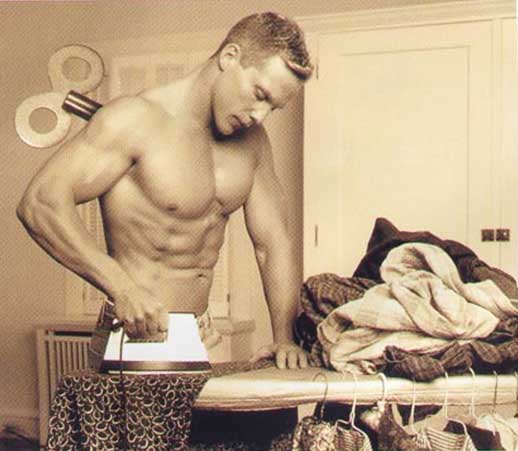
Look online, open a magazine, watch a movie, play a video game. Everywhere you look you will see the “ideals” for both genders. Me, I just google-imaged the perfect woman, here’s what I got right on page one:

ny-post-perfect-woman

Apparently the perfect woman should be in a bathing suit, how else would you appreciate her body, right? Anyway, let’s see what google-image search returns for the ideal man:

Ladies, he irons his clothes.

So the problems exist for both. Really when you think about it, having an ideal image is always going to create problems. Why: because no one out there is “ideal”; it’s impossible to be so. Being perceived as perfect is just that, a perception. Everyone’s going to have it, it’s going to be different for everyone. There are clearly similarities in the “ideal image”, if people were too diverse on the issue then it couldn’t be marketed. Yet the goal remains a fantasy. No one will ever be “perfect” by society’s standard. Anyway, bit of a ramble but at least slightly relevant.

The concept itself is flawed and its application is even more so. Look at those two images, both are attractive (I guess, that Frankenstein-style face on the “perfect woman” honestly terrifies me) but in different ways. For the woman it’s all about the sex appeal and the pure beauty aspect. For the man, yes there is sex appeal but there is power too. He is in better shape. While the woman is merely skinny (yet with curves), the man is chiseled by muscle. So while the ideal image of a woman is only sexy and visually appealing, the ideal image of a man conveys strength. Is this the case in video games, absolutely. Perfect example:

The male version of Commander Shepard in the Mass Effect Trilogy.
Same game but with the female version. I included the criticism because I agree with it. Get that woman a sandwich.

Clearly Bioware (and the rest of the video game industry) do not exist in a bubble. They are part of the media machine. Is this “ideal” image of woman misogynist in itself: absolutely, she looks unhealthy. I am not backtracking on my initial point. Yes while the created image is misogynist, video games are not. They are simply using the tools that the media world has provided them. Commander Shepard (female version) is a strong character in every aspect outside her body. If the marketing perception of the “ideal” woman changes, expect video games to follow suit.

Not every video game will, there are some developers out there whom I would label as misogynist. I will address them soon, I promise: that second part is coming. However I’m a little tired of hearing video games slammed simply because they are the newest medium. They are a marketed media platform and not exempt from the rules created in our society. Will the perception change: it is constantly changing. Anyone who disagrees with that, check out this image:

An advertisement from the 1940s telling women to gain weight.

Guess what though: there will still be a problem. When society tells an individual how he or she should look, there is a problem. Will they always do this: of course. And there will always be people who listen to them. The good thing about the world (educated nations at least) is that with a little knowledge, this manipulation can be understood and protected against. The marketing world exists to tell individuals that they need things, they will never, ever say that anyone is “just fine the way they are” without including a but immediately afterward.

Cheesy but ultimately true.

Now, unfortunately society is not simple as my little inspirational cat friend there. There is enormous peer pressure on every individual, I don’t mean to discount that. Is the “ideal” image of woman currently worse than the “ideal” image of man: absolutely. It is incredibly stupid how thin women are being told they have to be, while still maintaining weight in the right places. This image does feed into the rape culture as well. It creates problems and it always will.

Thoughts? Comments? Am I full of it or onto something? Let me know now in the feedback section of this article.

Further reading:

On women – http://newyorksociologist.org/11/Berberick2011.pdf

On men – http://www.public.iastate.edu/~cpb6666/pubs/Barlett%20Vowels%20%26%20Saucier.pdf

When Good Guys go Bad: Poor Scriptwriting

With the summer blockbuster season in full swing, a recent trend has become apparent: this is an off year. While releases like Iron Man 3, Star Trek Into Darkness and Man of Steel haven’t been critically panned (although Man of Steel only enjoys a 56 on Rotten Tomatoes and a 55 on Metacritic), the reaction from fans has been less flattering. For me personally, both Man of Steel and Iron Man 3 have been disappointing mixed bags with more to say against than in favor. I still stand by Star Trek Into Darkness as a simple yet enjoyable Star Trek movie. But this article is not about how I feel about summer films, this article aims to look at what is usually a weakness in the blockbuster genre overall: the writing. There’s a lot of areas here we could discuss. Bad writing ruins films by creating plot holes, cringe-worthy dialogue and nonsensical character action. Let’s talk about that last point.

Nonsensical character action is, quite simply, when someone in a movie does something that the audience doesn’t believe he or she would do. Whether it goes against the source material (which nearly every big budget movie has these days) or whether it defies an earlier scene in the movie, these are actions that just don’t make a heck of a lot of sense. I’m going to go into a few examples that will illustrate my point. Warning: there will be minor Man of Steel spoilers to follow. But let’s not start with a Superman movie… let’s start with a Michael Bay movie!

I will never understand how his name isn't as poisonous to the box office as M. Night Shyamalan's is.
I will never understand how his name isn’t as poisonous to the box office as M. Night Shyamalan’s is.

I almost feel that this is an unfair jab. If you’re paying to see a Michael Bay, you’re not paying for the script… at least he and his marketing have been honest about that aspect. For those of you out there who may not know the man pictured above, Michael Bay is the director behind blockbusters like the Transformers trilogy, the two Bad Boys movies, Pearl HarborArmageddon and The Island. He’s done others but that’s enough to get the idea. Let’s talk about those Transformers movies, in particular something that annoyed me in all three films:

Besides this guy.
Besides this guy.

Anyone familiar with the Transformers universe knows that the Autobots are the heroic good guys and the Decepticons are the evil, horrible, villains. The Autobots, lead by Optimus Prime, are valiant and peace loving while Megatron and his Decepticons would push puppies in front of buses. This is established in both the lore and the movies (I’m giving the movies credit for something). Yet in the movies, while the dialogue establishes this, the action paints a different picture.

The decepticons take autobot prisoners in Transformers: Dark of the Moon. Patrick Dempsey's character is the one who suggests killing them.
The decepticons take autobot prisoners in Transformers: Dark of the Moon. Patrick Dempsey’s character is the one who suggests killing them.

Wait, the decepticons are taking prisoners? That’s actually really nice of them, you know, given they’re at war with the autobots and everything. Maybe they have some honor after all. Well, I’m sure if the decepticons are this generous than the autobots are even greater pillars of morality.

Nope.
Nope.

The autobots kill the decepticons every chance they get. Not just kill either but in most cases tear to pieces. Watch those movies again (if you can) and observe just how brutal Optimus Prime and his heroic autobots are. It kinda adds an underlying sinister element to their characters when the good guy (who constantly professes to be good) is a lot more savage than the bad guy. But again, poking fun at a Michael Bay script is easy. Let’s go after George Lucas instead.

In this instance, I’m going to discuss two scenes in Star Wars Episode III: Revenge of the Sith. Let me say up front: I like this movie. Is it perfect: NOOOOOO (inside Star Wars humor there), but it’s still enjoyable and a lot of it really works. Here’s something that didn’t: remember when Anakin killed Count Dooku? He just executes him as a prisoner. This is huge, it is a giant step in Anakin’s fall to the dark side. Jedi don’t kill, they take prisoners whenever possible. Except when it’s this guy:

General_Grievous_(Qymaen_jai_Sheelal)

I know what you’re saying. Yes, I have thought way too much about this… but you’re reading it so what does that say about you?

Anyway, so Obi-Wan kills General Grievous and I personally don’t have a problem with that scene. Grievous poses a lethal threat and is about to kill Obi-Wan so it is in self defense. The Jedi seem to be cool with that. I have problems with all the scenes leading up to the confrontation. When Obi-Wan speaks to the council, and when they are speaking to each other, it becomes very clear that “taking prisoners” is not what they have in mind.

“If he does not give up his emergency powers after the destruction of Grievous, then he should be removed from office.”

That’s said by everyone’s favorite cone-head Jedi, Ki-Adi-Mundi (never mind how I know his name). At this point, Obi-Wan has only “made contact” with Grievous so… he should be trying to secure him as a prisoner, right? A whole part of this movie is how Anakin falls to the dark side by being too eager to kill. Seems like the Jedi Council is bloodthirsty too. Maybe the emperor had a point about them.

It’s a small thing but that’s just it. It’s one line of script: fix it before spending millions of dollars.

Last but not least, Man of Steel. As this is a new release I won’t say much here (I could, there is definitely a lot to say on this movie). Let’s go with those trailers, especially the newest ones. You see Superman fighting General Zod in a city. Looks really cool right? That city is full of people. Superman: the man of steel, the protector of humanity, has no problem with collateral damage in this film. He throws Zod through buildings in a city the audience knows to still be populated (the film makes sure to show this).

Disregard buildings and acquire cape.
That’s a lot of devastation in the background.

Again, what makes it worse is that one of the main theme’s of the film is Superman’s morality. How he will do anything to protect the people of Earth from an alien, super-powered, threat. Is he just not getting the irony in that? I know Superman isn’t supposed to be the smartest hero on the block but come on.

If you want to see a film that encompasses Superman's morality and character in a much more competent way, check out this movie instead.
If you want to see a film that encompasses Superman’s morality and character in a much more competent way, check out this movie instead.

So why is this such a common problem? Effects shots sell tickets. That’s the simple answer. That’s what people want to see in their summer blockbusters, right? Right. Because when it works, it’s awesome. When it doesn’t… blockbusters don’t have much to fall back on if they’re not enjoyable. I put this one on the scriptwriters and the directors. Movies shouldn’t be made for the sake of cool scenes, they should be able to work cool scenes into a great movie.

Christopher Nolan: putting cool scenes in great movies since 2000.

Thoughts? Comments? Am I full of it or onto something? Let me know now in the feedback section of this article.