S. is the Book for Anti-e-Readers Everywhere

If you are an avid reader/writer, chances are that you do not care too much for the e-readers (e.g., Kindle, Nook, Kobo). If you are not, do yourself a favor and find a reader/writer and ask them whether or not they prefer hardcover or e-reader. You will hear things like: “it doesn’t have the same smell,” “I miss the cover,” “I need to turn the pages.” Yes, avid book readers are junkies in their own right. For the most part, I agree with them. An e-reader will never be anywhere as good as a well-made hardcover. It just doesn’t have the same personality.

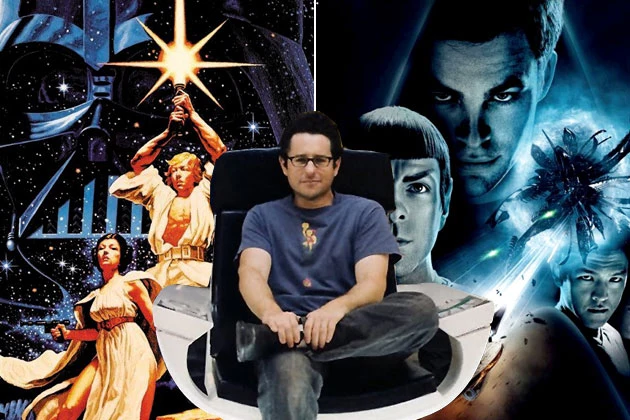
E-readers, however, do have their uses: mainly space-saving and book renting. I have a kindle and I love using it to ferret out future books to add to my collection. That said, not every author will even offer the choice to go digital. J.J. Abrams (yes, THAT J.J. Abrams) and novelist Doug Dorst (Alive in Necropolis) have come together to create S., a novel that absolutely cannot be read by e-reader. How was this accomplished? Take a look:

All of that is hidden inside the novel.

Anyone out there looking to get physcially excited to read a book, do yourself a favor and check this out. I may or may not have squealed with glee as I opened S. The hidden letters, the code-breaker, it all comes together to create an experience unlike any other. What is presented within the pages is a mystery, arguably the only genre that would work with this format. How is the story: couldn’t tell you yet, I’m still reading (it is nothing short of captivating so far). This is not meant to be a review for S. Let us instead examine the positives and negatives of this format, and whether or not authors have found a viable (if more in-depth) alternative to going digital.

For starters, the obvious good: this thing is FUN to read. The text itself is a complete novel. There are no nods or winks at the two commentators, whose notes provide a secondary story over the main source material. Anyone looking to blow through a book better just move on because S. will make a reader slow down and appreciate it. The format of the story draws the reader in as part of the mystery. Everyone (and when I say everyone, I mean us book geeks) has dreamed of finding that mysterious tome in the back shelves of a library and discovering something truly wondrous. No, this is not Tom Riddle’s diary, but expect to have fun nonetheless.

It is unclear which story is more intriguing, both succeed in keeping the reader entertained.

The obvious bad: there are pieces. This is not a book to be read on the train or while traveling, not unless one is extremely careful. Even reading in bed, I have had several occasions where one of the excerpts has nearly slipped free. If lost, there is no real indicator of where it belonged, short of reading the whole thing again to figure it out (another mystery!). There is a simplicity and convenience that can be found with most novels (and e-readers) that is lacking here. In most cases, it is not a bad thing. This is simply a book that demands one’s entire attention.

Even the outside of the book is specially designed to resemble a library book.
Even the outside is specially designed to resemble a library book.

I have seen other books attempt to do what S. accomplishes. The Jedi Path: A Manual for Students of the Force (no, I do not think I can get any more nerdy) also features notations from past readers, but these are little more than bizarre flavor and don’t really add anything substantial. There is also no extra material, allowing the book to be available via e-readers. Again, were S. not a mystery, I do not believe this format would work as well.

S. is not the only fascinatingly written book out there. For those seeking other experiences, I recommend House of Leaves. Simply put, there are some things e-readers can do, and some things they cannot. In the words of J.J. Abrams:

“It’s intended to be a celebration of the analog, of the physical object. In this moment of e-mails, and texting, and everything moving into the cloud, in an intangible way, it’s intentionally tangible. We wanted to include things you can actually hold in your hand: postcards, Xeroxes, legal-pad pages, pages from the school newspaper, a map on a napkin.”

Now that is a cool idea.

One last note, I know that Benedict Cumberbatch is rumored to be a villain in the book. I can neither confirm nor deny those rumors.

Godzilla Raids Again: A Review of Godzilla 2014

Godzilla is back.

Whether you love the new movie or hate it, there is no denying that the creature on the screen is the King of the Monsters. 1998, you are forgotten. This new movie is not the Jurassic Park-wannabe disaster that Roland Emmerich created. That said: do not set expectations fifty stories high. While Director Gareth Edwards has succeeded in creating a new narrative that tells a unique story in the Godzilla universe, this is not the definitive film that some of the early trailers led audiences to believe. For that honor: 1954 still reigns as king.

The plot and focus of the movie draw attention to one of my larger criticisms: I do not feel that this film should have simply been called Godzilla. My review title is in reference to Godzilla Raids Again, the second film of the Showa Series that was released in 1955. This is the Godzilla film that Gareth Edwards’ vision most closely resembles. The good news is that this iteration is much better than what was released nearly sixty years ago.

Fun fact: the United States changed the title of Godzilla Raids Again to Gigantis: the Fire Monster. They didn't think anyone would want to see a 2nd Godzilla movie. Thirty films later...
Fun fact: the United States changed the title of Godzilla Raids Again to Gigantis: the Fire Monster. They didn’t think anyone would want to see a 2nd Godzilla movie. Thirty films later…

The film opens with the discovery of MUTO. Two eggs are discovered in the Philippines, one of which has just recently hatched. The newly hatched monster heads straight for the first nuclear energy source, which as it turns out is a nuclear plant in Japan under the supervision of Joe Brody (Bryan Cranston). Muto arrives and wreaks havoc, resulting in a family tragedy. Fast forward fifteen years and Brody’s son (played by Aaron Taylor-Johnson) is grown and with a family of his own. He is a military man returned from service who is trying to connect with his family. The problem: Joe Brody has become something of a conspiracy nut in the past fifteen years. He keeps insisting their was something more to the nuclear disaster, something that the military is hiding.

Meet Muto, Godzilla's newest bug bad guy.
Meet Muto, Godzilla’s newest bug bad guy.

Of course, the audience can guess where it goes from here. Brody recruits his son and the two arrive at the old wreckage just in time to witness a full grown MUTO hatch. They meet Mr. Serizawa (Ken Wanatabe) who lets them in on a little secret: MUTO is not the only giant monster out there. Yes, it turns out that Godzilla still showed up in 1954, only this time he did not destroy Tokyo. Enter one of the film’s main weak areas: Godzilla’s origin is glossed over. The audience learns that he appeared in 1954 and that nuclear weapons were used to try and kill him (Godzilla is some type of ancient animal from the day’s when the world was a lot more atomic in nature). The weapons didn’t work and Godzilla has been doing… something for the past sixty years. Don’t worry though, the military has wisely been using that time to not prepare any contingency plans, should Godzilla ever grow aggressive.

The plot doesn’t allow any time to dwell on this rather bizarrely timed bit of exposition. Muto is heading for Hawaii and our heroes must give chase. Notice the problem so far: Muto is driving the story action. This never really ends throughout the movie. Muto is the main monster of the plot. This echoes other Godzilla movies where the antagonistic monster is more closely tied into the story. The problem is that the studio decided to call this film Godzilla, creating a set of expectations that he would be the main presence. Godzilla is in the movie to be sure, but he is not the sole star.

The plot revolves around trying to stop the spread of Muto eggs.

Go back to my title, Godzilla Raids Again. This was the first movie that Godzilla shared with another monster and both kaiju drive the plot forward. That said, Godzilla Raids Again was also attempting to be an incredibly personal story about one family in the midst of this epic monster battle. Edwards’ Godzilla is like this also. The audience follows Johnson’s character, Ford Brody, really from start to finish. Every shot of the movie is at the human level. This is both a strength and a weakness as this film provides some of the most breathtaking perspective in the series, while at the same time some of the fights feel restricted. There’s no areal view to show everything like in Pacific Rim.

The things they are able to do with CGI. This really is a gorgeous film.

Godzilla is an epic, and there is human drama aplenty to carry the film through its 123 minutes. Things never drag and the story maintains a slow, methodical pace (similar to the hulking steps of Godzilla). People seeking monster brawls and plentiful amounts of the big G might be disappointed. The final fight is cool but it isn’t overly long.

This image was from the initial teaser. Evidently there was a monster design that went unused.

Overall Edwards movie isn’t a classic but it isn’t a disaster. It is somewhere in between. If this is to be the first in a series then mission accomplished: the King of the Monsters is back, and I can’t wait to see who else he is going to fight.


The king has returned.

Ghidorah, the Three-Headed Monster or How Godzilla Became the Good Guy

I had some debate this morning as to what post to write. Should I write the Godzilla-related post that I had planned or should I instead pen a piece about the Montreal Canadiens, and the glorious level of hypocrisy they set for the rest of the NHL? As writing about the Canadiens now could be seen as a “sore-loser” move (seriously, the Bruins would have lost to any quality team… doesn’t matter who you’re playing when you can’t pass and you can’t shoot), I will put it off for a later date, simply finishing with: go Rangers. Anyway, now that I got that out of the way, let’s get back to Godzilla.

The Montreal Canadien version of Godzilla: smaller, quicker, can't take a shot... but probably could still wreck Boston if none of the city's military was working.
The Montreal Canadien version of Godzilla: smaller, quicker, can’t take a hit… but probably could still wreck Boston if none of the city’s military was working.

As has been stated before in other posts, Godzilla began his creation as an antagonistic force. He terrorized Tokyo and ruined lives. An unstoppable metaphor for the nuclear holocaust that was visited upon Japan at the end of World War II, Godzilla was nothing less than terrifying in his first appearance and played the villain in the following three movies. Yet as most out there already know, Godzilla is famous for more than just being a nuclear metaphor. In many of his films (particularly in his first series of movies, the Showa Era 1954-1975), Godzilla is the hero. The brave monster fighting for humanity against other threats. It should be noted that it was not simply the arrival of these ‘other threats’ that turned Godzilla into the good guy. In his three films after the original, Godzilla faced off against Anguirus, Mohtra, and even King Kong. In all of those movies: Godzilla was the bad guy.

King Kong was seen as the underdog of the fight while Godzilla was depicted as a stupid bully.

It wasn’t until 1964, in Ghidorah, the Three-Headed Monster, that Godzilla turned protagonist. For the record, this is not one of the better Godzilla films. It is not horrible, but it is far from the most entertaining. Essentially, it feels like a prototype for the far superior Invasion of Astro-Monster that would be released in the next year. Nevertheless, Ghidorah, the Three-Headed Monster was the film that introduced Godzilla to traditional, 1960s science fiction themes: namely, aliens. Alongside this introduction to beings from outer space came the unveiling of Godzilla’s greatest nemesis, King Ghidorah (pronounced GE-door-ah or Gi-dora, depending on the movie).

With three, lightning-shooting heads and the ability to fly, Ghidorah was a powerful enemy.

King Ghidorah comes from an unspecified area of space to destroy the world. According to the plot of the film, Venus was once a nice place to live before Ghiodrah got a hold of it. At this point of the movie, Godzilla is still the bad guy. He and Rodan (Row-dan) have been fighting and destroying cities. Mothra shows up to convince the two to put aside their differences and save the Earth. Godzilla and Rodan refuse and it isn’t until they watch Mothra fight Ghidorah alone that the two monsters put aside their differences to stop the evil Ghidorah.

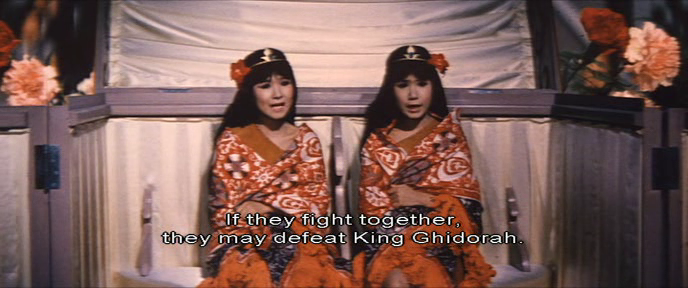
How is that communication-heavy scene of monster interaction accomplished? Quite well actually, thanks to the help of Mothra’s two fairy girls (don’t ask), the Shobijin (I have no idea how to pronounce it). Apparently, Mothra’s priestesses speak very good monster-ese. Regardless, the scene showcases and in-depth look into Godzilla’s psyche. He doesn’t hate people per say… he just doesn’t think much of humanity’s greatest achievements. By giving Godzilla a less pure evil personality, the film is able to transition him to a creature that can (and does) decide to fight for good. By creating Ghidorah as a nemesis, the series insures that there is usually a creature on screen that is far more evil than Godzilla.

Does any of it make sense: no. Does it work: sure.

One of the most fascinating aspects of the Godzilla film series is its commentary on culture. I am not only referring to the original here, but to the entire series. Godzilla can be seen as an allegory to more than just the atomic bombings, he can also be seen as America. Godzilla’s relationship with Japan begins as one of oppression but transforms into a mutually beneficial arrangement. This reflects Japan and the United States changing relationship as the two grew economically closer.

For Ghidorah, the Three-Headed Monster in particular, Mothra can be seen as Japan: a smaller, weaker force that nevertheless strides for good. Godzilla and Rodan represent America, larger and more powerful but currently indifferent to the plight of the Japanese people. Ghidorah, well that’s easy. This movie was made in the sixties and deals with a threat from outer space. What space-racing nation was challenging the U.S. and its allies at that particular time?

Ghidorah would return many times, including to fight in Destroy All Monsters. Don't ask me for allegory on that one.
Ghidorah would return many times, including to fight in Destroy All Monsters. Don’t ask me for allegory on that one.

Is the analogy 100% proof, no but it does highlight that there was more to some (definitely not all) of these movies than just people in suits beating each other up. Transitioning Godzilla into a good guy reflected a changing attitude in Japan. It wouldn’t be until 1984, with a desire to return to the dark tone of the original, that Japan would abandon the benevolent image of Godzilla. He would return to good guy status in later films (notably Godzilla: Final Wars) and it is said that the Big G even sports several shades of hero in the upcoming Gareth Edwards movie.

The review for said film will be going live tonight at midnight, I hope you will check it out.