Is the Conjuring Misogynistic?

Short answer: no.

Longer answer: While reading a review of Annabelle in the Boston Globe, I came across an unfamiliar accusation. Peter Keough opened his critique with the following:

“Some praised “The Conjuring” (2013), James Wan’s film about the exorcism of a possessed house, for being scary without resorting to gore or special effects. Others, myself included, found the scariest aspect of the film to be its misogyny.”

I have seen The Conjuring multiple times and enjoy the film very much. I find it to be a well-written, well-acted, retro film of demonic horror. Personally, I had never noticed the misogyny that Keough referred to. After a little digging, the internet was revealed to have a few writers with opinions similar to the Globe. Andrew O’Hehir‘s article,The Conjuring”: Right-wing, woman-hating and really scary, appeared to be the most notable piece of criticism. In it, O’Hehir damns The Conjuring for its portrayal of the Warrens, its use of female antagonists, and its implied message that the Salem Witch trials were justified. He also reveals that he had mixed feelings on the film.

Okay… slow down.

For the record, O’Hehir is not the only one to feel this way, there are other reviews that echo his own sentiments… but let’s look at the accusations. First off, the Warrens. For those out there reading this without seeing the movie, The Conjuring follows the horror standard of “based on a true story.” Ed and Lorraine Warren were real-life Christian demon hunters who roamed the land and looked for evil to exorcise. In short: they were/are religious extremists. The kind of people who are more likely to believe in the devil than Darwin.

Criticisms of The Conjuring take issue with the film’s validating portrayal of the Warrens. In the film, the couple’s faith is shown only as their greatest weapon. It is what allows them to defeat the demon and save the family from harm. While admittedly, the Warrens were not this positive in real life, I am curious as to what the solution here would be? In order for The Conjuring to work as a haunted house horror film – the Warrens have to be more than just religious kooks. The entire threat of the movie would vanish if the Warrens weren’t valid in their beliefs.
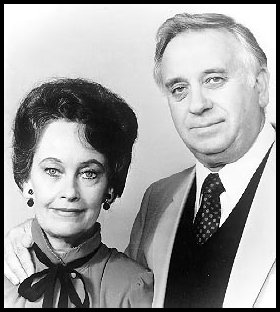
The real Warrens were probably wackos... but they are not in the movie.
The real Warrens were probably wackos… but they are not in the movie.

I feel that here is an instance where O-Hehir and other critics are projecting unreasonable expectations onto The Conjuring. EVERY MOVIE that uses the line “based on a true story” is fictitious. It is not the responsibility of any film maker to ever whisper to their audience “just remember kids, this isn’t real.” If The Conjuring were attempting a more meta approach, this criticism would be valid. As such, this is clearly a pure Hollywood thrill ride. The script does not address the fourth wall so director James Wan has no reason to either. It’s not that type of movie – these aren’t the real Warrens. They did not look like Vera Farmiga or Patrick Wilson either. Calm down about the portrayal.

Now, about the female portrayal:

Yes, the evil spirit haunting the house is a woman. A female antagonist does not misogyny make. It would as ridiculous as the claim that all black villains promote racism. Two of the main protagonists are women as well. Elaine Warren (who is depicted as the more essential of the couple) helps Lili Taylor‘s Carolyn defend her family from evil. O’Hehir seems to feel that the film labels women and their behaviors/identity as the source of all evil in the world. Again, this feels like a forced intrusion of perspective. Carolyn is not targeted for possession for neglecting her wifely duties – her family moved into a haunted house! If the ghost had attacked the husband, would that be a vengeful man-hating ghost uber-feminist? No, that would be a ghost.
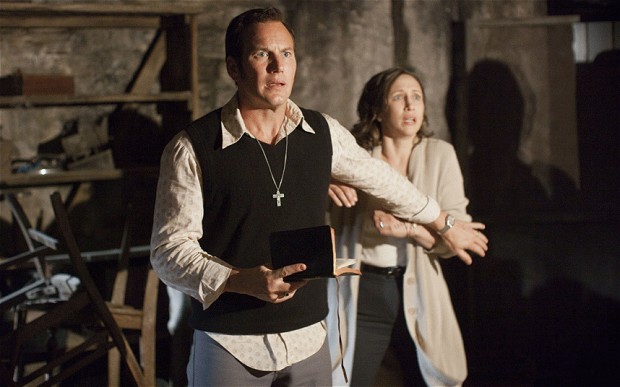
What do you see? A man protecting a helpless woman or a husband trying to guard his wife? Perspective makes a difference.

But Carolyn is saved by the power of maternal instincts!

Carolyn is saved by loving her children and not wanting to kill them… you know, not becoming a monster. Could a person project opinions/commentaries of maternal identity onto this action – of course. Yet at its heart, it is a parent refusing to abandon their child, and fighting off an evil force to do it. It is the climax of the film.

Yes, this is a movie that projects religious salvation over evil – because it is a movie about exorcism. Is it validating conservative roles and proclaiming religious faith is the ultimate way to go? Sure… if any audience member actually fights a real demon in their day-to-day life.

The last criticism I would like to address is the charge that The Conjuring validates the Salem Witch trials. This is both a serious charge and a baseless accusation. By claiming (in a fictional movie) that one real witch existed in the 1800s, The Conjuring is somehow saying that those poor victims deserved what they got in the 1600s. There is no line of dialogue that refers to the Salem Witch trials. There is nothing to connect the dots at all. Having a witch in the movie does not condone horrible crimes that happened in real life. There are several witches in Wizard of Oz, and yet I do not think that film is looking to serve as a commentary either.

Yes, witches were totally real. Just look at all the totally real stuff they could do.

The Conjuring, despite its marketing campaign, is not trying to be fact. There are many films that cross that line far worse (The Fourth Kind comes to mind). It is not as intelligent as certain horror gems like The Exorcist, but it is not trying to be either. It is fine to not like a movie, that is a very acceptable situation. That said, projecting an unreasonable set of expectations – and labeling the film as misogynistic – when it fails to follow them, goes too far. Certain people will see scenarios where none exist. Certain people will read novels in the blank spaces between the lines.

There are people out there who feel King Kong was made as a commentary on racism. Sure, if one discounts the people who made it - that is an acceptable thesis.
There are people out there who feel King Kong was made as a commentary on racism. Sure, if one discounts the people who made it – that is an acceptable thesis.

In certain cases, there is something to it. That said, The Conjuring is popcorn. You either like popcorn or you don’t. Just don’t go calling it milk duds. Do not go looking for sin where none exists. That sounds like a witch hunt.
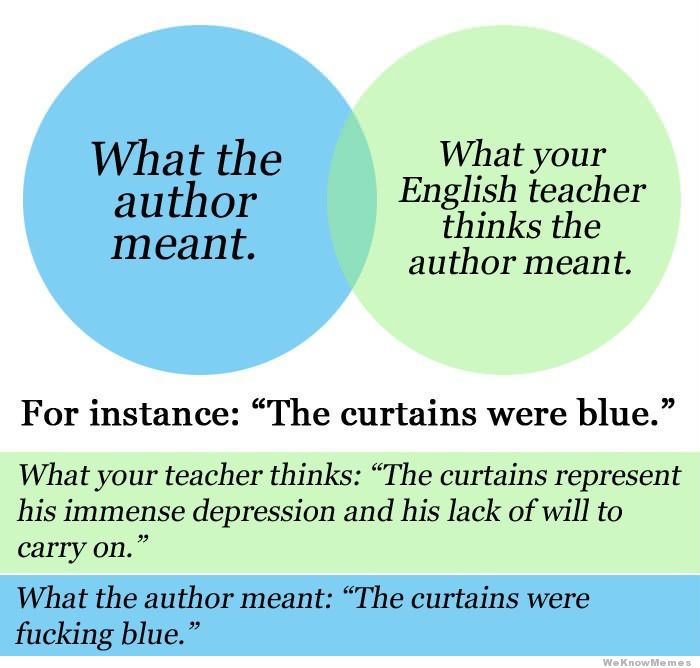
How James Wan probably reacted to the criticism.

Cinemassacre's Monster Madness is a Horror Fan's What-to-Watch

It’s October and that means horror, well at least for some people. Personally, I was grown on horror movies. Being the youngest sibling in the house, I would sometimes walk into things “I was not old enough for.” Let me tell you: with horror, I agree with the age limitations. I saw part of Evil Dead II when I was six years old – the scene where Henrietta bursts through the cellar floor. Needless to say, my basement and I became distant acquaintances for the next few years. Yet despite this (or maybe because of), I grew up loving horror films. The mark of any effective piece of art is its ability to leave an impression on the viewer. There is a real talent in being able to terrify someone with – essentially – nothing. Even the best horror movies have nothing on reality, yet they still leave audiences trembling. The problem is this: horror is a cheap genre to film. There is a plethora of horror cinema out there and most of it is not very enjoyable or scary. So what to watch? Thankfully, one man has taken it upon himself to answer that question.

Unfortunately it's this guy. Yes, this is the least flattering photo I could find.
Unfortunately it’s this guy. Yes, this is the least flattering photo I could find.

James Rolfe, more famously known as the Angry Video Game Nerd, created Cinemassacre.com years ago. An amateur (now going professional) filmmaker, Rolfe clearly enjoys horror films more than the average theater goer. For the past seven years, Rolfe has been bringing a thorough and usually very insightful compendium to the horror film genre. He calls it: Cinemassacre’s Monster Madness. Every October, Rolfe creates a daily entry, which is usually confined to examining (in fair depth) one single horror movie. Most years have themes. In his first run, he outlined a history of horror. In this second run, there was the Godzillathon, and so on and so forth.

Many people have reviewed movies, just ask Youtube. More reviews than anyone can shake a stick at – some presented well, others not so much. What sets Monster Madness apart from the throng of other material is the sense of perspective that Rolfe brings to his work. Anyone can review a movie, but listening to Rolfe almost feels like a short lesson in film history. This is not simply some fanboy rattling off all the movies everyone HAS to see before they die. The writing instead contains a well thought-out approach, and does not overstay its welcome.

Rolfe shows versatility in being able to switch off his 'persona,' in order to give a cooler approach.
Rolfe shows versatility in being able to switch off his ‘persona,’ in order to give a cooler approach.

This ability to edit and show self-restraint sets Rolfe apart from a lot of other internet personalities. The viewer gets the sense that he is not doing this for himself, but rather from the simple love of a well put together creation of art. It is also refreshing to see him break from his Angry Video Game Nerd personality to actually provide more direct and reasoned critique.

Halloween puts people in a mood for scary, there’s no two ways about it. With Cinemassacre’s Monster Madness, audiences can at least know how to navigate the sludge of sub-par films they are bombarded with. Interested in checking out a new thrill? Ask James Rolfe. He’ll always give you something (spoiler-free) to think about. And that, is a job well done.

The Simpsons Guy had Everything… Except Laughs

On September 28th, 2014: the great crossover happened. The Simpsons and Family Guy, together for the first time ever on TV. Wow, what a historic night… or it would have been say fifteen years ago. However, as the fist five minutes of the crossover point out – these things do not happen out of any sort of creative drive or desire to combine comic genius. The Simpsons Guy is exactly what any cynic might dismiss it as – a cash grab, a marketing ploy to make long wayward viewers (like myself) sit down for one more episode. Yet I do not want to give a victory to the cynical masses out there, so I will defend the episode as best I can. Let me say upfront that it has been years since I have cared to watch a new episode of either The Simpsons or Family Guy.

Actually, the plot of the Simpsons Guy is rather clever… once the episode gets to it. Peter Griffin’s beloved Pawtucket Pat is found out to be nothing more than a shameless ripoff of Duff: the long-established Simpsons brand of beer. As a result, Duff sues Pawtucket Pat, with Peter Griffin stuck in Springfield acting as his company’s defense. As any audience member might guess, this problem leads to many comparisons between not just beer brands, but the two shows in general. It is a fitting scenario for Family Guy to make fun of itself, while still making the case for its own identity. The differing joke styles are stated quite clearly in the episode, perhaps there is no greater stark difference than in this clip:

The problem, plot-wise anyway, is that the episode takes too long to set up this conflict. There’s an unneeded opening fiasco of Peter becoming a cartoonist (it actually isn’t bad, but nor is it great) and then it feels that the episode drags when the two families are meeting for the first time. Both of this diversions do not allow the main conflict to generate the full humor it was capable of. Instead, the lawsuit feels very rushed. The slow plot and ’empty’ spaces of the episode draw attention to the main problem the Simpsons Guy has: it has no soul.

A lot of the episode plays off nostalgia, rather than trying to do anything interesting.

No soul means that there is no organic drive. Neither the Griffins nor the Simpsons feel like real families anymore. Instead they all feel like actors, lining up to do the same routines regardless of whether or not there is any comedy left in them. When both shows were at their peak, they contained scripts that made the audience able to relate to the characters. Homer was a well-meaning nincompoop, Peter was… well very similar. Marge and Lois were family first stay-at-home women who each had private hopes and dreams. Meg and Chris were troubled teens. Bart and Lisa were the polar opposite of preteen development. In short: they were written like real people.

The moment where the episode begins to do something clever... occurs more than halfway into the episode.
The moment where the episode begins to do something clever… occurs more than halfway into the episode.

It is sadly funny that cynics will dismiss this episode, because it was definitely written by them. There was a recent article, published by Salon, on the need to remove irony and snark from their dominant places in our culture. The Simpsons Guy is material proof that cynicism has gone too far. While a fan of both shows (at least in their heyday), neither The Simpsons or Family Guy belong on the air any longer, especially with far superior animated comedies like Bob’s Burgers and Rick and Morty coming into their own.

Peter and Homer make a smug joke about needing to carry Bob, or else he'll wind up like Cleveland. Maybe Cleveland crashed because his show was more of the same? Ever consider that one, network execs?
Peter and Homer make a smug joke about needing to carry Bob, or else he’ll wind up like Cleveland. Maybe Cleveland crashed because his show was more of the same? Ever consider that one, network execs?

Was the Simpsons Guy worth watching… yes. If nothing else, it serves as a fond remembrance of what these shows used to be – while at the same time, proving that all good things do indeed come to an end.

Brace yourselves, even ending the series cannot save Futurama from being dragged back to life for another crossover. Coming this November.